







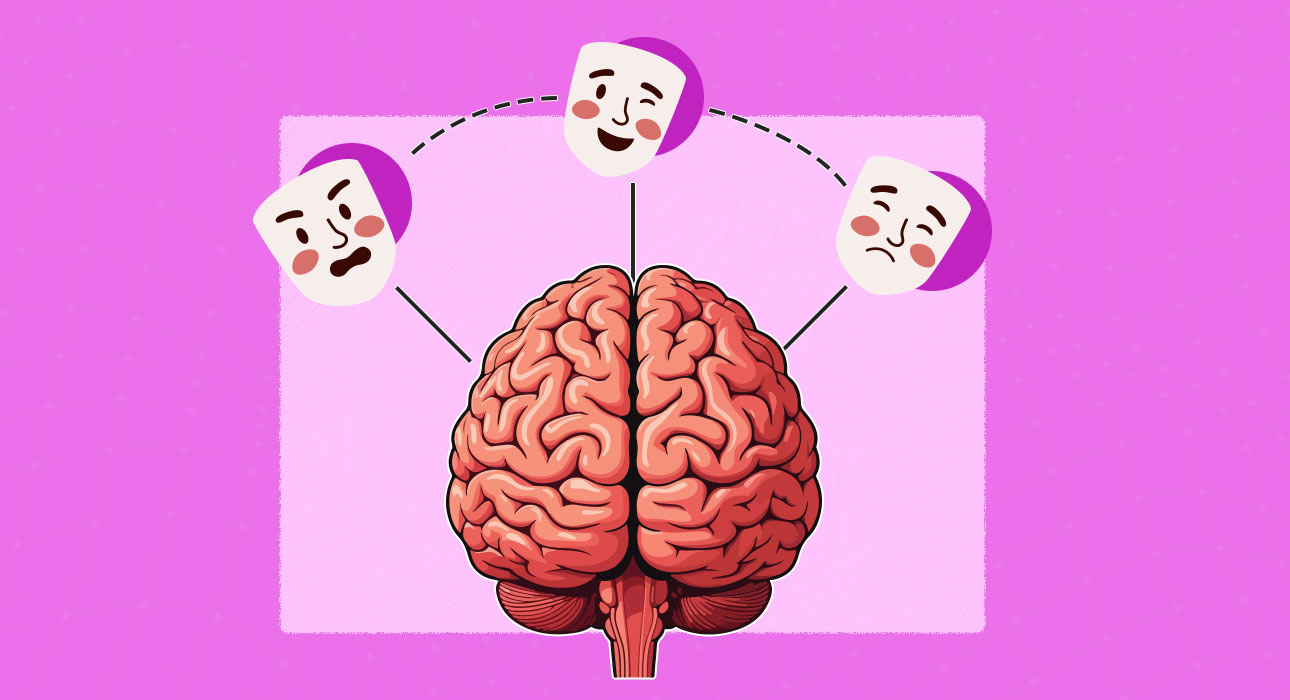
Imagine you’re about to step onto a stage for your presentation and suddenly your heart is pounding, your palms are sweating, and you’re breathing rapidly. Is it fear? Or is it also excitement? Most of us seem to believe that emotions “happen” to us like our brain is automatically wired with fear, anger, sadness, and happiness. For a long time, psychologists believed the same emotions and biological responses were universal to all humans.
But in recent years, modern psychological science has challenged this idea. One of the most prominent researchers, Lisa Feldman Barrett, advocates a shift in this field and her “Theory of Constructed Emotion” argues that feelings are not hardwired or automatic responses. But they are actively created by our brain by relating the information from prior experiences, learning from the culture we grow up in, and predictions about what those physical sensations mean (Barrett, 2017; Barrett, 2006).
The perspective changed the understanding of how emotions are made and how they can bring change in our daily lives, mental well-being and even in our interpersonal conflicts. We can start to think: ‘How is my brain trying to figure out what I’m feeling right now?’ rather than thinking ‘What emotion is happening to me?’ This question has large implications for all of us in a world where emotional stress, anxiety and mood disorders are prevalent (Barrett, 2017).
The Theory of Constructed Emotion
Historically, theories of emotion proposed that a discrete number of fundamental emotions (anger, fear, sadness and happiness) were triggered by certain stimuli and resulted in automatic facial expressions and neural circuits (Ekman, 1992). In contrast, Barrett argued that emotions are not ‘triggered’ but are ‘constructed’ (Barrett, 2006). Her theory of emotion construction states that the brain makes predictions about what is going on inside the body and in the world around us, and then organises sensations into specific emotions based on previous experience and the current context (Barrett, 2017). Key elements in this theory include:
- Prediction: The brain doesn’t just react, it anticipates meaning based on incoming sensory input before individuals become aware of it (Barrett, 2017).
- Previous experience: Past emotions and learning help the brain to interpret current sensations. For example, previous fear responses can predispose people to feel fear again in a similar situation (Barrett, Lindquist, & Gendron, 2007).
- Culture and language: Many emotional categories have been constructed based on individuals’ culture and language; in this way, many emotions are learned from social interaction (Mesquita & Walker, 2003).
- Context: An identical bodily experience, such as the feeling of the heart beating rapidly, may be interpreted differently depending on the context of people’s experience (Barrett, 2017).
In short, the theory suggests that emotions aren’t discrete “packages” hidden in our brains, but are complex mental creations based on bodily signals, predictions, learning, and meaning-making processes. This explains how two different people could react to the same event in different ways or how someone could mistake excitement for fear one moment and feel confident in a similar situation later (Barrett, 2006).
Read More: The Psychology of Emotional Granularity: Why Naming Your Feelings Changes Everything
How The Brain Constructs Emotions
Barrett’s theory aligns with advances in predictive brain science, which proposes that the brain is a predictive organ that anticipates incoming sensory information, rather than simply passively receiving it (Barrett & Simmons, 2015). When interpreting physical states of the body like heart beating, breathing rate, muscle tension and energy level, the brain uses memories of past emotional experiences and the current context to determine what the experience means, and this is the basis for emotional experience (Barrett, 2017). The construction of the emotion process can be simply explained in the following stages:
- The body sends signals: Changes occur within the body, such as increased heart rate, changes in breathing patterns, altered energy levels and increased muscle tension.
- The brain makes a prediction: Based on learned knowledge and the current context, the brain predicts what these bodily signals might mean.
- Emotion is attributed: The experience of bodily change coupled with prediction leads to the labelling and experience of emotion, whether anger, sadness, happiness, shame or other emotional state.
- Behaviour follows: Actions and behaviours manifest in response to the constructed emotional experience (Barrett, 2017).
This framework also explains how emotions aren’t always entirely predictable and universal; a racing heart could feel like fear if someone is in a hospital waiting room, but feels like excitement before seeing a loved one. The experience is neither just biology nor just prediction; it’s biology interpreted by prediction (Barrett & Simmons, 2015).
Implications for Mental Health In Everyday Life
The Theory of Constructed Emotion is more than just an interesting research finding; it has profound real-world implications. If emotions are constructed, this suggests that they are not fixed phenomena over which people are powerless to control. This is influencing the way psychologists understand stress, anxiety, anger and other mood disorders (Barrett, 2017). Everyday applications for this theory include:
- Emotion regulation by relabeling sensations to lessen negative emotions (Gross, 2015).
- Mental health treatment, symptoms of anxiety may often misinterpret bodily arousal as a threat, which cognitive therapy aims to correct (Clark, 1986).
- Maintaining interpersonal relationships by understanding that emotions are constructed based on context and learning that may help to reduce assumptions individuals make about other people’s intentions and feelings (Barrett et al., 2007).
- Cross-cultural differences in emotion can explain apparent differences in emotional expression and experience between cultures (Mesquita & Walker, 2003).
The theory has also contributed to discussions about mood disorders, emotional intelligence, and emotional literacy. Instead of being slaves to emotions, Barrett’s framework helps to see that emotions can be reshaped by how people interpret the stimuli, what people have previously learned and the context of their experience (Barrett, 2017). This perspective is particularly helpful in understanding the great concern about the impact of emotional stress and anxiety on people’s lives.
Read More: Yoga and Meditation Practitioners Deal with Negative Emotions More Effectively
Criticism and debate
Despite the strong support and influence this theory has already received, some researchers are critical of the theory. Certain bodily responses and facial expressions appear to show consistency across cultures, leading to the existence of basic emotions (Ekman, 1992). Critics of the construction view argue that not all emotions are fully accounted for solely by construction and that biological and social influences on emotion may be intertwined in a more complex fashion (Izard, 2007). With the advancement in science, there is an ongoing debate on this topic. Though Barrett’s work has encouraged the re-examination of much older assumptions regarding emotions and how they are experienced (Barrett, 2017).
Conclusion
Emotions may seem immediate, potent and automatic. But Barrett’s work suggests that they might also be inextricably tied to prediction, prior experience and context. A pounding heart doesn’t always mean you’re afraid; sometimes it can be exhilaration. The point is that emotions aren’t fake; rather, they are active creations generated by the brain from bodily signals as people make sense of their experiences and the world around them (Barrett, 2017).
This concept has radically changed the way psychology talks about how people experience feelings, and has real implications for their daily lives, self-reflection and empathising. For individuals experiencing psychological difficulty, the findings of constructed emotion promise the potential for completely novel perspectives on what suffering looks like and how people can reduce it. In the end, constructed emotion theory challenges us to embrace emotions not as things that merely occur, but rather as the fruits of the extraordinary capabilities of the brain to predict, interpret, and generate meaning.
References +
- Clark, D. M. (1986). A cognitive approach to panic. Behaviour Research and Therapy, 24(4), 461–470.
- Ekman, P. (1992). An argument for basic emotions. Cognition & Emotion, 6(3–4), 169– 200.
- Mesquita, B., & Walker, R. (2003). Cultural differences in emotions: A context for interpreting emotional experiences. Behaviour Research and Therapy, 41(7), 777–793. ∙ Barrett, L. F. (2006). Are emotions natural kinds? Perspectives on Psychological Science, 1(1), 28–58.
- Barrett, L. F., Lindquist, K. A., & Gendron, M. (2007). Language as context for the perception of emotion. Trends in Cognitive Sciences, 11(8), 327–332.
- Izard, C. E. (2007). Basic emotions, natural kinds, emotion schemas, and a new paradigm. Perspectives on Psychological Science, 2(3), 260–280.
- Barrett, L. F., & Simmons, W. K. (2015). Interoceptive predictions in the brain. Nature Reviews Neuroscience, 16(7), 419–429.
- Gross, J. J. (2015). Emotion regulation: Current status and prospects. Psychological Inquiry, 26(1), 1–26.
- Barrett, L. F. (2017). How emotions are made: The secret life of the brain. Houghton Mifflin Harcourt.




Leave feedback about this