







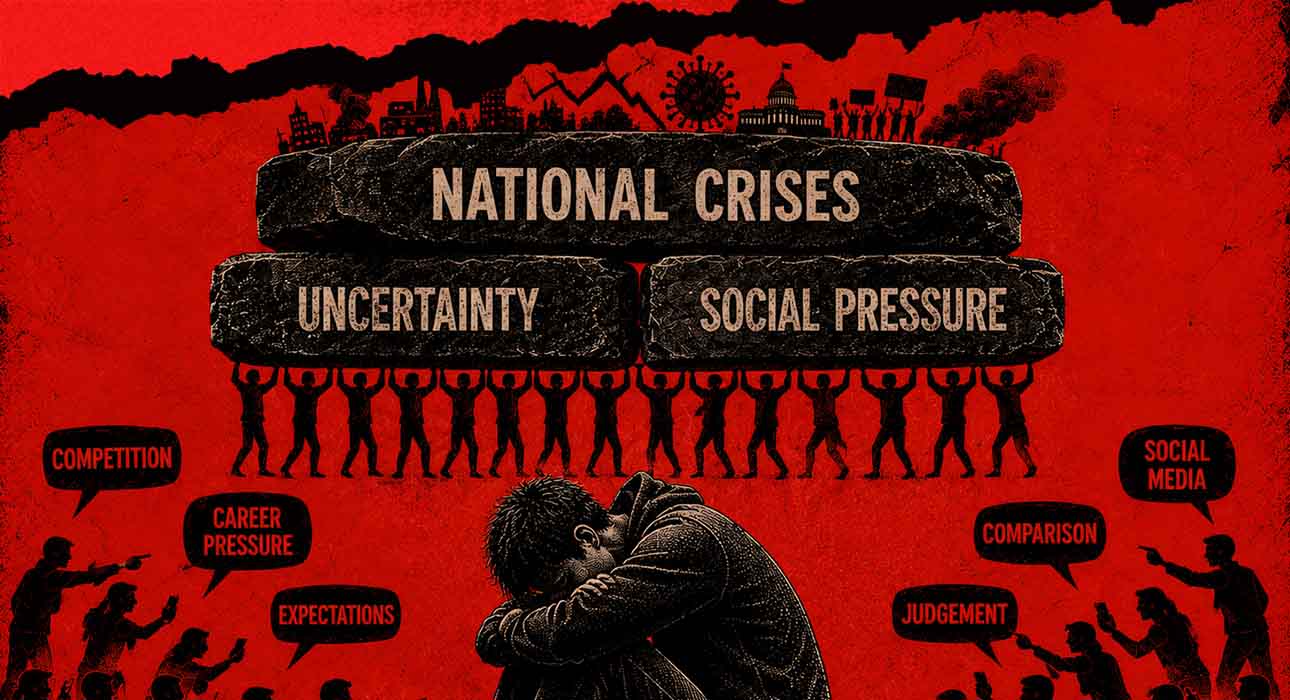
Not long ago, there used to be clear boundaries between politics and personal lives. There were discussions of politics on TV and economics in newspapers, and ultimately, everything continued as usual. This boundary no longer exists. A student scrolling through their phone prior to going to school can stumble upon such topics as examination issues, inflation, unemployment, high cost of LPG, tension in politics, and unstable economies within just a few minutes. Even when none of these topics applies to them personally, the stress associated with these is often internalised.
Today’s generation is maturing within a society where updates keep coming, and uncertainty becomes commonplace. Notifications, news, and discussions all lead to the normalisation of stress. Numerous studies have found that constant exposure to stressful information and uncertainty leads to problems with concentration, emotion control, sleep, and anxiety. It has been stated by APA (2022) that frequent exposure to media covering crises can significantly increase emotional distress and feelings of helplessness. According to the WHO (2022), social pressures and uncertainty are linked with the declining mental health in youth who are already battling with work and study pressures.
Read More: Does Politics Influence Your Sense of Self?
The NEET and Student Anxiety
This was evident in the NEET controversy. With the rise in debates regarding paper leakages and examination malpractices, students were on the brink of an emotional outburst. Within Indian society, students have historically intertwined their perspectives of competitive examinations with their social self, their parents’ aspirations, their financial future, and their overall future safety.
Many, in particular, wondered the following:
- “What if it stops making any difference if I study hard?”
- “What if the system suddenly goes crazy?”
As Carol Dweck notes in her mind-set theory, people whose self-concept depends largely on success feel more stress when facing situations that may be perceived as either uncertain or unfavourable. In much the same way, uncertainty about licensing regulations for psychology practice creates anxieties about career security among students of this subject area. Today, youth face uncertainties not only when preparing for exams but also about their future employment and professional well-being.
Read More: NEET Cancellation: Aspirants Again under Stress and Uncertainty
Why Uncertainty Affects the Mind So Deeply
Humans tend to fare well with predictability in life. Even though circumstances become more manageable if individuals know what to expect from them. The effects of uncertainty are different. With persistent uncertainty, the brain continues in a state of alertness. As per the stress appraisal theory put forward by Lazarus and Folkman (1984), stress often happens due to the lack of individuals’ ability to influence important events that impact them.
Such uncertainty might result from issues associated with exams, economic insecurity, policy change, politics, unemployment, and other things. It’s common for the burden of uncertainty to remain unnoticed for some time. Poor concentration at work, fatigue despite all the mental stress, or being overwhelmed by the most trivial things are the signs of the psychological stress of uncertainty.
Lack of sleep, irritability, tiredness, poor concentration, and anxiety about the unknown will worsen as the uncertainty continues. Young individuals casually refer to themselves as “tired all the time.” However, often, there is no physical factor behind such fatigue; it comes from uncertainty.
Read More: Psychology Behind Uncertainty: Why the Unknown Triggers Anxiety
Social Media and the Pressure to Keep Up
Stress these days isn’t something we deal with by ourselves. Students and workers post their achievements on social media for the world to see. Leon Festinger introduced social comparison theory in 1954. He proposed that people have the tendency to measure and compare their accomplishments and standards to those of others.
Social comparison can be detrimental to an individual’s self-esteem and happiness, particularly in highly competitive social settings. Social platforms such as LinkedIn and Instagram are the quintessential examples of social media sites that highlight positive achievements and neglect to mention the negative emotions of the hustle, such as burnout, failures, setbacks, and mental fatigue. People end up seeing carefully chosen stories that set impossible standards for how productive and successful they should be.
A student who feels stressed due to upcoming exams might become even more depressed from continuous comparison of marks, admission notifications, and success stories on social media. Working professionals who are frequently exposed to layoffs and economic downturn talk might also start doubting their stability and progress.
Economic Fear and Future Anxiety
Similarly, working adults are also severely impacted by national uncertainty. Discussions revolving around inflation, job cuts, unemployment, and increasing prices have become a common topic amongst Indian people. With regard to the increasing prices of LPG and financial caution, there is an increase in the anxiety of Indians regarding financial stability.
The public discourse encouraging people to spend sensibly, save money, or invest wisely during uncertain financial situations adds to emotional insecurity in people. Even though such discourses stem from national issues, their constant occurrence impacts the psychological security of individuals concerning their future. This kind of feeling is called anticipatory anxiety, whereby individuals become anxious about future threats even before they actually take place. Young workers become insecure about the following:
- What if the job becomes insecure?
- Would I still be financially stable?
- Am I able to plan for my future?
According to Baumeister et al. (1998), constant stress drains out mental energies to such an extent that simple decisions start taking a much emotional toll on people.
Emotional Numbness and Learned Helplessness
The emotional numbness and learned helplessness idea originated in 1975 with Martin Seligman. Learned helplessness is described as when the individual feels they have no control over their lives. This happens because they have been through a lot of stress that they could not control.
When young people experience learned helplessness, they might feel really disconnected from things; they might not want to do anything; they might think that bad things will always happen; they might not care about what’s going on; and they might not believe in themselves. Emotional numbness and learned helplessness can really affect how young people feel about their future and their lives.
Such an emotional state is commonly mistaken for laziness and lack of initiative on the part of the person. In fact, such people become emotionally drained as a result of constantly adjusting themselves under uncertain circumstances.
Political Communication and Public Emotion
Political communication also plays an important role in influencing the emotions of the public during times of national crisis.
Debates, speeches, and interviews affect the feeling of security or insecurity of the citizens towards their future lives. According to Marcus, Neuman, and MacKuen (2000), constant engagement with fear-inducing political communications may lead to higher levels of anxiety for people who are already worried about their prospects, especially young people facing difficulties in studies and finances.
Talks on issues of inflation, the increasing cost of LPG, buying gold, spending money outside the country, and economic preparedness go beyond policy talks and enter the domain of personal emotions of individuals. Alternatively, clear communication and assurances might be the factor in reducing the general fear.
Mental state when faced with uncertainty
Although uncertainty cannot always be controlled, a response to it can be. Psychologists commonly recommend:
- Reducing excessive doomscrolling and crisis exposure
- Limiting unhealthy social media comparison
- Maintaining consistent routines
- Seeking emotional support through trusted individuals
- Focusing on goals within one’s control
- Separating self-worth from marks, productivity, or income
For students, especially, it is important to recognise that academic scores or professional outcomes do not completely define personal worth. Career success matters, but mental well-being matters equally.
Conclusion
National crises no longer remain distant from personal life.
With headlines, social media posts, debate threads, notifications, and consistent exposure to technology, politics, education, economy, and even fear, slowly make their way into one’s psyche. Beginning with the RCI guidelines disturbed by NEET issues, inflation, expensive LPGs, layoffs, and general uncertainties in the economy, the Indian youth is being raised in an environment where the only reality is uncertainty.
Emotional exhaustion among the youth is becoming commonplace. The youth needs to recognise that this phenomenon could also indicate living in uncertain times and is most likely NOT indicative of personal deficiencies.
References +
- Baumeister, R. F. (1998). APA PsycNet. Psycnet.apa.org. https://psycnet.apa.org/record/1998-01923-011
- Bethune, S. (2022, October). Stress in America 2022. American Psychological Association; American Psychological Association. https://www.apa.org/news/press/releases/stress/2022/concerned-future-inflation
- Dweck, C. (2006). Mindset: the New Psychology of success. Psycnet.apa.org; Random House. https://psycnet.apa.org/record/2006-08575-000
- Festinger, L. (1954). A theory of social comparison processes. Human Relations, 7(2), 117–140. https://doi.org/10.1177/001872675400700202
- Lazarus, R., & Folkman, S. (1984). Lazarus, R., & Folkman, S. (1984). Stress, Appraisal, and Coping. New York Springer. – References – Scientific Research Publishing. Www.scirp.org. https://www.scirp.org/reference/ReferencesPapers?ReferenceID=1927117 Marcus
- G. E., Neuman, W. R., & MacKuen, M. B. (2013, July 18). Affective Intelligence and Political Judgment. Research Gate. https://www.researchgate.net/publication/37694302_Affective_Intelligence_and_Political _Judgment
- McEwen, B. S. (2007). Physiology and Neurobiology of Stress and Adaptation: Central Role of the Brain. Physiological Reviews, 87(3), 873–904. https://doi.org/10.1152/physrev.00041.2006
- Seligman, M. E. P., & Internet Archive. (1975). Helplessness: on depression, development, and death. In the Internet Archive. San Francisco: W.H. Freeman; New York: Trade distributor, Scribner. https://archive.org/details/helplessnessonde00seli




Leave feedback about this