






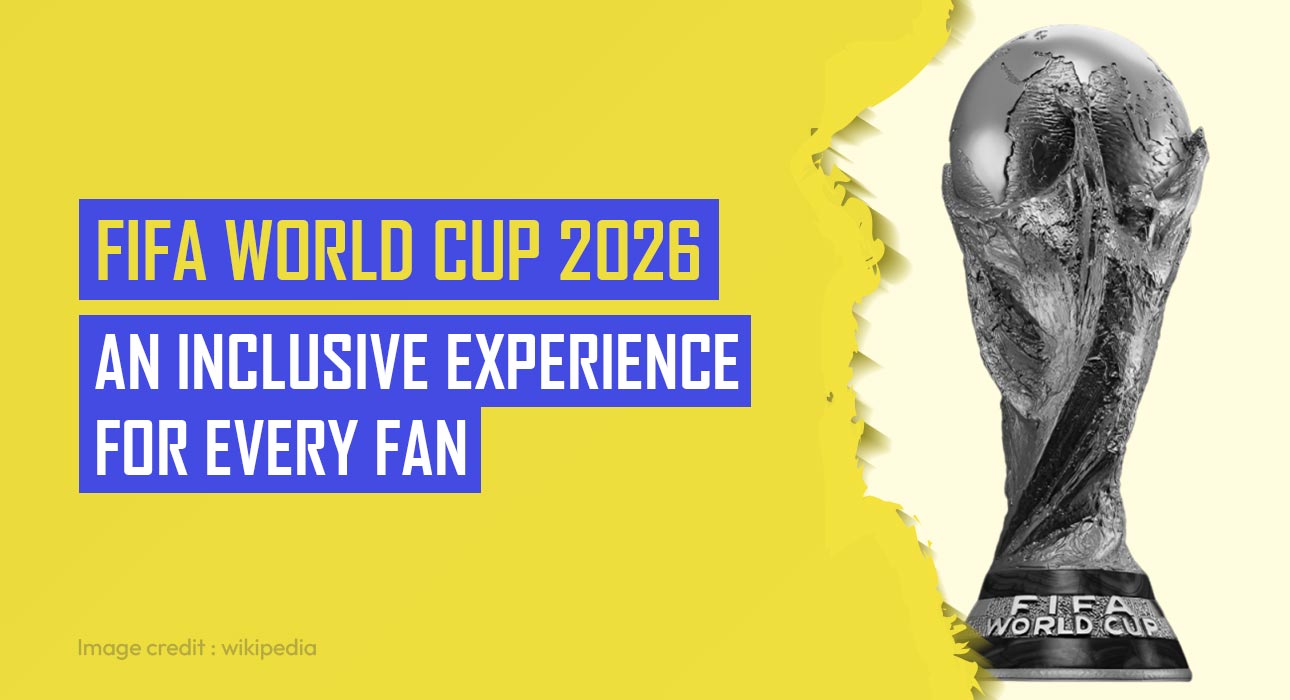
Living at a worldwide sports event is something exciting, like watching something that will be history. And that is an excitement an awaited event for thousands of fans. But is it the same for everyone? How accessible is it for everyone to see a sports game? Seeing from the perspective of disabilities can change the perspective on sports games. From accessibility to even just the way to watch it when there are limitations to the person can be a new perspective to consider.
Going to the stadium with a disability
Attending a soccer match can be an exciting experience. The fans, the supporting chanting, the feeling of being in the community and the excitement of the game make it a one-of-a-kind experience. But to experience all of that is not the same for everyone. For someone without a physical disability, it is a different point of view. Just imagine going on crutches and trying to get to a seat or inside a stadium. That changes the perspective of how these spaces are built and who they are built for.
Accessibility is not a new concept. In fact, it’s regulated by each country’s regulations for stadiums. Yazigi et al. (2015) researched stadiums, and even with projects to make places more accessible, they only do it with partial access and autonomy for people with reduced mobility. But what does that imply? There has to be a design that responds to the needs of people with different types of disabilities, thinking of connection, availability, comfort, proximity and convenience (Yazigi et al., 2015).
One thought that can come to mind would be the no attendance of people with disabilities. And the answer would be no. Research has actually shown the benefits of their attendance, especially for adults, since attending a soccer game can increase the opportunities for social interaction and community participation. Giving, as a result, having a sense of belonging and community and the feeling of validation of opinions and being valued (Anderson, Balandin, 2019). Also, participating in sports communities helps increase the sense of self-confidence, safety and cognitive aspects (Musleh, Shanah, 2019).
In the past, FIFA has actually taken these aspects into account. Neves et al. (2022) researched how FIFA was promoting the World Cup of 2022 as the most accessible for people with disabilities. Their plan included transport accessibility, guides, seating facilities, staff training, city accessibility, cultural and tournament accessibility.
As a matter of fact, they tested their accessibility in 2021 with the Arab Cup. How? Stadiums where checked for accessibility also had sensory viewing rooms for fans with sensory requirements, audio descriptive commentaries in Arabic and English for blind fans and volunteers and staff, some of whom also had a disability, were trained as support for fans who required assistance (Neves et al., 2022).
But, how is FIFA working in 2026 regarding accessibility? According to FIFA (2022), since it’s being held in three countries, the options that they are offering for people with disabilities in all of their spaces are: providing logistical information before the games, staff and volunteers trained to assist, sensory rooms, haptic boards for people with low vision or blindness, and sign language interpreters for hard of hearing or deaf.
Watching from home, can everyone see it?
Not everyone can go into a stadium for a soccer match. Especially in a World Cup. Just to make a small list of “reasons why no one can think of taking time off work or studies, prices, budget and the fact that most fans are going to need to travel. And that opens a new list of reasons why someone couldn’t go. Taking the time to travel, travel expenses, reservations, budget and planning for months alongside getting the documentation to travel internationally.
For the World Cup, there is another option: watch the broadcast.
FIFA offers an option for fans who can’t attend the matches live. With a live broadcast in real time, as any other local soccer match would do. Any fan just needs to check for the times of the match, see its local time and look for a TV channel that is approved by FIFA to broadcast the soccer game. And just like that, any fan can see it. But looking deep… is it really available for anyone?
Going through research about disability accessibility, there are a few requirements that need to be met. According to García & Benítez (2022), there are three requirements that TV programs need to accomplish to be accessible for people with disabilities. First, offer subtitles and the option of audio description and sign language.
Subtitles are useful for people with low visibility, sign language for deaf people, since most of the soccer game experience is through commentary done by sports reporters live. Audio description in soccer is mostly known as audio-described commentary. Halder & Squires (2023) research tracks the use of this resource in sports events such as the Olympics. It is used to translate visual information into a descriptive audio, making the information accessible for people who are blind or partially sighted.
But what are the options available for people with disabilities during the broadcast of the World Cup in 2026?
According to FIFA (2026), they are offering an optional broadcast with sign language available. But not on regular TV. So, an average fan can’t watch this option on a regular TV broadcast like any fan. This option, according to their article, is only available in a specific section of their app. And it’s only there.
What could improve in the next few years?
Going back to what was already mentioned, adding more options for the broadcast of soccer games can be a beginning for soccer fans with disabilities who can’t go to a game and prefer to watch it at home. Not only through an app, but it needs to be more accessible and easy to find for any interested person to watch it. Audio description and subtitles are an excellent option to add, besides the sign language. Also, Anderson and Balandin (2019) provide a list of recommendations for stadiums and organisations that can improve accessibility:
- Seating design: there needs to be access for wheelchairs, seats for the companion that goes with the person, and seats next to the aisle for people with walking difficulties. All of that instead of “Areas for people with disabilities only” to avoid isolation.
- Assistance animals: some people have trained animals such as guide dogs or seizure-alert animals, provided access to them, areas for assistance, provide resting areas and also have staff trained in animal assistance etiquette (such as not touching them or not petting them)
- Assistive listening systems: for people with hearing difficulties, for example, at window ticket booths.
- Viewing enhanced: for people with viewing difficulties. One option could be to provide a stadium live broadcast, but via a Wi-Fi-protected transmission.
- Affordable access: Some countries offer companion tickets at a low or no cost. That affordability helps people with disabilities consider going to a live soccer game.
- Inclusive network: some clubs encourage people to join support or cheer clubs by promoting inclusion.
- Employment: paid employees or volunteers can be an option for people with disabilities since it increases self-confidence, a sense of belonging and social experiences.
Conclusion
Any organisation that plans sports tournaments and competitions has to take into account the disabilities that are seen. And as is now seen with FIFA and the World Cup, there were efforts to make it inclusive for all. But there is space to improve. Even if a fan with a disability is going to a game or just watching the live broadcast, there are difficulties in both scenarios. Fans can expect difficulties going to their seats, seeing or listening to the game. And watching it on a live broadcast also brings difficulties because of only having the available sign language.
But not everything is lost. Since the World Cup, there have been accommodations for people with disabilities, such as sensory rooms or haptic boards. Nevertheless, there is still space for improvement, such as the allowance of supporting animals, the affordability of tickets, and allowing companions. There is space for improvement.
References +
- Anderson, K.L., Balandin, S. (2019). Kicking a Goal for Inclusion in Sports Clubs and Stadia. In: Halder, S., Argyropoulos, V. (eds) Inclusion, Equity and Access for Individuals with Disabilities. Palgrave Macmillan, Singapore. https://doi.org/10.1007/978-981-13-5962-0_15
- FIFA (2025). “First Accessibility Advisory Board Convened ahead of FIFA World Cup 2026TM.” Fifa.com, https://inside.fifa.com/human-rights/news/accessibility-advisory-board-world-cup 2026-miami-florida
- FIFA (2026). FIFA World Cup 2026TM to feature sign language interpretation for all matches, additional accessible experiences to help all fans enjoy the global showcase. (n.d.). https://inside.fifa.com/organisation/news/accessibility-world-cup-2026-disability-social-inclusion
- García-Prieto, V., & Figuereo-Benítez, J. C. (2022). Accesibilidad de los contenidos televisivos para personas con discapacidad: limitaciones y propuestas de mejora [Accessibility of television content for people with disabilities: limitations and proposals for improvement]. Contratexto, (38), 289-311.
- Halder, S., & Squires, G. (Eds.). (2023). Inclusion and diversity: Communities and practices across the world. Taylor & Francis.
- Musleh, M., & Shanah, M. (2019). The role of sports clubs in integrating and empowering people with disabilities from the point of view of the disabled people in Palestine.
- Neves, J., Al-Harahsheh, S. T., Swart, K., Shaban, S., & Hudaib, A. (2022). Inclusion of persons with disabilities in sport: part 2–best practices and policy recommendations from Qatar. British Journal of Sports Medicine, 56(22), 1259-1260.
- Yazigi, S., Resende, A. E., & Yazigi, R. (2015). Accessibility in Soccer Stadiums: Infrastructure and Organisation in Support of People with Reduced Mobility–A Use Analysis. Procedia Manufacturing, 3, 5557-5561.



Leave feedback about this