







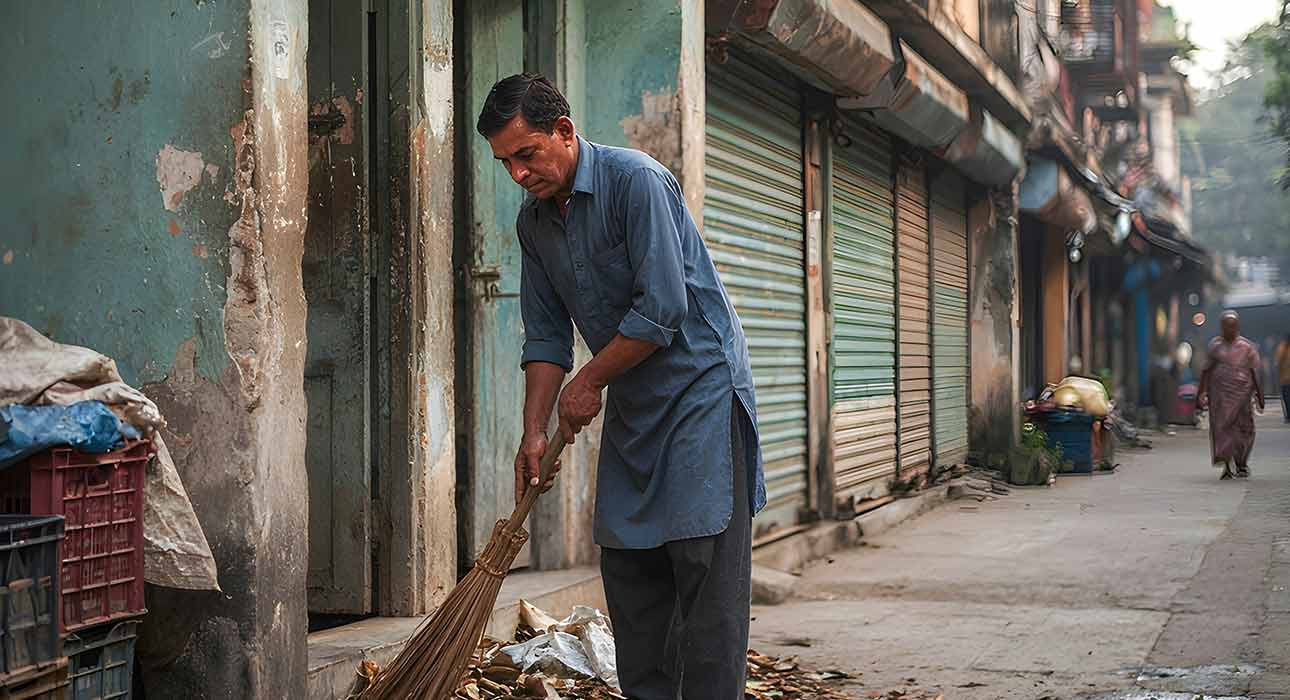
There is a need for sanitation work, but sanitation workers mostly seem invisible to the rest of the world. There are numerous responsibilities with the job that the worker usually begins the day with. The work could begin with picking up trash to washing down public areas. There are also other jobs that require a set of skills to deal with, such as pumping septic tanks or cleaning sewers. They may also require dealing with contaminated items.
Some of these jobs involve dangerous physical conditions. Others include low pay, short-term jobs, stigma or lack of recognition. Such pressures aren’t just about physical health. This can have certain psychological outcomes to deal with, such as fear, anxiety, stress, or feeling isolated socially. Research shows that sanitation workers face a combination of occupational and social risks that can affect their psychological well-being (Monteiro & Nalini, 2021; Oza et al., 2022). The article explores the high-risk associated with sanitation jobs and how it challenges the mental well-being of the workers.
When Work Itself is The Source of Fear
One subset of psychological burden exists around jobs set in unsafe conditions. Sanitation workers may be subjected to:
- Improper Equipment,
- Extreme Physical Exertion,
- Hazardous Gases,
- Injury, and
- Exposure to Infectious Materials.
Systematic reviews have found increased risks among sanitation workers of:
- Respiratory Conditions,
- Gastrointestinal Illness,
- Musculoskeletal Problems, and
- Other Occupational Health Concerns.
Less studied than physical outcomes, mental and social health risks have been identified (Oza et al., 2022). Fear can be a normal part of life on the job. For instance, if a worker walks into an unclean sewer, they might know the situation is very hazardous. The cumulative effects of repeated exposure to dangers can even lead to psychological stress even if there is no actual danger involved. The worker on duty may continuously consider whether the protective equipment will be effective or whether there will be an unforeseen incident. It’s not the same as regular work-related stress. The threat is linked to the essential requirements of the job (Tolera et al., 2023).
The situation is worse when the level of protection or the degree of training provided to the worker is less than adequate. An individual can be expected to perform the same task even if the machinery is in poor working order or the circumstances are unfavourable. This can contribute to a feeling of lack of control. Studies on sanitation workers and occupational stress have associated stressful working conditions, less support and a lack of individual control with stress (Tolera et al., 2023).
Suppose a worker is starting a shift and all that person knows is that the workload is high, but equipment is scarce. Sometimes they don’t really get to select whether or not to take on an unsafe task. This can add up to emotional stress over the years. Stress can also ‘linger’ post-work. It can be hard to mentally distinguish between work and family because of money, injury, and other factors (Monteiro & Nalini, 2021).
The Weight of Chronic Stress
The repetitive or unresolved stress can be especially problematic. Sanitation workers might face:
- Poor Supervision,
- Intensive Workload,
- Bullying,
- Isolation and
- Few Career Prospects.
Moderate occupational stress was reportedly found in a significant number of sanitation workers in India in a 2025 study. Sources of stress included workplace bullying, emotionally demanding work, and work overload (Siresha & Vijaya Lakshmi, 2025). Chronic stress has an impact beyond matters of mood. It could impede focus, sleep, motivation and relationships. A worker who works on a difficult job throughout the day may come home drained and tired. If financial concerns also exist, the chances of recovery might be very limited. This can create a vicious circle: physical fatigue leads to emotional stress, and their emotional stress can make tasks seem even more difficult (Monteiro & Nalini, 2021).
Chronic stress could also affect coping behaviour. A study of sanitation workers revealed links between substance use, negative coping behaviours, and the stress of the job. Such observations should not be used as indicators of workers’ personal responsibility for the issues. Rather, they point to the need to consider factors or circumstances accompanying the worker’s action (Monteiro & Nalini, 2021).
Stigma May Extend Beyond the Workplace
Sanitation work’s mental strain is not over when the shift is done. Sanitation workers are often subject to social stigma within many environments, for example, because their work is tainted with dirt or waste or due to social hierarchy. This stigma is also entrenched in the existing caste-based occupational system in India. The work of sanitation has been reported to be associated with discrimination and limited social mobility (Monteiro & Nalini, 2021; Sreenath, 2023).
This may have an impact on an individual’s sense of dignity/worth and sense of belonging. Suppose that someone is treated differently when others find out his or her occupation. That person might not be included in society or feel that their responsibilities make them lower class. The continued experiences of such rejection may lead to isolation, which could further cause feelings of anger, shame, or diminished self-esteem.
The reactions aren’t a display of weakness on the part of the individual. They may be reasonable instincts to long-lasting discrimination (Vigneshwaran et al., 2026). Pressure may be greater for women sanitation workers. Occupational stigma and gender, caste and poverty can coexist in their case. Research among women sanitation workers in India has described that they often deal with;
- Violence,
- Discrimination,
- Harassment,
- Economic Insecurity, and
- Limited Access to Resources.
Combined, these disadvantages can cause psychological risks (Monteiro & Nalini, 2021). Research involving women working in informal sanitation in Ghana and Kenya similarly found exposure to unfairness, mental anguish, and sexual abuse or harassment. The study also revealed the potential impact of dealing with shame and labelling in the system on job behaviour and safety protocols. This illustrates that constructing a social environment in which sanitation work takes place is essential for psychological well-being (Dery et al., 2023).
Job Insecurity Adds Another Layer
In some cases, sanitation workers are physically at risk, but also without a stable job. People who work on a contract job or in informal work experience less job security, lower pay, and may lack job protection. Employees might be reluctant or even unwilling to come forward about unsafe conditions out of fear of losing their jobs. Studies conducted in India have found that outsourcing and contractual relations can undermine sanitation workers’ rights to decent work (Khatarker, 2025; Sreenath, 2023).
This creates a psychological dilemma. A worker might know that something is risky, but may not be able to refuse an offer. When it comes to finances, it only becomes more difficult. The person might consider payments for rent, food, child care, educational costs, or medical bills. Fear of employment can thus overlap with fear of injury on the job. Chronic stress may be triggered by both these types of uncertainty (Monteiro & Nalini, 2021).
There is a recent study from Tamil Nadu that has a different solution. The survey of sanitation workers in 2026 revealed that many participants hailed from sanitation worker families. A significant number also indicated that they want to end up leaving the occupation if there were other opportunities available. The researchers did see correlations between intergenerational sanitation work and severe depression and anxiety symptoms. But the nature of the data does not imply causation (Vigneshwaran et al., 2026).
This is important because there are some choices of jobs that are not truly free choices. A high-risk occupation can be problematic when combined with education, economic opportunity, social discrimination, and family occupation. The psychological effect can thus be related not just to the work itself, but to a sense of experiencing very limited choices (Jha et al., 2025; Vigneshwaran et al., 2026).
Recognition Matters for Mental Well-Being
One thing that is overlooked is the importance of recognition. Sanitation workers provide services that often go unnoticed unless they are not performed. People may take clean streets, functioning drainage systems, and waste-free public spaces for granted. This lack of recognition can make workers feel that their contributions are undervalued, even though their work is essential to everyday life (Oza et al., 2022). There’s more to recognition than just getting praise. It’s also the dignity and safety of individual workers. The worker’s life seems to have value if they have access to;
- Protective equipment,
- fair wages,
- reasonable working hours,
- safe facilities, and
- opportunities to report problems.
Without these safeguards, gratitude messages can come across as casual or superficial. Studies on sanitation workers consistently identify the need for better working conditions and more robust health and safety measures and regulations for the sector (Khatarker, 2025; Tolera et al., 2023).
Mental Health Support in Workplace Safety
Mental health-related support is not a ‘luxury’. It should relate to occupational safety. People who experience repeated stress or psychological risks should have safe opportunities to discuss their mental health concerns without fear of judgment or negative consequences for their employment. Screening for anxiety, depression, burnout, and other mood-related difficulties can help identify issues that might otherwise go unnoticed (Monteiro & Nalini, 2021).
There should also be forms of assistance beyond individual counselling. Counselling cannot replace the need for workplace safety. If there are persistently poor or hazardous conditions present for a worker, emotional strain could increase. Workplace interventions must address both psychological support and the working conditions that cause mental strain (Siresha & Vijaya Lakshmi, 2025; Tolera et al., 2023).
Simple modifications can be advantageous. There needs to be management looking upon the work conditions as well as providing supervision to workers whenever necessary. Safety of the worker, providing them with breaks or rest, and treating them fairly are some of the basic aids. There should also be confidential mental-health services available to workers. These services must be both culturally appropriate and without occupational stigma (Dery et al., 2023; Monteiro, 2021).
Most importantly, sanitation workers must have a voice in decisions about their own working conditions. Studies on manual scavenging and sanitation labour have suggested that a ‘top-down’ approach has been unsuccessful when it excludes taking into account the workers’ experiences and structural factors of their work conditions (Jha et al., 2025; Sreenath, 2023).
Changing How Society Sees Sanitation Work
Mental health must always be considered alongside human dignity. In times of a socially devalued job, the people who do the work can become socially invisible. It takes more than an individual being aware to change this. It requires confronting discriminatory attitudes and recognising sanitation work as skilled and essential labour (Mala et al., 2023; Vigneshwaran et al., 2026).
Simple actions can impact public attitudes. A worker will only feel regarded in a community if their children and family feel the same. Talking with respect to the sanitation worker is important. So does providing clean facilities, proper treatment and safe equipment for workers. Children can also learn that doing cleaning work does not make anyone inferior or less valuable than others. Sanitation work is essential and deserves respect and recognition. These messages can help to desensitise the taboo or negative perceptions about sanitation jobs over time (Sreenath, 2023).
Conclusion
Physical risks, chronic stress, discrimination, and job insecurity together threaten the well-being of sanitation workers. Naturally, such stresses on the body may also impact mental health. Thus, support for mental health is a crucial component of occupational safety. However, counselling is not sufficient. Safe equipment, fair work conditions, respectful workplaces and social recognition are also workers’ needs. A person’s mental health cannot be protected unless the conditions causing distress are addressed. As an act of appreciation, we should treat sanitation workers with dignity and respect. It’s an essential component of making workplaces healthier and safer.
References +
- Dery, F., Bisung, E., Abudho, B., Soliku, O., & Dery, G. (2023). Examining the health and wellbeing of women sanitation workers in Ghana and Kenya. Wellbeing, Space and Society, 5, 100167. https://doi.org/10.1016/j.wss.2023.100167
- Jha, P., Sharma, N., & Singh, G. (2025). Damned and disposable: Manual scavengers in contemporary India. Millennial Asia. Advance online publication. https://doi.org/10.1177/09763996251365358
- Khatarker, D. (2025). Of sanitation labour, obsolete technologies and civilisation in India. Social Change, 55(3), 352–369. https://doi.org/10.1177/00490857251349966
- Mala, J., Byard, R. W., & Kaur, N. (2023). Manual scavenging and the right to health in India: Social and medicolegal perspectives. Medicine, Science and the Law, 63(3), 243–247. https://doi.org/10.1177/00258024221126098
- Monteiro, T. S., & Nalini, R. (2021). Mental health at the intersections of marginalisation: A conceptual model to explore the mental health concerns of women sanitation workers in India. Asian Social Work and Policy Review, 15(2), 102–111. https://doi.org/10.1111/aswp.12223
- Oza, H. H., Lee, M. G., Boisson, S., Pega, F., Medlicott, K., & Clasen, T. (2022). Occupational health outcomes among sanitation workers: A systematic review and meta-analysis. International Journal of Hygiene and Environmental Health, 240, 113907. https://doi.org/10.1016/j.ijheh.2021.113907
- Siresha, M., & Vijaya Lakshmi, V. (2025). Assessment of work stress among sanitary workers. Archives of Current Research International, 25(9), 27–37. https://doi.org/10.9734/acri/2025/v25i91472
- Sreenath, S. (2023). (Un)making the manual scavenger: Caste, contract, and ecological uncertainty in Bengaluru, India. American Ethnologist, 50(3), 491–505. https://doi.org/10.1111/amet.13202
- Tolera, S. T., Temesgen, S., Mulat Endalew, S., Alamirew, T. S., & Temesgen, L. M. (2023). Global systematic review of occupational health and safety outcomes among sanitation and hygiene workers. Frontiers in Public Health, 11, 1304977. https://doi.org/10.3389/fpubh.2023.1304977
- Vigneshwaran, K., Krishnendhu, C., & Gaitonde, R. (2026). Born to clean? Caste, occupation and health—An exploration among sanitation workers in Dindigul, Tamil Nadu, India. International Journal for Equity in Health, 25, 202. https://doi.org/10.1186/s12939-026-02963-3





Leave feedback about this