







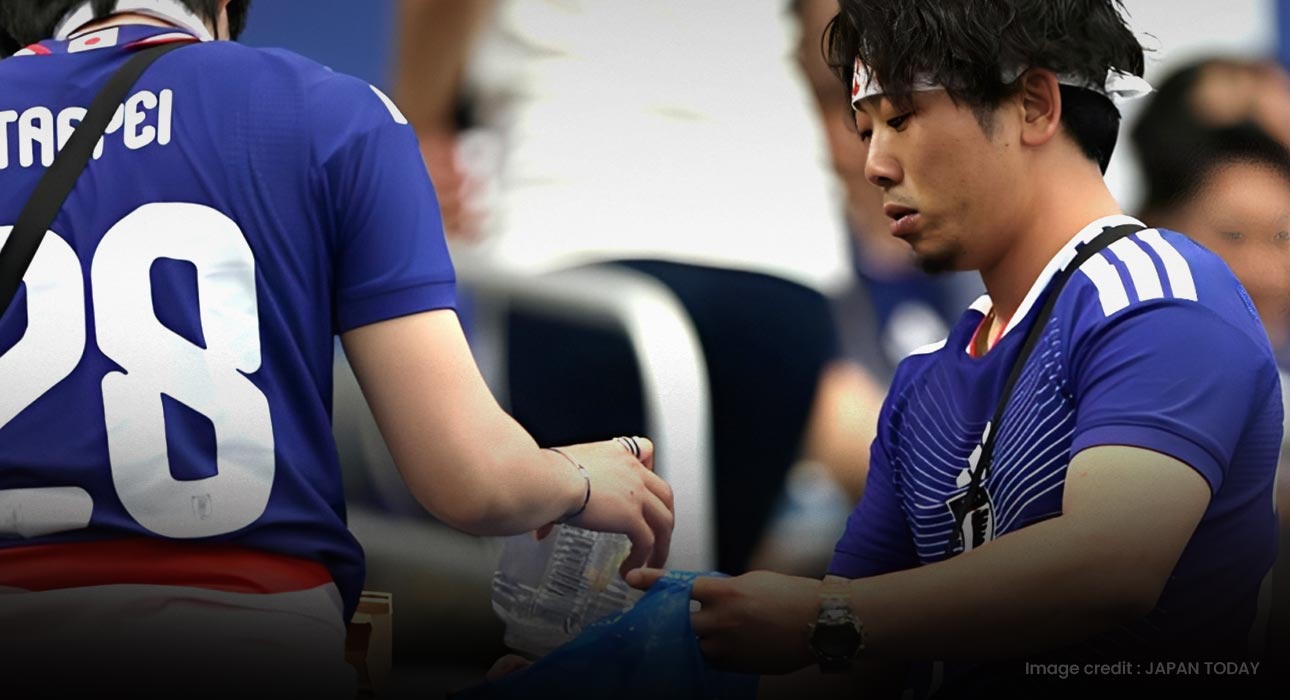
The FIFA World Cup 2026 has brought together some of the world’s finest football talent, but one of the tournament’s most compelling stories is unfolding far from the action on the pitch. Japanese supporters have once again captured international attention- not for their chants or celebrations. But for what they do after the final whistle.
Following Japan’s recent World Cup match, images of supporters collecting trash, sorting waste, and cleaning seating areas quickly spread across social media platforms. The scenes, which have become a familiar feature of major international tournaments, prompted admiration from fans and commentators worldwide. While many viewed the gesture as extraordinary, for the Japanese. It represents a deeply ingrained cultural practice rather than an exceptional act (NDTV, 2026).
As discussions around sustainability and civic responsibility gain momentum globally, Japan’s stadium-cleaning tradition has emerged as an unexpected highlight of FIFA 2026.
A Tradition That Continues to Impress the World
Japanese football supporters first gained widespread recognition for cleaning stadiums during the 1998 FIFA World Cup in France. Since then, the practice has become a defining symbol of Japanese fan culture at international sporting events. At the 2022 FIFA World Cup in Qatar, supporters attracted global praise after cleaning stadium sections and leaving behind thank-you notes for event staff. Four years later, the tradition remains intact, reinforcing Japan’s reputation for discipline and community-minded behaviour.
Observers note that even after emotionally charged matches, supporters often remain in the stands long after other spectators have departed, ensuring that the venue is left in the same condition or better than they found it (Associated Press, 2026).
The Roots of Japan’s Cleaning Culture Begin in Childhood
The explanation for this behaviour lies far beyond football. In Japan, children are introduced to cleaning responsibilities at an early age through a practice known as souji. Unlike many countries where janitorial staff handle maintenance, Japanese students routinely clean classrooms, corridors, cafeterias, and school grounds.
This educational approach is designed to instil responsibility, humility, and respect for shared spaces. By actively participating in maintaining their environment, students learn that cleanliness is a collective duty rather than a service provided by others. Experts believe these early lessons play a significant role in shaping adult behaviour, influencing how individuals interact with public spaces throughout their lives (NDTV, 2026).
Respect for Others Drives Everyday Behavior
Another factor behind Japan’s commitment to cleanliness is the cultural emphasis on social harmony.
The Japanese concept of meiwaku, which refers to causing inconvenience or trouble to others, is deeply embedded in daily life. Citizens are encouraged to consider how their actions affect those around them, whether in public transport, workplaces, schools, or sporting venues. Leaving litter behind is often viewed as transferring one’s responsibility to someone else. Consequently, cleaning up after oneself is seen not as an act of kindness but as a social obligation.
This mindset helps explain why many Japanese supporters arrive at sporting events carrying garbage bags and voluntarily organise cleanup efforts without instruction from authorities or event organisers.
Cleanliness Extends Beyond Stadium Walls
Japan’s reputation for cleanliness is visible across the country. Visitors frequently remark on the spotless condition of public spaces despite the limited availability of street trash bins. The country’s waste management system is among the most structured in the world. Residents are required to separate garbage into multiple categories, often following strict schedules and municipal regulations. Recycling and waste disposal are treated as community responsibilities rather than individual choices.
Religious and philosophical traditions also contribute to these attitudes. Shinto beliefs associate cleanliness with purity, while Buddhist teachings encourage mindfulness and respect for one’s surroundings. Together, these influences have helped create a society where maintaining cleanliness is viewed as both a civic and moral responsibility (NDTV, 2026).
FIFA 2026 Highlights a Global Lesson
The attention surrounding Japanese fans’ cleanup efforts has sparked conversations about environmental awareness and public responsibility far beyond the football community. As major sporting events generate significant amounts of waste, Japan’s example demonstrates how collective action can reduce environmental impact without requiring large-scale interventions. Many international observers have praised the supporters for showing that individual behaviour can contribute meaningfully to cleaner public spaces.
The story also resonates because it contrasts with the often chaotic atmosphere associated with major sporting tournaments. Amid intense rivalries and passionate celebrations, Japanese fans have offered a reminder that respect and responsibility can be just as powerful as competitive spirit.
More Than a World Cup Story
What makes this story particularly significant is that it transcends football. The images emerging from FIFA 2026 are not simply about fans cleaning stadiums; they reflect broader societal values that prioritise community welfare over individual convenience. In a world increasingly concerned with sustainability, public accountability, and environmental stewardship, Japan’s approach offers a practical example of how cultural habits can shape collective behaviour.
As the tournament continues, goals and victories will dominate headlines. Yet one of FIFA 2026’s most enduring memories may be the sight of Japanese supporters quietly gathering rubbish after the crowds have dispersed- demonstrating that sometimes the most powerful statements are made not through words, but through actions.
References +
- NDTV. (2026, June 16). FIFA 2026, Streets And Homes: Why Japan Is Obsessed With Cleaning. Retrieved from: https://www.ndtv.com/lifestyle/fifa-2026-streets-and-homes-why-japan-is-obsessed with-cleaning-11644016
- Associated Press. (2026, April 28). Why You May See Japanese Soccer Fans Cleaning Up Stadiums After World Cup Games. Retrieved from: https://apnews.com
- Japan National Tourism Organization. (n.d.). Japanese Culture and Daily Life. Retrieved from: https://www.japan.travel/en/
- Ministry of the Environment, Japan. (n.d.). Waste Management and Recycling in Japan. Retrieved from: https://www.env.go.jp/en
- FIFA. (2026). FIFA World Cup 2026 Official Tournament Information. Retrieved from: https://www.fifa.com/fifaplus/en/tournaments/mens/worldcup/canadamexicousa2026



Leave feedback about this