







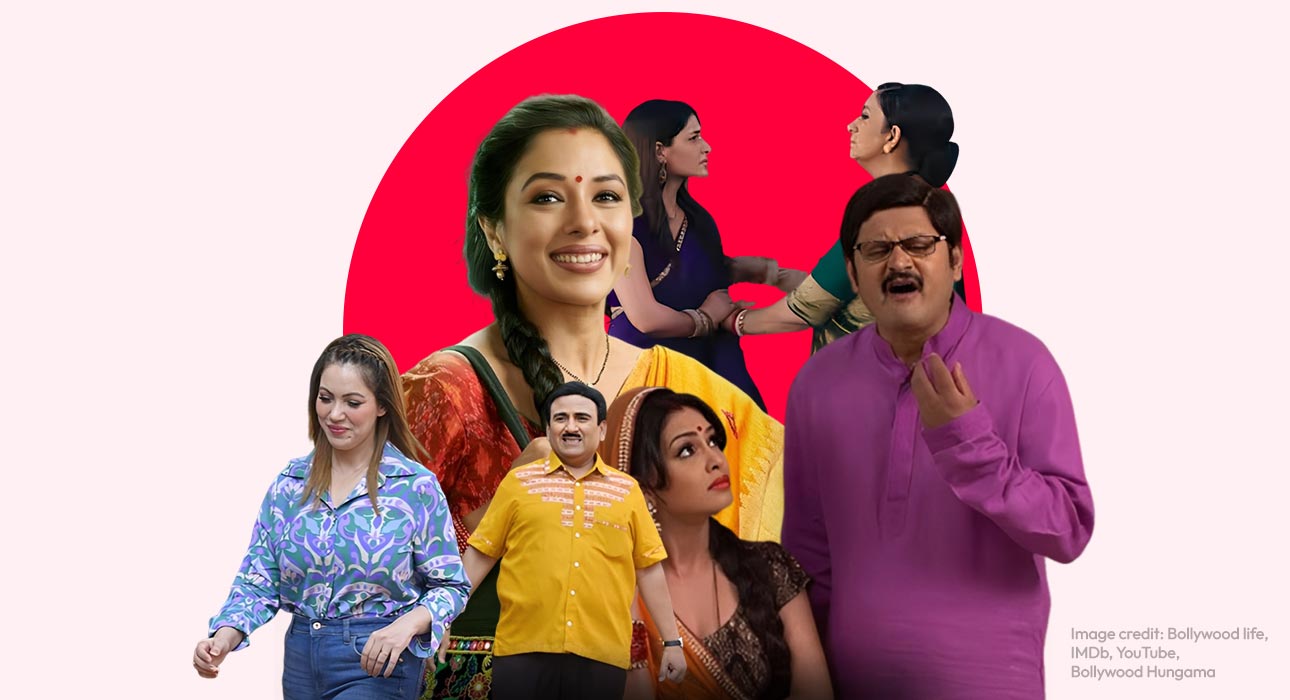
We all have seen that scene at least once where a man comes home, looks at his wife, and cracks a joke about how she burned the food “again,” which is followed by a laugh track. Everyone in the room smiles. Nobody questions it. And somewhere, a ten-year-old is watching, quietly learning that this is just how things are. It is sometimes not even subtle how Indian primetime television(TV shows) portrays misogyny, which has been repackaged as “family entertainment” for decades, where the joke is almost always on the woman.
Read More: How Television Shapes Stereotypes: The Impact of Media Representation on Society and Psychology
The “Harmless Comedy” That Isn’t so harmless
Let’s start with the big one: The Kapil Sharma Show, one of the most-watched entertainment programs on Indian television. On the surface, people start playing out those scripts in real life, so we can’t be surprised; it looks like harmless fun, just a celebrity chat show with song, dance, and a few laughs. But when we look closer, the pattern is hard to miss. The lead actor makes absurd, sexist jokes about female guests’ appearances. Writers and creators often hypersexualise and objectify male characters dressed as women. The humour consistently revolves around women, their bodies, and their looks, reinforcing harmful stereotypes (Kanishka Tandon, 2025, SheThePeople).
A 2017 critical essay published in Cafe Dissensus, a peer-reviewed cultural platform, broke this down more precisely. The show features a chaiwala with a “gawon ki ganwar” (village bumpkin) wife; an “over-sexy, seductress nurse,” a deeply disturbing patriarchal stereotype for the profession of nursing; and various other characters used to consolidate a gross stereotypical portrait of women in Indian society.
The unabashed display and celebration of uncensored patriarchy onscreen isn’t just low-quality content; it’s the show’s main comedic engine (Nasima Islam, 2017, Cafedissensusblog). Let’s think about it: why is the wife always the butt of the joke? Why is the working woman always portrayed as aggressive? Why does “comedy” only work if a woman is either ignorant, seductive, or shrill?
Read More: Psychology of Misogyny: Signs, Causes, and Impacts
Taarak Mehta Ka Ooltah Chashmah: The “Clean Show” but always with a Dirty Secret
Ask any Indian millennial about their childhood TV show memories, and Taarak Mehta Ka Ooltah Chashmah will likely top the list. It is one of the longest-running comedy shows in Indian television history, and for many of us, it was practically like a second family. But here’s what we glossed over: what has been consistent throughout its long run is Jethalal hitting on Babita, his married neighbour. How does a married man flirting with his neighbour fall under “clean comedy”? (Priya Hazra, 2022, ScoopWhoop).
We watched this as kids and just… laughed it off. Nobody told us that normalising a married man’s persistent, unwanted attention toward a woman was a problem. The show presented it as a quirky character trait and not as harassment. And that framing matters, because children don’t have the critical lens to separate what’s “just funny” from what’s actually a blueprint for how to treat women. And the fact that this show has been widely viewed by children, as it is supposed to be a “family show.”
Even Shailesh Lodha, who played Taarak Mehta himself for years before leaving the show, has spoken out. When asked about men cross-dressing and flirting with neighbours’ wives in shows like TMKOC and Bhabhi Ji Ghar Par Hai, he stated, “I disagree with that kind of comedy; main sahej nahi hoon (I’m not comfortable with it)” (Aseem Sharma, 2023, India TV News). If the man who played Taarak Mehta is uncomfortable with the show’s content. Maybe it’s time the rest of us got uncomfortable, too.
Read More: Dark Humour: The Fine Line Between Comedy and Insensitivity
Bhabhi Ji Ghar Par Hai: When the Joke Has Only One Punchline
Bhabhi Ji Ghar Par Hai (BJGPH) takes the premise even further. The comedy show revolves around two neighbouring married couples where the husbands constantly flirt with each other’s wives (Priya Hazra, 2022, ScoopWhoop). The central joke repeated in episode after episode is that women exist to be desired, competed over, and commented upon. That’s it. That’s the whole show in a nutshell.
The women here arnormalisingen’t characters with ambitions, fears, or depth. These “scripted” shows have become a reflection of reality, normalising harmful behaviour. Mocking a wife, objectifying women, and passing sexist comments are all branded as “harmless comedy” (Kanishka Tandon, 2025, SheThePeople).
The word “harmless” is doing a lot of heavy lifting there. Because when millions of viewers, including children, consume this content daily, the harm is cumulative and quiet. It doesn’t announce itself. It just slowly rearranges what you consider normal.
The Daily Soap Problem: Saas, Bahu, and Everyone Suffering
Step outside the comedy genre, and you walk straight into the saas-bahu universe. Which is India’s other great TV shows tradition. Kyunki Saas Bhi Kabhi Bahu Thi, Kasautii Zindagii Kay, Yeh Rishta Kya Kehlata Hai, and Kumkum Bhagya; these shows collectively shaped the worldview of millions of Indian women and girls.
Indian daily soaps have been perpetuating misogynist structures, from being caught up in the saas-bahu drama depicting women as essentially docile and submissive to storylines confining women within households and normalising them taking up the double burden of having a career as well as running a family, cementing gender roles. The dominant theme of these soaps has become anchored on the patriarchally established myth, “aurat hi aurat ki sabse badi dushman” (Akanksha Jain, 2020, Feminism in India).
Gender Roles and Representation in Indian Television
The “ideal bahu” in Indian TV shows is someone who covers her head with a veil, is overly dressed in blingy ethnic outfits, is adorned with jewellery first thing in the morning, and is often seen cooking and serving food to the entire family before attending to her own needs. Many TV shows show women being “discouraged” or “restricted” from working after marriage, glorifying how men should be the breadwinners of the family while women’s job is to be a housewife (Garima Rajan, 2025, Flame University). Even the more recent Anupama, often praised for featuring a woman who “stands up for herself,—has attracted scrutiny.
A content analysis published in the Scholarly Research Journal for Interdisciplinary Studies found that Anupama’s character is silent, homely, and not particularly educated. Even when someone taunts her, she doesn’t reply but helps them unconditionally. Not a single man is portrayed taking care of the house, cooking food, or feeding kids in such series; always women are shown doing these jobs, which creates a picture in the audience’s mind that this is the natural order of things (Neha & Kamaljeet Kaur, 2023).
Read More: Gender Norms and Self-Concept in India
What This Does to Kids Growing Up With These Shows
Here’s where it gets really important. Gender stereotypes have harmful impacts on children, ranging from mental health problems like depression, anxiety, and somatic complaints to bullying, problematic peer relations, impaired academic performance, and school misconduct (Arulchelvan Sriram, 2017, ResearchGate). These aren’t just abstract social concerns. They show up in how children treat each other in classrooms, in playgrounds, and eventually in workplaces and relationships. Even our cartoons, Chhota Bheem and others, showed that Indian children consume a large amount of gender-stereotypical content, with male characters dominating the screen and women appearing more frequently in household and beauty-product contexts (Chitra Kamalakannan Ravishankaran, 2023, Frontiers).
When a kid watches Jethalal lust after Babita every single episode, they’re not watching harmless comedy. They’re watching a social script. One that tells boys: this is what desire looks like. One that tells girls: your job is to be desired, not to be known.
Watching Indian TV shows after school was how many mothers and daughters used to bond, sitting for hours and carefully analysing the behaviour of the saas, the bahu, and the men who reeked of patriarchy. These shows constantly reinforced the notion that women were only meant to work in the kitchen, do household chores, and have children, influencing gender role stereotypes (Ward, 2003). Many of us absorbed those messages without realising it, and some of us are still unlearning them, as repeated exposure to media shapes our beliefs according to the social learning theory (Bandura, 1977).
Read More: Stereotypes on Screen: How Media Shapes Perceptions of Communities
“But It’s Just Satire!”: The Defence That Doesn’t Hold Up
The most common response when you raise these concerns? “Relax, it’s just a show, it’s scripted humour. You’re applying a feminist lens to entertainment.”
But here’s the thing—despite the rise of streaming platforms, these programs continue to draw large audiences, often depicting men dominating women as natural, suggesting that many viewers accept or even find relatable such depictions. When challenged, a common defence is that these shows are just “scripted humour” or “satire.” However, this misses a crucial point: the reason these scripts resonate with audiences is that they reflect the lived reality of many people (Kanishka Tandon, 2025, SheThePeople).
Satire is supposed to critique social norms, not uncritically reproduce them for laughs. When a show makes the same joke about wives being incompetent for fifteen straight years without ever questioning it, that’s not satire. That’s an endorsement (McGraw & Warren, 2010).
Is There a Better Way?
Yes, and it already exists — just not in the highest-TRP time slots. Comparatively progressive shows tend to have consistently lower TRP levels compared to saas-bahu dramas, resulting in them either being taken off air more quickly or being morphed into a more stereotypical saas-bahu drama to appease viewers (Akanksha Jain, 2020, Feminism in India).
Sarabhai vs. Sarabhai, Delhi Crime, Panchayat—these are shows that feature women as full human beings, with flaws, ambitions, careers, and interior lives. They exist. They just don’t get the same airtime or cultural weight that the misogynistic ones do.
While modern Indian serials increasingly depict empowered female protagonists, they often remain embedded within conservative family structures that subtly maintain gender hierarchies (Aarav Arora, JAAFR). Even progress, in other words, comes with fine print.
So What Do We Do With This?
You don’t have to throw your TV out the window. But the next time someone cracks a joke about Angoori Bhabhi being dim-witted, or Kapil Sharma makes a comment about a female guest’s weight, maybe don’t just laugh. Ask why it’s funny and who the joke is at the expense of. Ask what a child watching this is learning right now. At a time when women are overtaking men in all fields, our daily serials still want us to believe that the man is the sole provider for the family, and that women are decoration. This is the picture these serials want us to believe (Dr Shruthi T., 2025, IJNRD).
Television doesn’t just reflect culture. It shapes it. And if we keep watching the same jokes, the same subservient bahus, and the same husbands ogling the neighbour’s wife, generation after generation. We can’t be surprised when those scripts start playing out in real life. The remote is in your hands.
References +
‘Chained by Tradition’: Investigating the Psychology Behind Stereotyping Women in Indian Soap Operas
https://oaji.net/articles/2023/1174-1720266624.pdf
GENDER BASED DISCRIMINATION: PORTRAYAL OF WOMEN IN INDIAN TELEVISION
Women and Gender Roles in Indian Television Dramas: A Critical Discourse Analysis
Analysing Television Serials Through The Feminist Lens Of Simone De Beauvoir | Feminism in India
Beyond ‘Bhabhi Ji’: Unpacking The Everyday Sexism In Indian TV Shows
8 ‘Family Comedy Shows’ That Are Actually Outright Problematic – ScoopWhoop

Leave feedback about this