







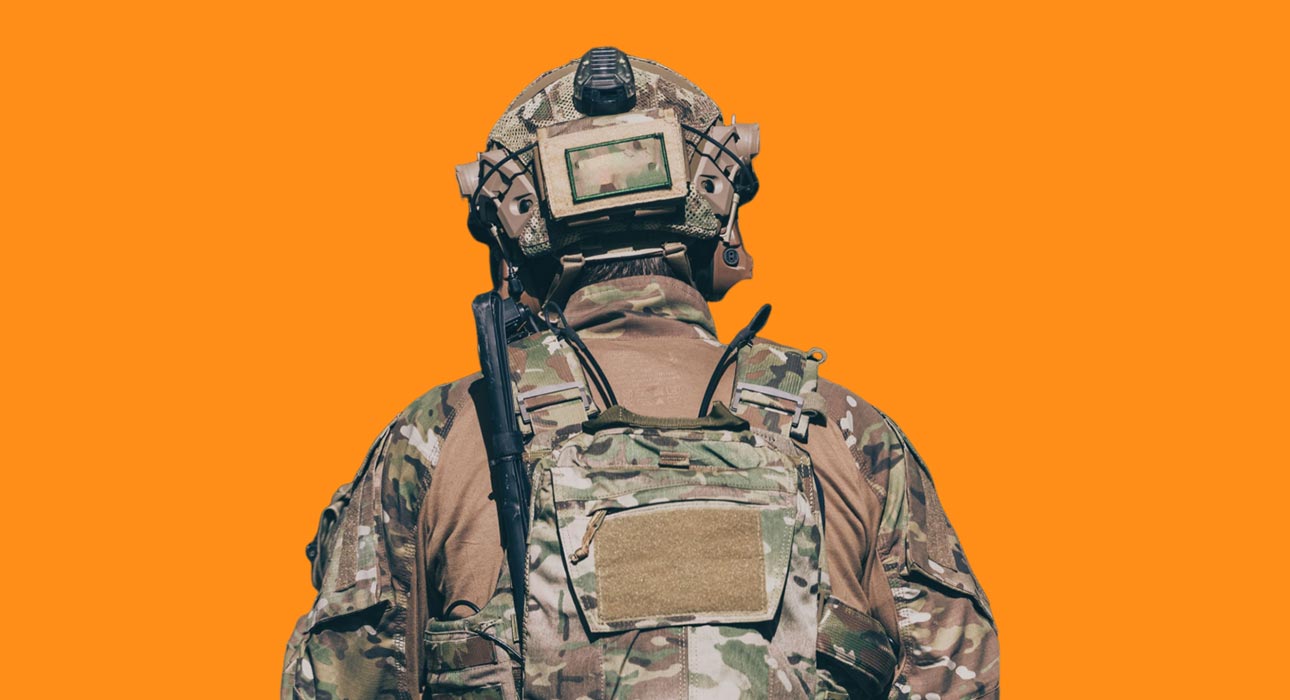
Initially on deployment, a soldier can’t sleep, tossing and turning the night away. His mind is filled with thoughts about the assignment he is about to undertake, his family and friends who are left behind, and whether he will return home safely. He doesn’t express any of these thoughts out loud because the man in the adjacent bed is likely having similar concerns.
This psychological state of a soldier about to enter combat is one of the most complex emotional states human beings can experience: fear and courage coexist, while grief and pride surface simultaneously, the weight of what may be lost sitting alongside the quiet dignity of choosing to go. Duty calls in one direction, and love holds firm in another, and a soldier must somehow carry both at once. This article examines the insights science provides on a soldier’s psychological state before combat: the anxiety, the courage, the emotional control, the drive, and the anguish of parting from loved ones.
Fear Before the Fight: What Anxiety Actually Does
Fear is the honest response to mortal danger. Previous research has shown that a sharp surge in anxiety in the weeks leading up to deployment is not a sign of weakness for troops, but rather a reasonable reaction of the brain to genuine dangers (Staal & Stephenson, 2006). Anxiety, as defined by the American Psychological Association (2018), is a condition of prolonged concern about future occurrences, accompanied by bodily tension. This condition may lead to greater attention to threats, improved planning capabilities, and increased motivation to take preemptive action (APA Dictionary of Psychology, n.d.)
The challenge of pre-deployment anxiety lies in the necessity for soldiers to suppress it. There’s never been much room in military culture for the open expression of dread. (Staal & Stephenson, 2006) found that personnel preparing for deployment typically concealed significant psychological discomfort from their peers and superiors because of concerns about what others might think. The fear does not disappear when silenced. It goes inward, and that is where it does the most damage (Killgore et al., 2008).
Swank and Marchand’s foundational research on combat exhaustion found that soldiers with no anticipatory anxiety before entering battle were more likely to experience severe psychological breakdown during combat than those who had recognised and addressed certain issues in advance (Swank & Marchand, 1946). Psychological prep involves acknowledging the fear, sitting with it, and deciding to go on anyhow. Suppressing it entirely is not.
Read More: Silent Battles: Destigmatizing Mental Health in the Indian Armed Forces
Courage Does Not Require Fearlessness
In contemporary society, valiant fighters are often portrayed as those who lack the perception of fear. The evidence says otherwise. Rachman’s research on fear and courage established that Bravery does not correspond to the lack of fear. But rather to the ability to act effectively in its presence (Rachman, 2014). The soldier who trembles and goes forward is, by this definition, braver than one who feels nothing.
As Shay (2014) said, a soldier might be terrified of death, yet absolutely confident that going is the correct thing to do. They are not opposites. They are the same moment.” This is the point of moral courage: doing the right thing even when you are deeply afraid. Military training is not intended to get rid of fear. It seeks to provide troops with the necessary abilities and routines to work through it. Drilling a procedure until it becomes automatic means the body still knows what to do even when fear narrows rational thought.
Bartone (2006) found hardiness to be a critical predictor of psychological stability under operational stress. Hardiness has three components: a feeling of devotion to one’s duty, a perception that one can influence obstacles rather than just suffer them, and a view of hardship as significant rather than just scary. Soldiers with high hardiness were much more likely to have psychological stability during and after war exposure. Most importantly, hardiness enhances courage; it doesn’t remove fear but provides warriors with the mental scaffolding to act forcefully in its face. And, importantly, hardiness is not a permanent characteristic. This is something that can be developed via training and leadership.
Shay’s (2014) research on moral injury, the psychological damage caused when a soldier acts against their deeply held moral beliefs, further highlights why moral clarity before deployment matters. Soldiers who leave with unresolved moral doubt are more vulnerable to lasting psychological harm. A clear sense of purpose and ethical grounding is therefore not only a motivational asset but also a form of psychological protection.
Read More: Why Do Humans Fear Rejection? The Psychology of Belonging
How Soldiers Handle Their Emotions: Keeping It Together
Emotional regulation is the tactics a person takes to control the strength and expression of his or her emotions. For a soldier preparing for deployment, it is not a choice; it is an essential survival competency. A soldier unable to manage overwhelming fear in combat may make choices that risk their safety or that of their unit (Gross, 2015). Gross (2015) describes two broad approaches to emotion regulation.
The first is an antecedent-centred approach. This involves modifying the way a situation is evaluated before an emotion is completely formed. For instance, a soldier may think of risk as a recognised task rather than an unpredictable threat. The second is strategy oriented to reaction. This is about regulating emotions after they have emerged, such as suppressing outward expressions of dread. The first strategy is widely used in training by the military. When soldiers declare “this is what I trained for” or “my unit is counting on me”, they are consciously reframing.
However, over-relying on suppression carries risk. Castro & Adler 2011 discovered that hiding pre-deployment anxiety correlated with worse mental health results during and after deployment. Emotions that are pushed down accumulate. The soldier carrying unprocessed grief and unnamed fear carries extra weight into terrain that is already difficult enough.
What Keeps Them Going: Unit Bonds and Meaning in Service
Many factors, all at once, lead soldiers: patriotism, professional commitment, financial need and unwillingness to let teammates down. Research consistently finds that the most powerful motivator in combat contexts is not ideology but unit cohesion the bonds formed with the people standing beside them (Britt et al., 2001). It is not the abstract cause but the concrete person next to them that keeps soldiers moving forward.
Britt et al. found that soldiers with a strong sense of engagement in meaningful work showed significantly lower psychological distress before and after deployment, even when exposure to danger was high (Britt et al., 2001). Meaning does not remove fear. It gives fear a context. Shay’s research on moral injury the psychological damage caused when a soldier acts against their deeply held moral beliefs highlights why moral clarity before deployment matters: soldiers who leave with unresolved moral doubt are more vulnerable to lasting psychological harm (Shay, 2014).
Leaving Those You Love: Attachment and Separation
Of all the emotions before deployment, the hardest to acknowledge in a military context are often those tied to love. Bowlby’s attachment theory describes the fundamental human need for close emotional bonds and the psychological distress that their disruption causes (Knobloch et al., 2018). Leaving a kid, lover, or parent triggers the same neural mechanisms as any severe separation; systems developed over millions of years to warn that something crucial is being lost (Panksepp, 2011).
Research on pre-deployment stress found that concerns about family welfare whether children will be safe, whether relationships will survive the absence are among the most frequently reported sources of psychological distress before departure (Shumate & Borum, 2006). Managing attachment-related grief while simultaneously preparing for combat requires a form of emotional compartmentalisation that has real limits. It is a skill. And it comes at a cost that people rarely discuss and address even less often.
Conclusion
To think that a soldier is only courageous before combat, that he has conquered his fear, is to misunderstand the soldier’s psychology. It’s a picture of dread and pain, of love and duty and bravery. Training, loyalty, and a commitment to not letting the people beside them down hold it together. Studies have demonstrated over and over again that mental readiness for battle is as crucial as physical readiness. Studies have proved that mental preparation for war is as important as physical preparation. Soldiers who relate to their concerns, mourn, find purpose in their mission, and forge true relationships in their unit are more resilient pre-and post-deployment than those who just shut down and leave.
Mental health specialists, unit commanders, and welfare officers have limited but valuable time to help soldiers explore their inner world in the hours before deployment. In the Indian setting, regimental welfare institutions, sainik welfare councils and experienced counsellors entrenched in units may play a significant role in establishing this space. Creating an environment where people can acknowledge fear without shame and express grief without appearing weak is not a sign of softness; it is operationally intelligent. A soldier who leaves knowing that others have acknowledged and respected their emotions is better prepared, in every sense, to return home.
References +
- APA Dictionary of Psychology. (n.d.). Retrieved August 20, 2026, from https://dictionary.apa.org/anxiety
- Bartone, P. T. (2006). Resilience Under Military Operational Stress: Can Leaders Influence Hardiness? Military Psychology, 18(SUPPL.). https://doi.org/10.1207/S15327876MP1803S_10
- Britt, T. W., Adler, A. B., & Bartone, P. T. (2001). Deriving benefits from stressful events: the role of engagement in meaningful work and hardiness. Journal of Occupational Health Psychology, 6(1), 53–63. https://doi.org/10.1037/1076- 8998.6.1.53
- Castro, C. A., & Adler, A. B. (2011). Military mental health training: Building resilience. Resilience and Mental Health: Challenges Across the Lifespan, 323–339. https://doi.org/10.1017/CBO9780511994791.024
- Gross, J. J. (2015). Emotion Regulation: Current Status and Future Prospects. Psychological Inquiry, 26(1), 1–26. https://doi.org/10.1080/1047840X.2014.940781.
- Killgore, W. D. S., Cotting, D. I., Thomas, J. L., Cox, A. L., McGurk, D., Vo, A. H., Castro, C. A., & Hoge, C. W. (2008). Post-combat invincibility: Violent combat experiences are associated with increased risk-taking propensity following deployment. Journal of Psychiatric Research, 42(13), 1112–1121. https://doi.org/10.1016/J.JPSYCHIRES.2008.01.001
- Knobloch, L. K., Basinger, E. D., & Theiss, J. A. (2018). Relational turbulence and perceptions of partner support during reintegration after military deployment. https://doi.org/10.1080/00909882.2017.1409906
- Panksepp, J. (2011). The basic emotional circuits of mammalian brains: Do animals have affective lives? Neuroscience & Biobehavioral Reviews, 35(9), 1791–1804. https://doi.org/10.1016/J.NEUBIOREV.2011.08.003
- Rachman, S. J. (2014). Fear and Courage: A Psychological Perspective. Social Research: An International Quarterly, 71(1). https://doi.org/10.1353/SOR.2004.0060
- Shay, J. (2014). Moral injury. Psychoanalytic Psychology, 31(2), 182–191. https://doi.org/10.1037/A0036090
- Shumate, S., & Borum, R. (2006). Psychological Support to Defence Counterintelligence Operations. Military Psychology, 18(4), 283–296. https://doi.org/10.1207/S15327876MP1804_3
- Staal, M. A., & Stephenson, J. A. (2006). Operational Psychology: An Emerging Subdiscipline. Military Psychology, 18(4), 269–282. https://doi.org/10.1207/S15327876MP1804_2
- Swank, R. L., & Marchand, W. E. (1946). Combat neuroses: development of combat exhaustion. Archives of Neurology and Psychiatry, 55(3), 236–247. https://doi.org/10.1001/ARCHNEURPSYC.1946.02300140067004




Leave feedback about this