








Not every child wakes up to the sound of their alarm; some wake up before the sun rises and the streets begin to stir, before the morning arrives and the daylight takes over the dark sky, not for a trip, not for school, but to go to work. Their little hands repeat the movements they never chose to learn; their bodies are now accustomed to the environment that was never meant to hold them. There is no question of why, only a silent understanding that today’s work decides if they get to eat. For them, childhood is not about curiosity; it’s about responsibility and a daily battle of survival.
Somewhere else, a child of the same age gets to attend school, make friends, enjoy family vacations and live their childhood. While the other is destined to work. It is not their potential that decides their fate; it is the life they were born into. Child labour is often discussed in terms of poverty and necessity. However, what remains less understood is the inner world of the child. When survival comes before safety and responsibility replaces curiosity, the inner child does not disappear at once; it fades.
This article explores the psychology behind child labour, how stress, hardship and exposure to harsh environments shape the child’s mind, leaving marks which persist beyond childhood.
Read More: The Psychological Effects of Growing Up in Poverty
Survival Comes at a Cost: Basic Needs Have a Price & All Must Pay
In today’s world, the basic needs of survival come at a cost. As Rutger Bregman aptly remarked, “Poverty isn’t a lack of character. It’s a lack of cash.” A child earning in a family is not a choice but a necessity. Survival instinct is an innate human reaction designed to ensure that humans are aware and able to preserve and protect themselves. Maslow’s Hierarchy of Needs is a psychological theory suggesting that primary concerns, including food and shelter, are prioritised over secondary concerns such as personal development and education (Maslow, 1943).
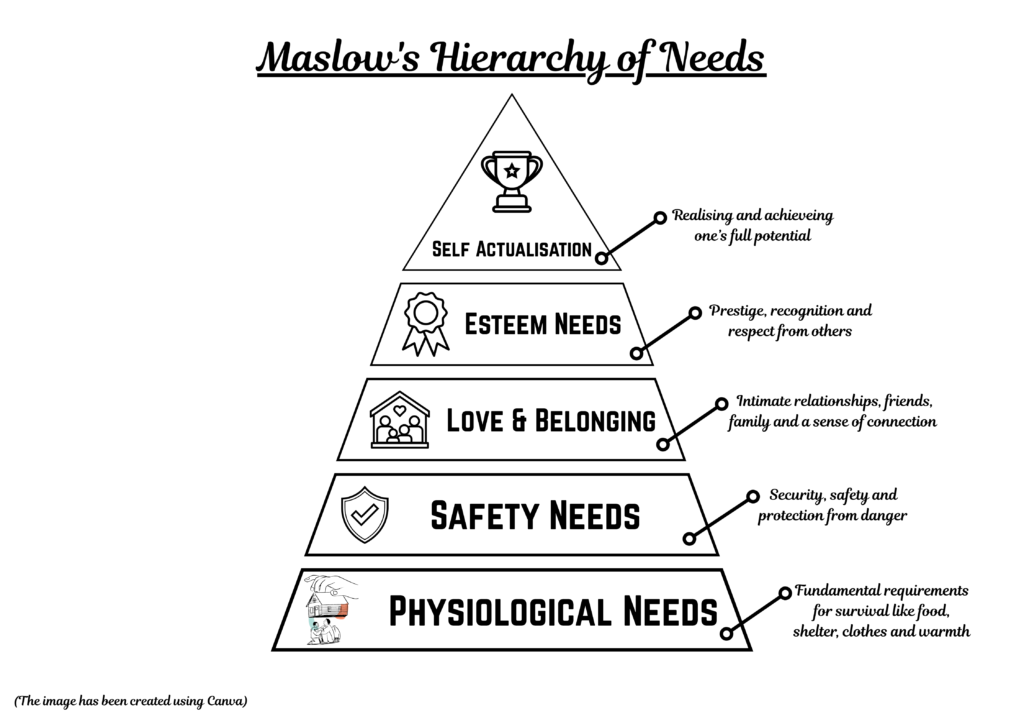
The uncertainty of the next meal shifts the brain of a child to survival mode. In the midst of daily negotiation for survival, children often fail to explore their curiosity, creativity and social relationships as their world gets bound within work, responsibility, and uncertainty.
The child eventually develops the idea that love and acceptance within the community and their family depend on how much they can earn. They conceptualise that money is the way to get affection.
They become vulnerable and push themselves to work relentlessly in dangerous situations like mines and factories, ignoring their own safety. Thus, for the child, fulfilling the most basic needs in Maslow’s Hierarchy of Needs becomes so laborious that aspirations like personal growth, recognition and self-actualisation remain beyond their consideration of imagination (Maslow, 1943). In these circumstances, a nurturing childhood is no longer fundamental; it is a rare privilege. Child labour not only exhausts a child’s physical health but also reshapes their understanding of love, value and identity.
Read More: World Day Against Child Labour: Protecting Innocence From Being Destroyed
Distressing events corrupt the development of young minds
Children working for long hours and exposed to harsh environments and exploitation develop chronic stress. Unlike short-term stress, which can serve as a motivation sometimes, chronic stress is a parasite to the developing mind, which harms the cognitive and emotional development of a child (Shonkoff et al., 2012).
Often, children in labour experience traumatic events, termed ‘Adverse Childhood Experiences‘ (ACEs). These include being neglected, abused, facing financial hardships, etc. (Felitti et al., 1998). ACEs increase the risk of mental health issues such as anxiety and depression, and difficulty in regulating emotions, as well as risky behaviour in adulthood.
Exposure to traumatic events affects the child’s interpretation of the world. They become more expectant of danger and instability, leading to emotional numbness or, quite possibly, hypervigilance, the state of constantly being on high alert. Over time, growing up in such an environment deeply shapes the child’s intellect, influences their choices, and affects their social relationships.
Learned Helplessness & Moral Developments
One of the most concerning observed psychological effects of child labour is learned helplessness, a state where the individual accepts their situation as their absolute fate, believing they have no control over it (Seligman, 1975). When children repeatedly encounter harsh environments and experience hardships, unable to change them, they stop trying altogether. This acceptance affects their self-belief; they start normalising their difficulties. With the progress of time, this mindset gradually nullifies their curiosity and ambitions.
Child labour also affects moral development. Moral development refers to how an individual differentiates right and wrong. According to developmental theories, children learn morality through guidance, education and social interaction (Kohlberg, 1981). However, exploitative environments prioritise survival over ethical consideration, leading children to obey the person exploiting them.
Resilience: The Strength to Defeat the System
Child labour remains a harsh, widespread reality that puts at stake an innocent soul’s life. It profoundly impairs their cognitive growth (Chudgar et al., 2022). However, not every child ends up rotting helplessly. Many children show remarkable resilience, the ability to cope despite adversity (Masten, 2001).
Resilience refers to the child’s ability to hold onto hope and maintain strength in a harsh environment. To them, even small supports such as a caring adult or a little access to education hold significant worth. Certainly, some children develop efficient problem-solving skills, intellect and emotional strength while living their distressing lives. However, it is important to understand that strength through hardship comes at a cost, and resilience must not be admired; rather, the effort should be to reduce such environments that demand resilience from children.
Conclusion
Child labour not only reflects the economics of a state; rather, it reflects the development of a child under the consistent pressure of survival. Long working hours and harsh environments hurt the psychological development of the child. Researchers have structured observed behaviours into concepts like survival instinct, stress, trauma and learned helplessness, which helps us in understanding how child labour affects a child at the core level.
However, concepts like resilience show that children are active adapters rather than just victims. Yet, it is crucial not to mistake the adaptation for well-being and remember that every child deserves a better childhood. Understanding the psychology behind child labour shifts the discussion from the number of affected children to the ways child labour affects a child. Perhaps it also serves as a reminder that protecting every child’s childhood is not just a social responsibility but also a psychological necessity.
References +
Maslow, A. H. (1943). A theory of human motivation. Psychological Review, 50(4), 370–396.
Seligman, M. E. P. (1975). Helplessness: On depression, development, and death. W. H. Freeman.
Kohlberg, L. (1981). The philosophy of moral development: Moral stages and the idea of justice. Harper & Row.
Felitti, V. J., Anda, R. F., Nordenberg, D., Williamson, D. F., Spitz, A. M., Edwards, V., Koss, M. P., & Marks, J. S. (1998). Relationship of childhood abuse and household dysfunction to many of the leading causes of death in adults: The Adverse Childhood Experiences (ACE) study. American Journal of Preventive Medicine, 14(4), 245–258. https://pubmed.ncbi.nlm.nih.gov/9635069/
Masten, A. S. (2001). Ordinary magic: Resilience processes in development. American Psychologist, 56(3), 227–238. https://pubmed.ncbi.nlm.nih.gov/11315249/ 6. Shonkoff, J. P., & Garner, A. S. (2012). The lifelong effects of early childhood adversity and toxic stress. Pediatrics, 129(1), e232–e246. https://pubmed.ncbi.nlm.nih.gov/22201156
Chudgar, A., Grover, V., Hatakeyama, S., & Bizhanova, A. (2022). Child labour as a barrier to foundational skills. International Journal of Educational Development, 90, 102565. https://pmc.ncbi.nlm.nih.gov/articles/PMC9427166/
Bharat, P., Dhimaan, N., Raddi, S. A., Bist, L., Kaur, K., Tiwari, J., & Kaur, D. (2024). Socio-cultural discourses of children engaged in child labour in India: A macro ethnographic study. Indian Journal of Community Medicine, 49(2), 392–397. https://pmc.ncbi.nlm.nih.gov/articles/PMC11042127/





Leave feedback about this