







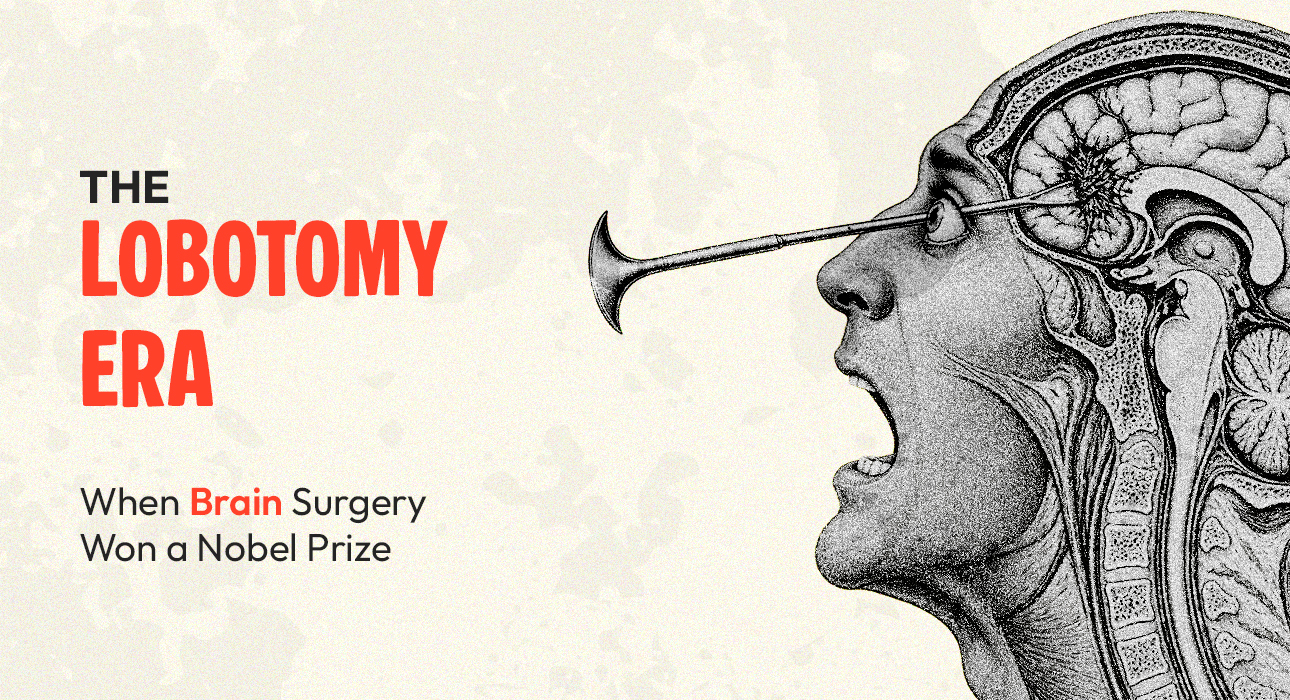
Today, many individuals experience depression, chronic anxiety, emotional imbalance and similar psychological issues. While today the treatment is more oriented toward therapy and medications, there was a phase in history when treatment for this was surgical. This era was between the 1930s and 1950s. Back then, if an individual would walk into a hospital with symptoms of psychological difficulties, instead of receiving therapy or medication, the doctor would drill into their skull or use a sharp instrument through their eye socket to permanently alter their brain.
The surgical procedure would take a few minutes of time, and the individual would walk out of the hospital just like any other person. However, there would be a major psychological difference between the individual who was admitted and the one who got discharged from the hospital. Their emotions might flatten, their personality would change, and their ability to think and connect with others would have been affected permanently.
By modern standards, the approaches of the lobotomy era are considered unethical. However, between the 1930s and 1950s, lobotomy was one of the most celebrated achievements in the field of psychiatry. Thousands of patients underwent this procedure worldwide. In 1949, the inventor of lobotomy, António Egas Moniz, was awarded the Nobel Prize in Physiology or Medicine. Yet today, the lobotomy era is remembered as one of the darkest chapters of history and reminds us about the devastating consequences of treatment without proper evidence (Terrier et al., 2019).
Why Was Lobotomy Accepted?
The acceptance of lobotomy was out of a desperate need for treatment. In the early twentieth century, many individuals visited hospitals with psychological illnesses. There was a rise in the number of cases; however, due to a lack of treatment approaches, the patients received only limited care. With time, the pressure was increasing on the scientific community to provide a treatment for this. (Tan & Yip, 2014). Against this backdrop, any intervention with promising results seemed revolutionary.
In 1935, Portuguese neurologist António Egas Moniz proposed this theory, stating that abnormal thoughts and emotions are due to faulty neural connections in the frontal lobes. He believed that severing these connections would interrupt pathological patterns of thinking and reduce mental illness. This procedure was termed prefrontal leucotomy (Moniz,1936). While the biological aspect was speculative, the timing was perfect. Treatment was desperately needed.
One of the Most Optimistic Decisions of the Scientific Community
As per the data, the procedure proposed by António Egas Moniz showed significant improvement in twenty patients. However, the data were from short-term follow-ups and lacked rigorous evaluation. The long-term data and possibility of complications remained absent in his publications (Terrier et al., 2019).
Despite methodological weakness, the promising claims led hospitals across Europe and North America to adopt the procedure. In 1949, Moniz received the Nobel Prize in Physiology or Medicine “for his discovery of the therapeutic value of leucotomy in certain psychoses” (Nobel Foundation, 1998). This award was a reflection of the medical community’s optimism rather than definitive proof of effectiveness.
In today’s perspective, the decision would likely seem astonishing. However, back then physicians genuinely believed to have found an effective treatment for severe mental illness. The lack of alternatives made the slightest of improvements seem extraordinary (Abimbola, 2006).
Read More: The Origin of Psychological Testing- A Brief History
The Rise of Lobotomy in America
A fair share of credit for the widespread practice of this procedure goes to American neurologist Walter Freeman and neurosurgeon James Watts, who introduced lobotomy to the United States. Freeman believed that the surgical procedure needed to be simpler and quicker so that it could be available in every psychiatric hospital. Thus, in 1946 he developed the transorbital lobotomy, commonly known as the “ice-pick lobotomy”. Rather than drilling into the skull, Freeman would insert a sharp instrument above the patient’s eyes and strike it with a surgical hammer to reach the frontal lobe. Then, the instrument would be moved side to side to sever the brain connections.
This procedure was a quicker alternative that would take a few minutes and eliminated the need for an operating theatre. Freeman travelled across the country to demonstrate the procedure and train physicians. Eventually, the accessibility contributed to the growth of popularity of the procedure, and thousands of people underwent this procedure in the United States itself (Tan & Yip, 2014).
The Cost of Failure Which the Patients Paid
Many hospitals considered lobotomy a success because patients were reported to become calmer, less aggressive and easier to manage. However, the consequences of lobotomy were much more horrifying than its success. Many patients lost their ability to express themselves, be creative and make independent decisions. Reportedly, lobotomy resulted in severe cognitive impairment, personality changes, incontinence and even death. One of the most famous cases was that of the victim named Rosemary Kennedy, sister of future U.S. President John F. Kennedy. She underwent the lobotomy procedure at the age of 23 to address her behavioural difficulties and mood swings.
However, instead of curing her, she became permanently incapable of being independent and needed institutional care for the rest of her life. Such cases were not isolated. Many families witnessed irreversible changes in their loved ones. Instead of curing the psychological illness, lobotomy left individuals with permanent neurological disabilities (Terrier et al., 2019).
Why Did the Doctors Not Question?
Modern readers often question how the intelligent physicians accepted such a treatment, which would make the patient permanently disabled. The major reason was the scientific standard of the era. Back then, randomised controlled trials and standardised outcome measures were not taken into account. Hospitals interpreted the calmness after surgery as a sign of “improvement”, and possible reasoning such as neurological damage and consequences such as loss of cognitive abilities were not taken into account.
Alongside this, confirmation bias played a significant role as well. Doctors who expected positive results would either underreport the unsuccessful cases or interpret them as a severe attribute of the original illness (Valenstein, 1986). The lobotomy era had highlighted the difference between symptom suppression and genuine recovery.
Lobotomy Had to Decline
In 1952, the introduction of chlorpromazine, the first effective antipsychotic medication, transformed psychiatric treatment completely. For the very first time, physicians had an approach to reduce psychotic symptoms without permanently destroying brain tissue. At the same time, the long-term follow-up studies documented the consequences of lobotomy. Alongside the evolution of ethical standards in medical research, lobotomy began declining (Valenstein, 1986). By the end of the 1960s, lobotomy was no longer practised in hospitals.
Today, highly selective forms of psychosurgery do exist. However, they are much different from historical lobotomy. Modern techniques rely on advanced neuroimaging, precise targeting, multidisciplinary review and strict ethical oversight (Terrier et al., 2019).
Read More: India’s Psychosurgery Milestone
Ethical Standards Must Never Be Compromised
The era of lobotomy highlights not just the failure of medical procedures but also how urgency can lead to compromising with evidence, which can have one of the most fatal consequences. It is a lesson about how science, authority and desperation can interact in dangerous ways. Some of the ethical lessons learnt from it and applied till today have been listed below:
- While prestige is an achievement, it does not guarantee scientific truth. The Nobel Prize awarded to Moniz was the highest honour, which later seemed flawed.
- Urgency can even make the most intellectual community compromise with evidence. The limited treatment options and rising cases of psychological illness made the physicians so desperate that they accepted a methodology before knowing its long-term consequences.
- Convenience and healing are totally different. Lobotomy made patients easier to handle but did not actually heal them. In that era, the efficiency of the medical care unit of the institutions was mistaken for the success of the procedure.
- Most importantly, ethical standards are a must. History has shown what can happen in the absence of informed consent, randomised trials, long-term monitoring, etc. Thus, it is important to maintain and not compromise the ethical standards in any scenario.
Conclusion
The lobotomy era is one of the darkest phases of history, where thousands of patients, including children, were sentenced to lifetime disability. When an individual goes to a doctor, they hope to recover. But wrong treatment can put them in a much worse condition from which they might not ever recover.
Medical science has had remarkable advancements since the lobotomy era. Today, neuroscience recognises the complexities of the human brain, and all psychological approaches are combined with personalised treatments. However, the story of lobotomy remains significantly relevant. While every generation is eager to find the next big groundbreaking theory, ethical standards must be maintained alongside the research. The lobotomy era keeps reminding us that the greatest danger in scientific research is not just ignorance but being “promising” and not “evident with evidence”.
References +
- Moniz, A. E. (1936). Tentatives opératoires dans le traitement de certaines psychoses. L’Encéphale, 31, 14–29.
- Nobel Foundation. (n.d.). The Nobel Prize in Physiology or Medicine 1949.
- Valenstein, E. S. (1986). Great and desperate cures: The rise and decline of psychosurgery and other radical treatments for mental illness. Basic Books.
- Pressman, J. D. (1998). Last resort: Psychosurgery and the limits of medicine. Cambridge University Press.
- El-Hai, J. (2005). The lobotomist: A maverick medical genius and his tragic quest to rid the world of mental illness. John Wiley & Sons.
- Abimbola, S. (2006). The white cut: Egas Moniz, lobotomy, and the Nobel prize. BMJ, 332, 060112.
- Tan, S. Y., & Yip, A. (2014). António Egas Moniz (1874–1955): Lobotomy pioneer and Nobel laureate. Singapore Medical Journal, 55(4), 175–176.
- Terrier, L.-M., Lévêque, M., & Amelot, A. (2019). Brain lobotomy: A historical and moral dilemma with no alternative? World Neurosurgery, 132, 211–218.
- Mahoney, D. E., & Green, A. L. (2020). Psychosurgery: History of the neurosurgical management of psychiatric disorders. World Neurosurgery, 137, 327–334.



Leave feedback about this