







How does it feel for someone’s identity to be consistently and indefinitely shamed for their culture? What happens to the mind when you are brought up in a system that gives you rewards for thinking as your coloniser and punishes you for thinking as yourself? These are not the kind of questions that can be neatly answered in a clinical psychology book.
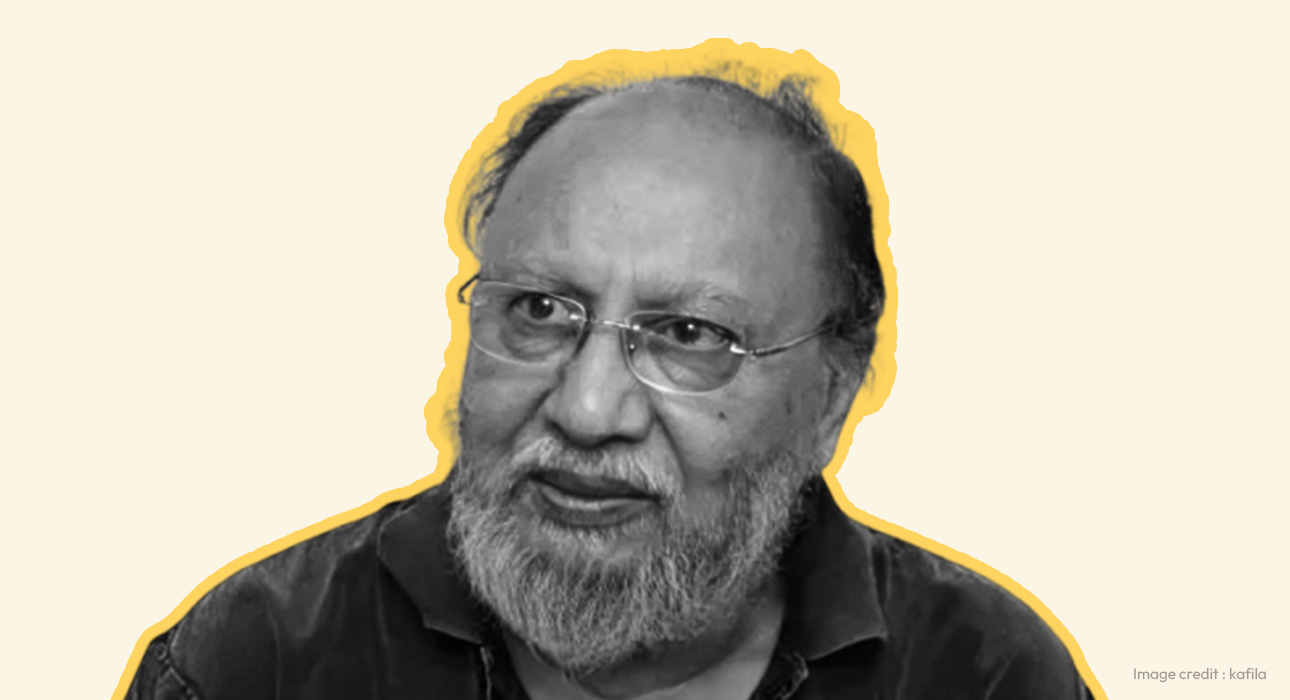
The questions, however, are what have shaped the life’s work of Ashis Nandy (Brown University, n.d.), born in 1937 in British India, trained as a clinical psychologist, and described as one of the most formidable and original public intellectuals India has produced. Nandy borrowed the ideas of identity, self, projection, anxiety and defence from psychology and extended them from the therapy couch to the civilisations, political systems and cultural histories themselves. Here’s the evolution of his thinking- how he was able to marry psychology with colonialism, culture and identity and why his research still questions psychology’s limits.
The Man and his Method: Psychologist as Social Theorist
Ashis Nandy earned his doctoral degree in clinical psychology from Gujarat University in 1967, with his dissertation on the psychological significance of valued objects in personality – namely, the significance of money. The intellectual restlessness was always directed outward from the individual to the social. He was at the Centre for the Study of Developing Societies (CSDS) in New Delhi, where he worked for most of his professional life as Senior Fellow and then Director. This organisation is not a psychology department, but rather is centred on culture, politics, and society (Wiley Online Library, 2016).
Nandy has not termed himself a clinical psychologist but a political psychologist, someone who applies psychological insights to the fields of politics, power, and collective life. His method is not experimental or statistical. It is interpretive: he reads history in the same manner that he reads a person, a political movement, a social phenomenon, a cultural document- he seeks to discover what they reveal about the emotional, psychological and moral life of a society. He has studied Bollywood, cricket, Partition, Emergency, Hindu nationalism, Gandhi, Utopia and nuclear weapons, all from a psychological perspective (Nandy, 1980; Nandy, 1983).
It is Nandy’s ability to treat folk knowledge, ways of comprehending the world, non-Western notions of the self, and psychological aspects of experiences, which are often considered purely political or economic, as serious objects of study that sets his work apart. He has described himself as an “intellectual streetfighter”, a psychologist who is unwilling to “stick in the clinic when the world outside is burning” (Wiley Online Library, 2016).
What Colonialism Does to the Self
His most famous publication, The Intimate Enemy: Loss and Recovery of Self Under Colonialism (1983), is credited with revolutionising the study of post-colonialism, an academic study of the cultural and psychological effects of colonisation and its aftermath. The main psychological insight in the title is that the coloniser is an intimate enemy, rather than a distant oppressor who could be simply hated and resisted, but a person who had become part of the colonised person’s own sense of self, values, and aspirations. (Nandy, 1983)
For Ashis Nandy, British colonisation of India was not just a political/economic endeavour; it was a psychological one. It worked not so much through the actual use of force as through the internalisation of colonial values: the colonised were encouraged, rewarded and socialised into believing that British modes of thinking, dressing, speaking, and being were superior, that their own ways were backward, irrational and childish. It took time, but over time many educated Indians saw themselves through the eyes of the British. The measures that they had created by which they judged Indians of a different civilisation. It is an intuitive dimension of colonialism which is more intimate rather than external, and this is what Nandy calls the “intimate” dimension of colonialism (1983).
The Internalisation of Colonial Identity
From a psychological perspective, this phenomenon is referred to as internalised oppression, or when a marginalised group takes up the dominant group’s sinister view of the marginalised group. Other psychologists and theorists have explored related terrain in the context of French colonialism in Africa, such as Frantz Fanon. It was Nandy’s task to track this process specifically through the Indian context and culture, to show how the British coloniser portrayed the Indian as feminine, childlike, and needing guidance and tutelage- and how many Indians internalised these qualities, believing them to be characteristics of their own people, to survive and succeed within the colonial framework (Nandy, 1982; Fanon, 1952).
It is important that Ashis Nandy also discussed the impact of colonialism on the coloniser. He was unusual in his time in claiming that the British were also psychologically damaged by colonialism, that the “nervous isolation” of their subjects involved the suppression of empathy, the development of emotional distance, and the creation of the hard, masculine character of the coloniser that ultimately left the British deprived of their own inner life. Colonialism, in Nandy’s understanding, was a psychological calamity for both sides, though in different ways; it disempowered both parties (Nandy, 1983; Brown University, n.d.).
Against Modernity: Culture, Tradition, and the Politics of Knowledge
A consistent thread in Nandy’s oeuvre is his scepticism towards the ideology of modernity (which is shared by intellectual cultures in both the West and postcolonialism) that purports that progress entails the abandonment of tradition, religion and non-rational modes of knowledge, for a secular, scientific and rational framework that is presumed to be universal. However, this is not a universal framework, but one that is specifically European and exported around the world through the process of colonialism, and it is still functioning as a “kind of intellectual imperialism” (Nandy, 1987).
This has psychological repercussions. When the only way to know is to know rationally, according to Western scientific models, then all of those ways of knowing – including many of the Indian philosophical, spiritual, and folk traditions- are invisible, invalid, or rudimentary. Those whose inner life is influenced by these traditions are implicitly told that their inner frameworks of self-understanding and world do not count. This epistemic violence is not physical, but the silencing of modes of knowing, as Nandy (1987; Postcolonial Studies, 2014) puts it.
Questioning Western Models of Psychology
The Savage Freud and Other Essays on Possible and Retrievable Selves (1995) makes this critique even more pronounced: Nandy’s criticism goes beyond the history of psychoanalysis and applies it to psychoanalysis itself. Freudian psychoanalysis, Ashis Nandy points out, too, is a culturally specific creation with specific assumptions about a “normal self” as well as about the nature of the relationship between a person and society, and what is considered to be a “pathological” state (one that is “abnormal” or “disordered”). If these are taken as given in the case of non-Western people and cultures, they might be a type of cultural distortion (Nandy, 1995).
Nandy’s notion of critical traditionalism is neither a return to the past nor an uncritical approach to it. But selecting critical elements of traditional knowledge that have a psychological and moral generative value, with the rejection of romanticising uncritically. He regards Gandhi as the most formidable instance of this strategy, as one who ‘borrowed’ from Hindu and Jain traditions as well as others in India, to build a ‘society’ and ‘good life’ based not on nostalgia but on alternative notions like non-violence, self-sufficiency, communal responsibility that he invented and developed based on non-Western values, not from the coloniser’s playbook (Nandy, 1983; Nandy, 1987).
The theme of identity, violence, and the political psychology of the self
Ashis Nandy’s investigations of identity are not those of conventional psychology, but are in between the personal and the social. One of his most salient insights is that political violence – riots, pogroms, communal massacres – is not just a result of rational political calculation or competition that is driven by economic factors. It’s psychological; it reflects the anxieties, humiliations and unexpressed paradoxes of the community’s sense of self. He has co-authored several human rights reports on riots and communal violence in India, and focused on these issues with a clinical psychological eye, rather than one that was political or sociological (Watson, n.d.; Postcolonial Studies, 2014).
An interesting aspect of Nandy’s approach to identity is that he is not bound by any fixed categories. He is very sensitive to any identity politics that essentialises the divisions between the communities, whether it is the Hindu-Muslim divide, the Indian-Western divide, or the traditional-modern divide. He believes that rigid identities with a bounded nature are themselves a part of colonial modernity, which tended to impose more exclusive and even sharper categories on societies that previously had more fluid, overlapping and contextual perceptions of their identities. These fixed identities have a psychological price, he claims, an ever-present fear of “contamination” by the other (Nandy, 1995; Wiley Online Library, 2016).
Conclusion
Ashis Nandy’s brand of psychology is one that most psychology programs do not yet know what to do with. He has no interest in cognitive biases in lab experiments or therapy results in clinical trials. What is the meaning of being a self- a human being with a sense of self in a world formed by power, history, and cultural violence- is his focus of interest. His response- a response that spans over two and a half decades of public intellectual life and the writing of over two dozen books- is that the self is always political, always cultural, and always in a history it did not select.
In traditional psychology, the problems are considered to be within the individual, and solutions are within the individual. Ashis Nandy argues that many of the deepest psychological wounds stem from structures and histories that cannot be solved by a single individual and that are shame, anxiety and violence of the colonised, dispossessed and threatened. For Healing, within his structure, cultural recovery- the retrieval of suppressed, delegitimised, and stolen ways of being- is a necessary component of healing.
References
Brown University, Saxena Center for Contemporary South Asia. (n.d.). Ashis Nandy. https://watson.brown.edu/southasia/people/ashis-nandy
Fanon, F. (1952). Black skin, white masks (C. L. Markmann, Trans.). Grove Press. (Original work published 1952)
Lal, V. (Ed.). (2000). Dissenting knowledges, open futures: The multiple selves and strange destinations of Ashis Nandy. Oxford University Press.
Nandy, A. (1980). At the edge of psychology: Essays in politics and culture. Oxford University Press.
Nandy, A. (1982). The psychology of colonialism: Sex, age, and ideology in British India. Psychiatry, 45(3), 197–218. https://doi.org/10.1521/00332747.1982.11024170
Nandy, A. (1983). The intimate enemy: Loss and recovery of self under colonialism. Oxford University Press.
Nandy, A. (1987). Traditions, tyranny and utopias: Essays in the politics of awareness. Oxford University Press.
Nandy, A. (1995). The savage Freud and other essays on possible and retrievable selves. Princeton University Press.
Postcolonial Studies, Emory University. (2014). Nandy, Ashis. https://scholarblogs.emory.edu/postcolonialstudies/2014/06/19/nandy-ashis/
Wiley Online Library. (2016). Nandy, Ashis. In Encyclopedia of Political Psychology. https://doi.org/10.1002/9781119076506.wbeps261




Leave feedback about this