






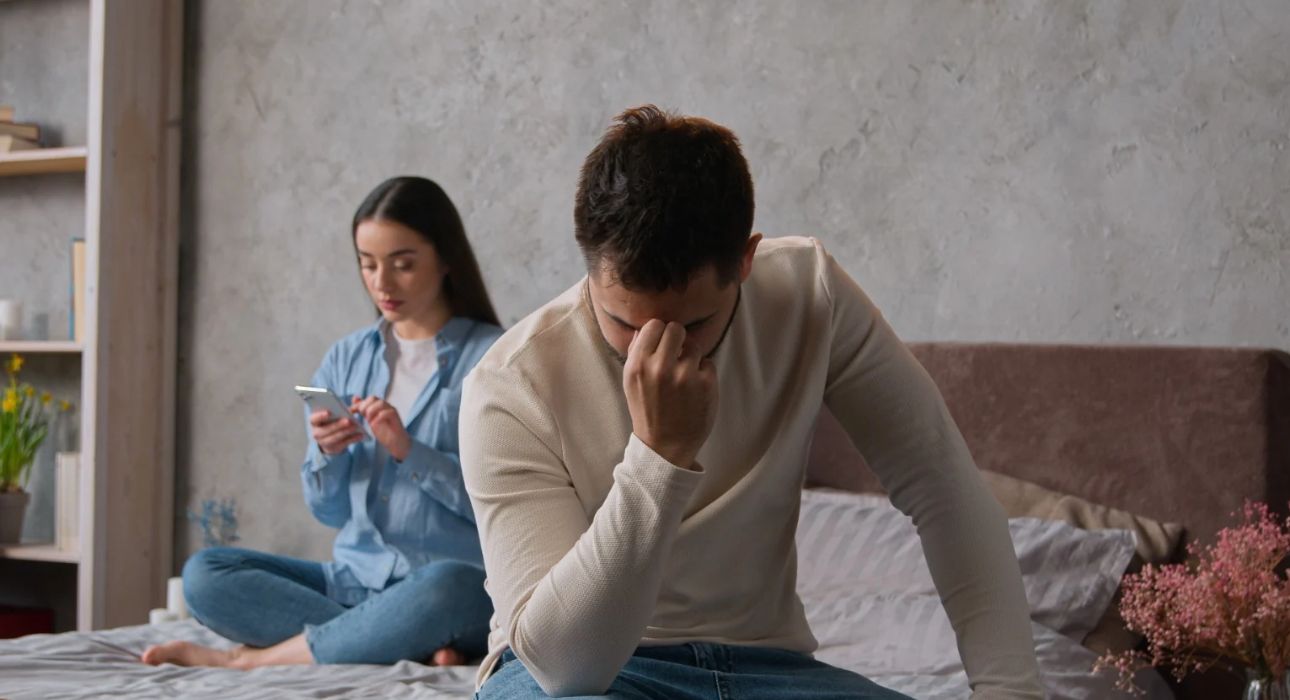
If you’re busy, you say you’re unavailable. If your friends plan a party and you already have plans, you say you’re unavailable. You call someone, and they tell you they’re unavailable right now. It’s a word we use all the time, without a second thought. But has anyone in your life ever actually said they were “emotionally unavailable”? Probably not. It’s not a word people use to describe what’s happening inside them. What we see is only ever the surface, the smile, the easy conversation, the willingness to go along with whatever you want to do. None of that tells you what’s actually going on underneath.
There are experiences and challenges that create emotional barriers in a person. Ask them how they’re doing or ask questions about their relationships, and you will see them dodge your questions or abruptly end the conversation with a smooth trick. Emotionally distant people are not good at talking about themselves and are more present physically than emotionally.
Emotional unavailability has been discussed many times in relationship and dating talks. Psychologists are using attachment theory to identify the psychological factors that lead to such behavior in the first place. What they have found is far more extensive than what this phrase suggests. In this article, we will break down the origin of this behaviour, why it works as self-protection rather than indifference, and why it’s crucial to separate this relationship pattern from a formal mental health diagnosis.
Read More: Is Your Partner Emotionally Unavailable? 7 Signs to Consider
The Origin of Emotional Unavailability
The first time this phrase was researched was in 1987. In a study that talks about adult romantic relationships in terms of attachment processes, it was found that adult relationships share the same bonding system that exists between infants and caregivers. Their bond revolves around three types of attachment styles, which are secure, avoidant, and anxious. Research pointed out that these styles are the ones that predict how individuals will experience closeness, conflict, and trust later in their romantic lives (Hazan & Shaver, 1987).
Among these styles, being emotionally unavailable is closely related to the avoidant style. A longitudinal study was carried out that documented histories of childhood maltreatment. In the study, childhood experiences and their links to adult attachment types in men and women were analyzed to identify the role of adult attachment styles in mediating childhood experiences into adulthood, affecting future health. The attachment adaptation one develops during childhood shapes how he or she behaves in relationships during the upcoming years. Hence, emotional isolation is repeated because people get used to acting in a certain way since childhood (Widom et al., 2018).
Read More: The Role of Attachment Styles in Romantic Relationships
Emotional Avoidance Is Self-Protection, Not Indifference
By the time individuals grow into adulthood or initiate their first romantic relationship, they often become used to avoiding feelings and have acquired the habit of being defensive. Researchers call this pattern within avoidant attachment “deactivating strategies” (Mikulincer & Shaver, 2016). These are not manipulative tactics but unconscious habits that the person’s response system creates to protect themselves from closeness itself. A partner expressing love, or asking for a deeper connection, can register less as comfort and more as a threat to their independence, which is what pushes them toward distance rather than toward the relationship.
This theory has been measured using a mixed-methods study, involving a survey and daily check-ins for a week. According to research findings, people with elevated levels of attachment avoidance are more inclined to resort to self-help solutions. They often suppress their feelings or work through them alone, rather than relying on their partners for support, and even when their partners are willing to assist them, they prefer to go through the emotional challenges independently (Mosannenzadeh et al., 2024). Their default system has picked up the habit of self-reliance.
Fear of Vulnerability
Individuals with emotional avoidance are concealing their sense of vulnerability beneath all the withdrawal symptoms. In 1991, psychologists Descutner and Thelen created the Fear-of-Intimacy Scale to gauge this tendency. According to Descutner and Thelen (1991), fear of intimacy is a constrained capacity, motivated by worry, to share genuinely meaningful thoughts and emotions with a significant other.
A later study using the same scale on large samples in China and the United States confirmed the pattern holds up well beyond the original group it was developed on: those who scored highly on that fear were significantly more likely to report low self-esteem and depression than those who scored low, alongside the anxiety and broader psychological difficulties Descutner and Thelen originally identified (Ingersoll et al., 2008; Descutner & Thelen, 1991). These results provide a key understanding of why closeness feels so unsafe for some people.
Read More: Importance of Emotional Vulnerability in Relationship
The Communication Gap
Being closed off emotionally is not limited to withdrawal. Research has suggested that it also affects how the person perceives their partner’s true feelings. In one study, three separate samples of couples were combined and found that people who have high attachment avoidance were significantly less accurate at picking up their partner’s positive emotions, such as love or affection. It is not because they are deliberately dismissing those emotions during conversation or misleading them in a biased direction. They simply have difficulty distinguishing warmth or real emotion when they are right in front of them (Gauvin et al., 2025).
Read More: Communication in the Digital World: Why Understanding Matters More Than Speed
What It Looks Like From the Other Side
The majority of the studies about this topic revolve around the one who feels unavailable. In contrast, a 1992 study focused on the “receiving” aspect of the situation. As part of a study, couples were filmed in a waiting room while one member was going to experience something stressful. It was discovered that more avoidant partners gave and sought less support in that moment than less avoidant partners (Simpson et al., 1992).
This situation is puzzling to the other partner. They may feel neglected or inferior when, in fact, the situation is nothing like that. This is not merely a subjective feeling of the partner. A study conducted in a large group of dyads where both partners of 185 couples were interviewed independently has shown a statistically significant partner effect: those who had partners with higher levels of attachment avoidance were less satisfied in their relationships and felt less secure about it, irrespective of their own level of attachment avoidance (Rodriguez et al., 2021).
Emotionally Unavailable vs. Avoidant Personality Disorder
The terms emotionally unavailable and avoidant personality disorder are two different issues altogether and differ mostly in terms of extent and ramifications. One should indeed differentiate between someone’s attachment style and a personality disorder; otherwise, one could experience communication problems with a partner. Indeed, avoidant attachment is a style of relating to others, a form that manifests itself mainly in close relationships. This is not a stable and irreversible condition, and a person who possesses this style can lead quite a normal life in everything else as well, except for romantic relationships.
Avoidant personality disorder (AvPD) is entirely distinct from the previous problem. The symptoms of AvPD include self-doubt, social withdrawal, and extreme sensitivity to rejection. These symptoms do not operate only on the romantic partnership level. They affect a person’s social functioning in a much wider manner, making it very hard for people to make friends, build work relationships, and deal with social situations.
Researchers have found that people with avoidant personality disorder often have more anxiety tied to attachment, especially around being abandoned. They tend to show a fearful attachment style, not just an avoidant one, compared to those with social phobia (Eikenaes et al., 2015). What we can learn from the above is a significant point: both people are going through some hardship, but to different degrees. Avoidant people do not necessarily have a label, but their fear is very real. Meanwhile, those with AvPD have to deal with much bigger and heavier issues that go beyond the problems of intimacy.
Conclusion
The term “emotionally unavailable” should not be perceived as a negative trait. It is a form of self-defense in which a person protects themselves from vulnerability by not allowing themselves to form close connections with others. Important to identify those who are emotionally unavailable, and the process is not a simple one. It is difficult for us to understand when our friends or coworkers are in distress and unable to let us close for some reason.
We can create trust, provide appropriate answers, and help them communicate their needs. However, this requires both parties to put in some effort to be successful in this endeavor. It is essential to understand that emotional unavailability is not a diagnosis that needs to be treated. But a condition that leaves once a person is willing to accept it and provide a high level of honesty and consistency in the relationship.
References +
- Descutner, C. J., & Thelen, M. H. (1991). Development and validation of a Fear-of-Intimacy Scale. Psychological Assessment, 3(2), 218–225. https://doi.org/10.1037/1040-3590.3.2.218
- Eikenaes, I., Egeland, J., Hummelen, B., & Wilberg, T. (2015). Avoidant personality disorder versus social phobia: The significance of childhood neglect. PLOS ONE, 10(3), e0122846. https://doi.org/10.1371/journal.pone.0122846
- Gauvin, S. E. M., Maxwell, J. A., Impett, E. A., & MacDonald, G. (2025). Love lost in translation: Avoidant individuals inaccurately perceive their partners’ positive emotions during love conversations. Personality and Social Psychology Bulletin. https://doi.org/10.1177/01461672241258391
- Hazan, C., & Shaver, P. (1987). Romantic love conceptualized as an attachment process. Journal of Personality and Social Psychology, 52(3), 511–524. https://doi.org/10.1037/0022-3514.52.3.511
- Ingersoll, T. S., Poulin, J., Deng, R., Shan, X., Witt, H., & Swain, M. (2012). Fear of Intimacy with Helping Professionals Scale: Reliability and Validity of English and Mandarin Versions. Journal of Evidence-Based Social Work, 9(4), 317–332. https://doi.org/10.1080/15433714.2010.516689
- Mikulincer, M., & Shaver, P. R. (2016). Attachment in adulthood: Structure, dynamics, and change (2nd ed.). Guilford Press.
- Mosannenzadeh, F., Luijten, M., Maciejewski, D. F., Wiewel, G. V., & Karremans, J. C. (2024). Adult attachment and emotion regulation flexibility in romantic relationships. Behavioral Sciences, 14(9), Article 758. https://doi.org/10.3390/bs14090758
- Rodriguez, L. M., Coy, A., & Hadden, B. W. (2021). The attachment dynamic: Dyadic patterns of anxiety and avoidance in relationship functioning. Journal of Social and Personal Relationships, 38(3), 971–994. https://doi.org/10.1177/0265407520975858
- Simpson, J. A., Rholes, W. S., & Nelligan, J. S. (1992). Support-seeking and support-giving within couples in an anxiety-provoking situation: The role of attachment styles. Journal of Personality and Social Psychology, 62(3), 434–446. https://doi.org/10.1037/0022-3514.62.3.434
- Widom, C. S., Czaja, S., Kozakowski, S., & Chauhan, P. (2018). Does adult attachment style mediate the relationship between childhood maltreatment and mental and physical health outcomes? Child Abuse & Neglect, 76, 533–545. https://doi.org/10.1016/j.chiabu.2017.05.002


Leave feedback about this