







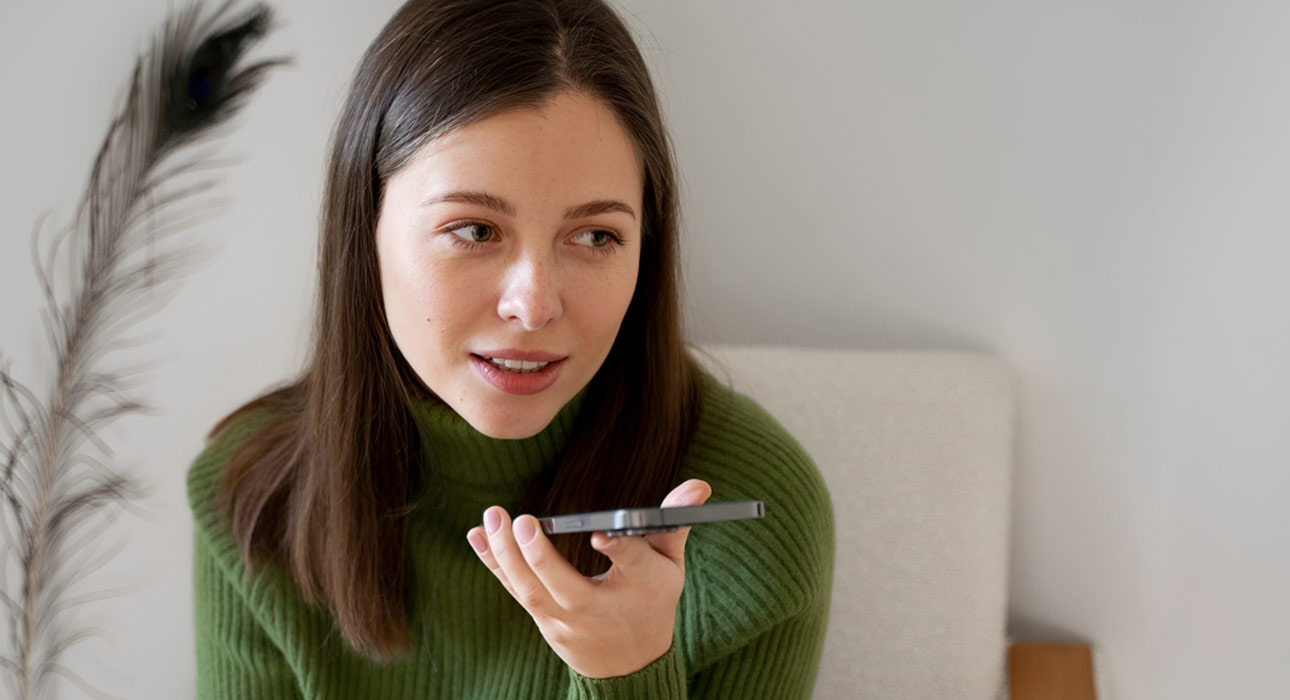
You get a WhatsApp voice message that lasts four minutes and thirty-seven seconds. You check your phone and then start to wonder if the person who sent it thinks you’re interested in podcasts. But now think about the other scenario: when you send a detailed message in which you explain how you feel and the only reply you receive is ‘Okay’, at that moment you begin to look at the punctuation, question the nature of the relationship, and practice a conversation that has not yet happened.
That’s the way things are with modern communication, a 30-second voice message can be expanded into a whole audiobook and a single full stop can come across as a personal attack. As messaging has become such a regular part of daily life, we rarely take the time to consider what our habits tell us about ourselves. There are some people who would rather write an essay than record their voice, while others press the voice message button as if they were at a press conference. Such behaviour doesn’t reveal anything about a person’s personality, emotional intelligence, or the way they handle relationships; rather, it reflects our own habits, emotional needs, and level of social comfort.
The Psychology Behind Voice Notes vs Texts
It’s not merely a matter of passing on information since communication also includes expressing emotions, building up relationships, managing one’s image and understanding the intentions of others. The method of communication you choose has an effect on all these areas. Daft and Lengel (1986) stated that different communication channels differ in the amount of information they carry and in their ability to reduce ambiguity. Face-to-face conversation includes a variety of cues such as facial expressions, gestures and intonation. Text messages have fewer emotional cues even though emojis, punctuation and timing can recover some of them. Voice notes are in a middle position because the listener can play them at any time and the sender does not have to reply right away. You can still detect tone, emphasis and pauses. Therefore, messaging provides the convenience of speech along with its emotional content.
Read More: Messages! Are you taking it too seriously?
The Texting Enthusiast: Thinks Before Typing
It’s quite possible that you know someone who can go through a complete emotional crisis by putting their thoughts into well-structured paragraphs, yet who vanishes completely when asked to record a voice message. That person might just be you. Texting gives you time. In a spoken conversation, there’s an expectation of an immediate reply, whereas with a text message you get the chance to think, to edit what you write and to choose how much to say. Walther’s (1996) research into computer-mediated communication illustrates the kind of impressions we form of each other when communicating online.
Even though text doesn’t include non-verbal cues, it does allow us to alter our language over time in order to show how we feel about the relationship. For some people that is precisely what appeals to them. They can express themselves without having to face interruptions, uncomfortable silences or words which they might later regret.
To regard writing a text as better than having a conversation is not the same as shunning a conversation due to difficult emotions, even if the two seem similar at first sight. There are certain individuals who type ‘HAHAHAHA’ even though their facial expression remains entirely blank; in such a case, it is clear that it is their fingers that are having more fun than the rest of them. The truth is that digital communication allows us to express our emotions without showing them physically, and this is not dishonest; it is merely another way of handling how we present ourselves.
Read More: The Psychology of Unspoken Expectations in Relationships
The Fan of Voice Notes
For those who prefer to use voice messages, there is no need to type out a long explanation since a two-minute spoken message would do just as well. This argument makes sense. Because it is generally easier to speak than to type when you have a hundred ideas racing through your mind. The tone of voice also allows the person on the other end to get an idea of how you are feeling; something about the way you speak cannot be expressed simply by words alone. For instance, the statement “I’m so happy for you” can sound enthusiastic, polite, sarcastic or completely detached depending on how it is delivered. A voice message thus gives the listener extra information when trying to understand the meaning of the message. Studies that have compared electronic with face-to-face communication consistently highlight the importance of vocal and non-verbal cues (Epley & Kruger, 2005).
You can start by recording a message about a specific topic, only for the conversation to shift on to your childhood, the unreasonable actions of a colleague, and an event that took place three years ago which has nothing to do with the subject in question. By the six-minute mark the original reason for making the recording is likely to have disappeared. There is also a practical consideration: an advantage for the person who is sending the message may turn out to be a problem for the one who is receiving it. Both an audio connection and sustained attention are needed when listening. The fact that someone sends long voice messages does not mean that they are more emotional or have a greater interest in the relationship; they might simply prefer to speak rather than type.
What happens when texts lose their tone?
Simple text is easy to be misunderstood. If you look at “Okay.”, “Okay!” and “Okay” you will notice that all three express agreement. But each gives a different impression depending on the situation, the relationship between the individuals concerned and the sender’s usual style. Poirier, Cook and Klin (2025) found that certain text patterns and the use of punctuation can mimic spoken pauses and intonation and that they are able to directly convey emotions such as frustration or disgust.
In online settings, punctuation acts as an emotional signal; a full stop can show finality while an ellipsis implies ambiguity. Kruger et al. (2005) discovered that people have a tendency to overestimate how clearly their tone is communicated in writing. As vocal cues help to express the emotional nuances of speech, the results from text messaging or live conversation cannot be directly transferred to asynchronous voice messages without having carried out specific research on that form of communication.
The Overthinker: Reading Between Lines That May Not Exist
Research shows that without non-verbal cues there is likely to be more ambiguity and this in turn affects the way individuals form impressions (Walther, 1996; Kruger et al., 2005). When the information available is incomplete, the person who receives it turns to their prior expectations and assumptions about the relationship. If you are already uncertain, an ambiguous message may make you think about it excessively. A delayed reply could be seen as a rejection. A short reply might be interpreted as a sign of anger. A change from a person’s usual behaviour might be taken as meaning that something is wrong. Yet this is often not true. A delayed reply is merely a delayed reply and a prompt reply does not show that someone is interested.
The mistake is to take our own understanding of a message as proof of the sender’s intended meaning. When you say “that message made me feel ignored” you are merely describing your own experience. Whereas when you say “they ignored me because they don’t care” you are attributing a motive to the other person. By keeping these two ideas apart, you will be able to prevent unnecessary conflict and improve your communication. Although the person who said ‘hmm’ might be upset, they might simply be having dinner at the moment.
Read More: How to deal with conflicts in a relationship?
Do Voice Notes Make Us Feel Closer?
In 2009 Pettigrew examined how text messaging works in close relationships. The participants stating that it enables them to stay in touch while at the same time retaining their individuality. Digital communication allows people to keep in contact without exhausting their social energy. Asynchronous voice messages include intonation and tone. More emotional information is communicated when someone talks about a difficult day. Then laughs about it than can be achieved through simple text. Nevertheless, claims that voice messages lead to a greater sense of closeness should be kept separate from the findings concerning live voice calls or face-to-face interaction.
A study conducted in 2025 by Holtzman and his colleagues and posted online in Psychological Reports looked at a variety of support channels, including text messages, voice calls, video calls, and face-to-face interaction. Among the 348 young adult women surveyed, text-based support was found to be linked with lower levels of positive affect and satisfaction when compared with more extensive forms of contact such as face-to-face meetings or voice calls. The findings show the limitations of text-based support. Yet it would be incorrect to claim that voice notes in particular foster closeness. Since the study only looked at live communication methods.
Read More: Communication in the Digital World: Why Understanding Matters More Than Speed
The Psychology of Convenience
The way we decide to communicate is generally guided more by practical reasons than by our emotions (El-Shinnawy & Markus, 1997; Lengel & Daft, 1988). There is no need to type a long explanation when you say something out loud (Lacey, 1985). It is inconvenient to leave a voice message in either noisy or quiet environments. Writing gives us the opportunity to arrange our thoughts, whereas speaking allows us to avoid having to type.
These practical factors have almost as much effect on our habits as our personality does (Daft et al., 1987). Recording a voice message may in fact just be a question of convenience. Preferring to text rather than to make a call might be a way of not interrupting someone. When we write down the main points before engaging in a sensitive conversation, this generally reflects a wish for clarity. None of these choices on their own suggests laziness, a wish to avoid conflict, or superior communication skills.
If convenience is uneven then it becomes a problem; even though sending a long voice message saves the person who sends it time. It puts the duty of having to listen to the person on the receiving end. In the case of a sensitive conversation, using very long text paragraphs can hide the nuances which speech would convey more effectively. Communication should be based on how easily the person receiving the message can understand and respond to it rather than on how quickly the person sending the message can send it.
Introverts, Extroverts, and the Myth of the Perfect Messaging Personality
It’s tempting to believe that introverts prefer text messages while extroverts enjoy voice notes. But the research reveals a more complicated scenario. Although extraversion in general is linked to a preference for more abundant and real-time forms of communication (Seltzer et al., 2012), the particular choices people make depend very much on the situation, the relationship, and their individual reasons. For instance, an introvert may be willing to send long voice messages to a close friend. Because this helps to build intimacy without the need for a live phone call. In contrast, an extrovert might restrict themselves to sending short text messages when they are busy at work in order to avoid breaking their concentration.
It is not possible to tell from a person’s messaging habits whether they are introverted or extroverted, nor can you judge their degree of social anxiety or their level of emotional intelligence (Mavletova et al., 2015). Things like convenience, being used to the person they are messaging, cultural norms, and the demands of the workplace all play a role. A person who has trouble speaking spontaneously may prefer to write since it gives them a sense of control. On the other hand, someone who finds typing boring might opt for short audio messages. The way in which people communicate reflects the behavioural strategies they use. The situations they are in, not fixed psychological traits.
Conclusion
The way we communicate gives us genuine information about contemporary relationships, since it reveals how we express ourselves, form connections and handle our personal boundaries in an age of constant connectivity. When it comes to the argument between voice messages and text messages, texting reflects thought, control and efficiency, while voice notes convey warmth, spontaneity and nuance. Both methods can help to strengthen a relationship and both can lead to confusion. The real problem arises when we turn a simple preference into a fixed personality trait or a secret motive. A brief text message is not an insult and a lengthy voice note does not automatically mean intimacy; a delayed reply doesn’t always indicate disinterest.
There is always a real person behind each screen, someone with their own daily routines, habits, and method of communication. The issue isn’t whether we prefer to type or to speak, but rather whether the person on the other end feels that they are heard, respected and understood. You’ve proven your point if you’ve just sent a friend a seven-minute voice note to explain why you love voice notes; your friend is now looking at the waveform and considering whether to press 1.5x.
References +
- Daft, R. L., & Lengel, R. H. (1986). Organizational information requirements, media richness and structural design. Management Science, 32(5), 554–571. https://doi.org/10.1287/mnsc.32.5.554
- Walther, J. B. (1996). Computer-mediated communication: Impersonal, interpersonal, and hyperpersonal interaction. Communication Research, 23(1), 3–43. https://doi.org/10.1177/009365096023001001
- Kruger, J., Epley, N., Parker, J., & Ng, Z.-W. (2005). Egocentrism over e-mail: Can we communicate as well as we think? Journal of Personality and Social Psychology, 89(6), 925–936. https://doi.org/10.1037/0022-3514.89.6.925
- Epley, N., & Kruger, J. (2005). When what you type isn’t what they read: The perseverance of stereotypes and expectancies over e-mail. Journal of Experimental Social Psychology, 41(4), 414–422. https://doi.org/10.1016/j.jesp.2004.08.005
- Pettigrew, J. (2009). Text messaging and connectedness within close interpersonal relationships. Marriage & Family Review, 45(6–8), 697–716. https://doi.org/10.1080/01494920903224269
- Mavletova, A., Couper, M. P., & Lebedev, D. (2015). Precision and disclosure in text and voice interviews on smartphones. PLOS ONE, 10(6), e0128337. https://doi.org/10.1371/journal.pone.0128337
- Poirier, R. C., Cook, A. M., & Klin, C. M. (2025). Read. This. Slowly: Mimicking spoken pauses in text messages. Frontiers in Psychology, 16, Article 1410698. https://doi.org/10.3389/fpsyg.2025.1410698
- El-Shinnawy, M., & Markus, M. L. (1997). The poverty of media richness theory: Explaining people’s choice of electronic mail vs. voice mail. International Journal of Human-Computer Studies, 46(4), 443–467. https://doi.org/10.1006/ijhc.1996.0099
- Lengel, R. H., & Daft, R. L. (1988). The selection of communication media as an executive skill. Academy of Management Perspectives, 2(3), 225–232. https://doi.org/10.5465/ame.1988.4277259
- Daft, R. L., Lengel, R. H., & Trevino, L. K. (1987). Message equivocality, media selection, and manager performance: Implications for information systems. MIS Quarterly, 11(3), 355–366. https://doi.org/10.2307/248682
- Seltzer, L. J., Prososki, A. R., Ziegler, T. E., & Pollak, S. D. (2012). Instant messages vs. speech: Hormones and why we still need to hear each other. Evolution and Human Behavior, 33(1), 42–45. https://doi.org/10.1016/j.evolhumbehav.2011.05.004
- Lacey, M. (1985). Advantages of speech over text: Voice messaging vs. electronic mail. Data Processing, 27(8), 10–14. https://doi.org/10.1016/0011-684X(85)90229-1




Leave feedback about this