







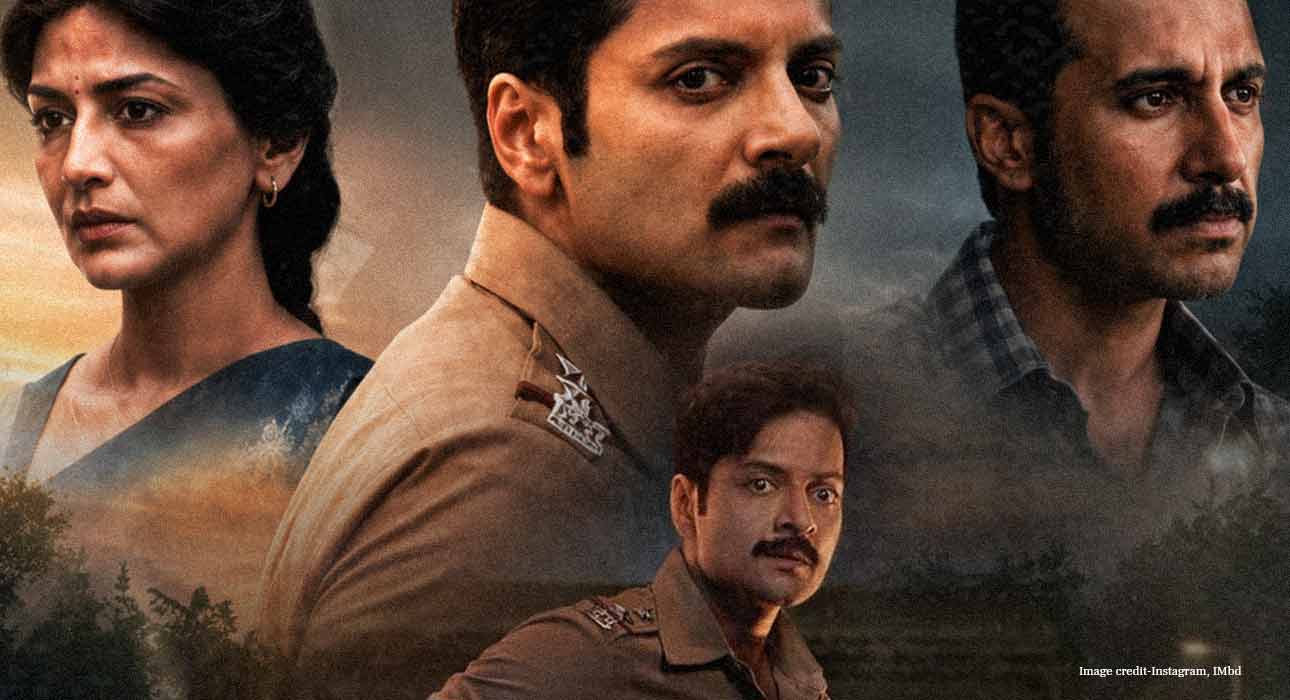
Once a crime is committed, it never fades. Whenever we think of crime, we think of the act itself, the police investigation, the arrest and the verdict, but does it really end there? It never does. The survivors continue to grieve, the families continue to mourn, and communities silently develop fear: What if it happens to us?
Amazon Prime’s Raakh (2026) is an 8-episode web series, inspired by the infamous 1978 Ranga-Billa case. The web series reminds the viewers that the deepest consequences of crime are often psychological rather than physical. The series does not provide the standard entertainment to the audience by emphasising suspense and climax alone; rather, it remarks on the more unsettling question: What does violence do to one?
Crime Shatters the Illusion Society Lives In
Most people live knowing they are safe in their known places. The unspoken belief of the world around us being safe and terrible things existing but happening elsewhere makes one believe that the familiar streets are safer. However, traumatic events shatter this belief of an individual and expose them to a world that seems unpredictable to them (Janoff-Bulman, 1992).
This psychological disruption lies at the heart of the web series Raakh (2026). The innocence of the two young siblings results in their horrifying plight. The tragedy not only affects the lives of the victims’ families but also alters how people perceive everyday risks. The drama remarks on how an incident can leave a deep impact on the beliefs of communities and change the way they experience safety. Something which once seemed ordinary becomes threatening, and what once seemed to be safe and trustworthy becomes uncertain (Jannof Bulman, 1992).
Read More: Understanding The Psychology Behind Crime
The Family Continues to Grieve Even After the Justice Is Served
Raakh (2026) does not reduce the victims to a mere number. The series highlights how every crime leaves people with a feeling of emptiness. Traumatic loss involves helplessness, memories and questions which remain unanswered (Herman, 2015). Throughout the series, the victims’ parents are haunted by unanswerable questions like:
- Couldn’t the incident be avoided?
- How must the children have felt when it happened to them?
- Were there any warning signs?
Individuals who experience traumatic loss often have such thoughts, which potentially contribute to their prolonged psychological distress (Herman, 2015). The portrayal of the victims’ families is one of the most emotionally devastating parts of the series Raakh (2026). The grief experienced by the family goes beyond mourning; it becomes a struggle to understand and accept the reality. In the series, when the verdict is passed against the criminals, the entire courtroom applauds the decision while the victims’ parents sit in silence with negligible expression. This powerful portrayal highlights the void feeling within them. This will continue to live with them, although the file of the crime was closed now.
The Silent Burden that Every Investigator Must Carry
Often, both in real life and dramas, investigators are considered to be emotionally detached professionals who solve the case, arrest the guilty and move on. However, the reality is different. Repeated exposure to suffering does have significant psychological consequences. Studies have demonstrated that individuals working closely with trauma survivors, like police officers, therapists and emergency responders, do experience an emotional impact due to the incident. This is termed the concept of secondary traumatic stress (Figley, 1995).
In the series Raakh (2026) the series skilfully portrays the concept of secondary traumatic stress. As the investigation proceeds, the case becomes an emotional burden for the investigators. Every piece of evidence acts like a reminder of the horrifying crime, which leaves a psychological imprint. Through a powerful portrayal and outstanding performances, the series Raakh (2026) has shown that sometimes arresting the criminals of the crime does not erase the emotional cost of witnessing it.
Read More: Somatic Experiencing and Body-Based Trauma Therapy for Survivors of Known-Perpetrator Abuse
Understanding the Unjustifiable Criminal Mindset
One of the most challenging topics in psychology is to understand the origin of criminal behaviour. The violent nature is a complex outcome of various environmental, developmental and psychological factors (Andrews & Bonta, 2010).
The series explores the complexity behind criminal behaviour. While most dramas portray criminals as monsters, Raakh (2026) presents them as human beings who make the choice. It is important to know that understanding the criminal behaviour is not the same as justifying the act. The series forces the viewers to look beyond the simple notion of good and evil and makes the audience realise that violence is a combination of personal choice and social influence (Andrews & Bonta, 2010).
Evil Remains Unrecognisable
The most unsettling and horrifying conclusion that Raakh (2006) presents is that evil is unidentifiable. The criminals in the series are not supernatural but humans who reside in the same society as everyone else, and they cannot be distinctly identified (Arendt, 1963; Zimbardo, 2007, Chapters 12 and 13). As the series proceeds, it illustrates how the occurrence of a crime affects the way people communicate with each other, their trust and their sense of safety (Herman, 2015).
Read More: Revolving Door Justice in India: Understanding Juvenile Re-Entry and Recidivism
Conclusion
Raakh (2026) has had a unique approach of exploring the psychological impact of the violence on the people directly or indirectly connected to the case. Studies suggest that traumatic experiences, such as a violent crime, often affect the way society interprets their safety and justice (Alexander et al., 2004). Raakh (2026) is inspired by a real-life tragedy, and the series illustrates how society remembers the violent act and how it affects their beliefs (Alexander et al., 2004). While the justice might be served, the emotional consequences are perennial.
In the end, Raakh (2026) is a well-portrayed, weighted crime series that goes beyond the crime and puts forward to the viewers how a single incident can affect communities. The audience ponders the fragile belief of living in a safe world. The series speaks of the ashes that continue to remain long after the flames have disappeared.
References +
- Arendt, H. (1963). Eichmann in Jerusalem: A report on the banality of evil. Viking Press.
- Janoff-Bulman, R. (1992). Shattered assumptions: Towards a new psychology of trauma. Free Press.
- Figley, C. R. (Ed.). (1995). Compassion fatigue: Coping with secondary traumatic stress disorder in those who treat the traumatized. Brunner/Mazel.
- Alexander, J. C., Eyerman, R., Giesen, B., Smelser, N. J., & Sztompka, P. (2004). Cultural trauma and collective identity. University of California Press.
- Bonanno, G. A. (2004). Loss, trauma, and human resilience: Have we underestimated the human capacity to thrive after extremely aversive events? American Psychologist, 59(1), 20– 28.
- Zimbardo, P. G. (2007). The Lucifer effect: Understanding how good people turn evil. Random House.
- Carlsmith, K. M., Wilson, T. D., & Gilbert, D. T. (2008). The paradoxical consequences of revenge. Journal of Personality and Social Psychology, 95(6), 1316–1324.
- Andrews, D. A., & Bonta, J. (2010). The psychology of criminal conduct (5th ed.). LexisNexis.
- Herman, J. L. (2015). Trauma and recovery: The aftermath of violence—From domestic abuse to political terror (2nd ed.). Basic Books. (Original work published 1992)


Leave feedback about this