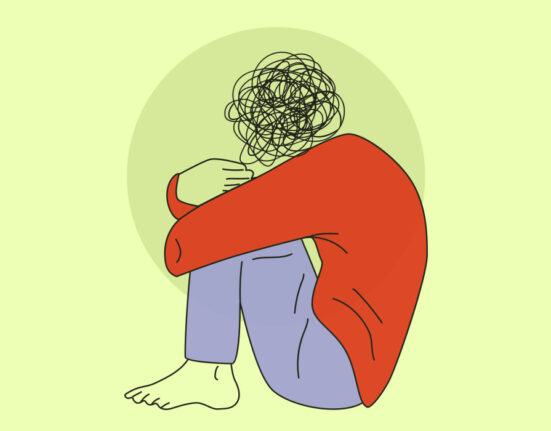


A different view sits quietly behind old beliefs about disability. Inside each person labelled broken, life often just moves at its own pace. Fixing isn’t always the answer when stairs block doors meant for wheels. Barriers rise less from bodies than from sidewalks without ramps. Imagine a classroom where silence is mistaken for the absence of thought. Curbs matter more than chromosomes when access gets denied. Some minds work differently, yet demand equal space just the same. Exclusion grows not from diagnosis, but from refusal to adapt. Buildings speak louder than doctors when entry is impossible. The problem does not lie in speech delayed, but in ears unwilling to listen. Change stirs only once walls shift, not people.
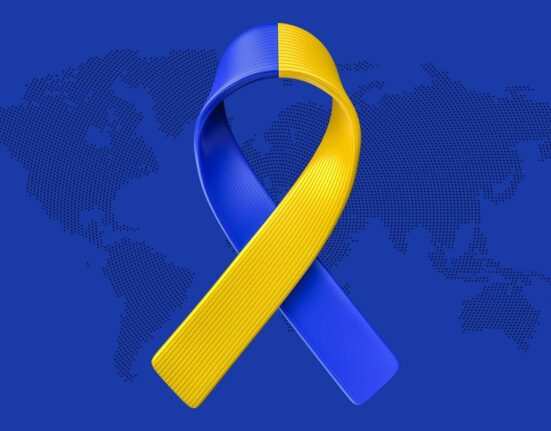
One extra piece of chromosome 21 leads to Down syndrome, usually bringing slower development and some medical issues. That reality makes many fixate on limitations first, overlooking the person behind them. But that view feels incomplete, and honestly, unfair. Across the world, individuals with Down syndrome are slowly, but powerfully changing what we think ability looks like. Not by “overcoming” their condition, but simply by being given the chance to exist beyond it (Centres for Disease Control and Prevention, 2023; World Health Organisation, 2022)
When examining their paths, a single truth stands out. Talent exists in every corner. Chances do not show up equally.
Read More: Down Syndrome: A Guide to Symptoms and Treatments
Breaking Stereotypes By Achieving
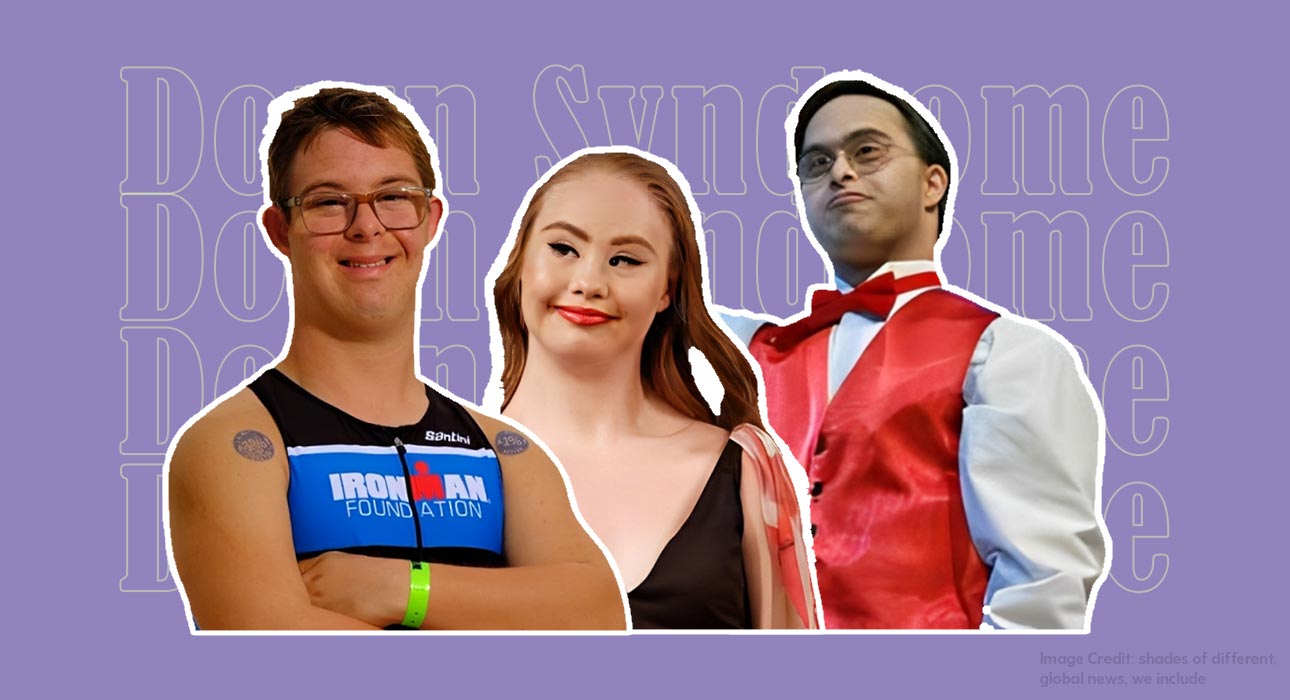
Picture someone like Chris Nikic, who became the first with Down syndrome to finish an Ironman race. That moment changed more than his own life; perceptions around grit and stamina began to shift, too. The path didn’t explode overnight nor arrive with fanfare. Progress stacked slowly: tiny gains piling up, steady work showing up daily, help from those who valued growth far beyond flawless results (Special Olympics, 2020)
Madeline Stuart entered fashion, a world long strict about looks, with quiet determination. With her mom by her side, she focused on strength, shaped her photoshoots carefully, then began claiming room where few thought possible. Now she moves across global catwalks, not to make a point, yet simply because she earns her place (Disability Horizons, 2025).
Music shaped Sujeet Desai’s life from the start. Though born into rhythm, effort filled the gaps talent left open. Because support showed up, lessons began, practice deepened, and confidence grew. Instead of fading, curiosity turned into skill through steady guidance. While many drift away, he kept moving forward, note by note. Later, stages far beyond home welcomed his sound, even one inside the United Nations (Global Down Syndrome Foundation, n.d.)
We often call such stories “inspirational,” but that word can sometimes be misleading. It makes these journeys feel rare, almost unreachable. But maybe they aren’t. Maybe they simply show what happens when the right support meets existing potential.
The Role of Support Systems
Something always backed each journey. Not far behind stood parents betting on hope rather than borders. Classrooms shifted shape, refusing to turn kids away. Places opened up room, no blocking, just breathing. Helping here does not mean taking over every task. What matters is setting up situations so people find their own way. From the start, learning environments that include everyone, plus chances to grow abilities, fit together like parts of a whole. Not add-ons. Necessary ground. (American Academy of Paediatrics, 2022)
Starting, parents usually step into advocacy without warning. When systems expect too little from their kids, they respond by pushing back. Access to regular classrooms becomes a battle some must win. Seeing the child beyond labels matters most in the long run.
Educators play an equally important role. A well-supported inclusive classroom doesn’t just benefit one child; it changes how every student understands difference (UNESCO, 2020). But inclusion cannot exist in theory alone. If there are no skilled educators, adaptable approaches to instruction, or suitable facilities, the effort might turn into a gesture without substance.
Read More: Empathy in Action: Helping Children Navigate Big Emotions
Resources and opportunities shape outcomes
Success tales draw applause without effort. Yet silence often follows those denied a shot at the beginning. Access is uneven. Out here, getting help before problems grow means luck plays a big role. Where you’re born decides if clinics show up on your map or vanish into silence. Some villages wait years for a trained counsellor; others never see one at all. Missed chances pile up quietly when schools lack tools to spot struggles early. Support fades where roads stop, and budgets shrink. Hidden strength stays locked without keys, like access, awareness, and timing.
What you get a chance to do weighs just as heavily. Because ability needs space to be seen. Whether it’s in sports, arts, education, or employment, exclusion often has less to do with capability and more to do with access. When institutions actively include, through hiring, training, and representation, they don’t just change individual lives (International Labour Organisation [ILO], 2024). They slowly reshape what society sees as “normal.”
Read More: Together Against Loneliness: World Down Syndrome Day
Moving Beyond Inspiration to Inclusion
There’s a shift we need to make, subtle, but important. From admiring individuals to actually changing systems. From seeing these stories as exceptions to making them more common. Even the way we speak matters. Phrases like “suffering from” or “burden” quietly reinforce stigma (World Health Organisation [WHO], 2011). On the other hand, constantly framing people as “overcoming” their disability can also feel limiting, as if their existence is something to fight against.
A fresh view on disability comes from the social model. Not just health issues hold people back, but also stairs without ramps, quick judgments, and closed doors. When sidewalks rise to meet wheels, when voices are heard not doubted, more becomes possible. Walls built by society tend to shrink when we rethink how spaces work. (Michael Oliver, 1990)
Conclusion
Every time a person with Down syndrome hits a goal, it isn’t a chance. It shows what opens up when care takes the place of looking away. Such times reveal that ability doesn’t come set in stone; instead, it grows from the spaces they’re allowed to move through. What matters most isn’t how fast you go or if you hit expected milestones. Access shapes success instead, learning, care, chances, and room to live without barriers. With those pieces in place, limits start to bend where they once held firm.
Someone isn’t solely to blame. Shaping belonging falls on the places people move through each day, like classrooms or offices – where fairness just shows up, without fanfare. Maybe the real hurdle wasn’t the added chromosome at all, just the walls grown up around it. Shift those, then every piece after starts shifting too.
References +
Bull, M. J., Trotter, T., Santoro, S. L., Christensen, C., & Grout, R. W. (2022). Health supervision for children and adolescents with Down syndrome. Pediatrics, 149(5). https://doi.org/10.1542/peds.2022-057010
Centres for Disease Control and Prevention (CDC). (2024, December 26). Down Syndrome. Birth Defects; CDC. https://www.cdc.gov/birth-defects/about/down-syndrome.html
Disability Inclusion | World Bank Group. (2026). Worldbank.org. https://www.worldbank.org/ext/en/topic/social-development/disability-inclusion How Chris Nikic Made History. (2021, May 5). SpecialOlympics.org.
https://www.specialolympics.org/how-chris-nikic-made-history
International Labour Organisation. (2024, January 28). Disability and work. International Labour Organisation. https://www.ilo.org/topics-and-sectors/disability-and-work
Oliver, M. (1990). The Politics of Disablement — New Social Movements. The Politics of Disablement, 112–131. https://doi.org/10.1007/978-1-349-20895-1_8
Purcell, E. (2025, February 4). Madeline Stuart: diversity advocate and the world’s first Down syndrome model. Disability Horizons. https://disabilityhorizons.com/2025/02/madeline-stuart-we speak-to-the-downs-syndrome-disabled-model-and-diversity-advocate/
Sujeet Desai | Adults with Down Syndrome Task Force. (n.d.). Global Down Syndrome Foundation. https://www.globaldownsyndrome.org/our-story/leadership/adults-with-down-syndrome-task force/sujeet-desai/
UNESCO. (2022, April 21). 2020 GEM REPORT ANIMATION. Unesco.org. https://www.unesco.org/gem-report/en/publication/inclusion-and-education
Vygotsky, L. S. (1978). Mind in Society: Development of Higher Psychological Processes. In JSTOR. Harvard University Press. https://www.jstor.org/stable/j.ctvjf9vz4
World Health Organisation. (2011). World Report on Disability. World Health Organisation. https://www.who.int/teams/noncommunicable-diseases/sensory-functions-disability-and-rehabilitation/World Report on Disability