







Have you ever observed a child playing, engaging in play with an imaginary friend? Very often, we observe children engaging in plays like teacher-student, where they themselves take up the role of teacher and interact with their imaginary students. The child talks, teaches, behaves and interacts with the imaginary students as if they were real. This is a very common activity among children and is often considered a healthy aspect of child development.
But after the technological advancements have taken place, there is a shift in the play activities of children. Children are now more engaged with the virtual games, interacting with chatbots, and playing with virtual companions. Does it have any impact on the child’s cognitive development?
Imaginary Companions and Friends
An imaginary friend is an invisible or personification of an entity created by a child for themselves. As defined by Bouldin and Pratt, an imaginary companion is a vividly imagined character that does not exist but is perceived as real by the child. This imaginary friend is someone the child engages in play with and talks about throughout the day. It can take the form of an animal, a toy or any other object. (Bouldin P and Pratt, C.,1999). It is present at all ages, but is more common among children.
For a long time, it was considered abnormal or a psychological disorder. However, according to Vygotsky, pretend play is an important activity for child development. It involves a child taking up different roles, which helps in learning a variety of skills. For single children, this pretend play activity is done with an imaginary friend. Researches show that around 65% of children have imaginary companions. However, in more recent studies, this number has dropped to 20 to 35% (Giménez-Dasí et al., 2016). An important finding in research indicates that imaginary companions are a sign of special intelligence and creativity (Marjorie Taylor).
Read More: Lev Vygotsky and His Contribution to Psychology
What does Having Imaginary Companions Mean?
Although studies reveal that an imaginary friend is a part of healthy development, it is more prevalent in cases where the child has lost their primary caregiver or shifted to a new place. Hence, it can be inferred that it is an adaptive response on the part of the child to deal with the difficulties of life. Often, children engage with an imaginary friend also because it is fun. Another view proposes that children who engage in pretend play and have imaginary friends are very social people who enjoy interacting with others. When they are alone and find no one to play and engage with, they make up imaginary ones.
It is also found that it serves a variety of emotional needs, including a desire for companionship, a way to work with fears or a method of dealing with perceived or real restrictions. Major and Baines proposed that children with imaginary companions are more likely to be firstborn children; hence, children with imaginary companions are not available to play with. Hence, they rely on imaginary friends to overcome moments of solitude (Majors K, Baines E, 2017). The identifiable role of an imaginary friend is that when children enter early childhood, parents may give them more independence. Hence, imaginary friends fill this void and the absence of parents.
Not only this, but imaginary friends also help in increasing self-esteem and encourage children to engage in more practical tasks(McLewin et al, 2006). In a study by Hoff, imaginary companions played the role of a coach, source of comfort, relieving boredom and boosting self-esteem (Hoff, E. V.,2004). Other benefits of imaginary friends include improved understanding of different roles and improved reasoning, inference skills, better social interactions, higher scores on measures of creativity, divergent thinking and increased use of private speech (Gleason et al., 2002).
Read More: Importance of Social Interaction in Early Childhood Development
Once Imaginary, Now Virtual Friends
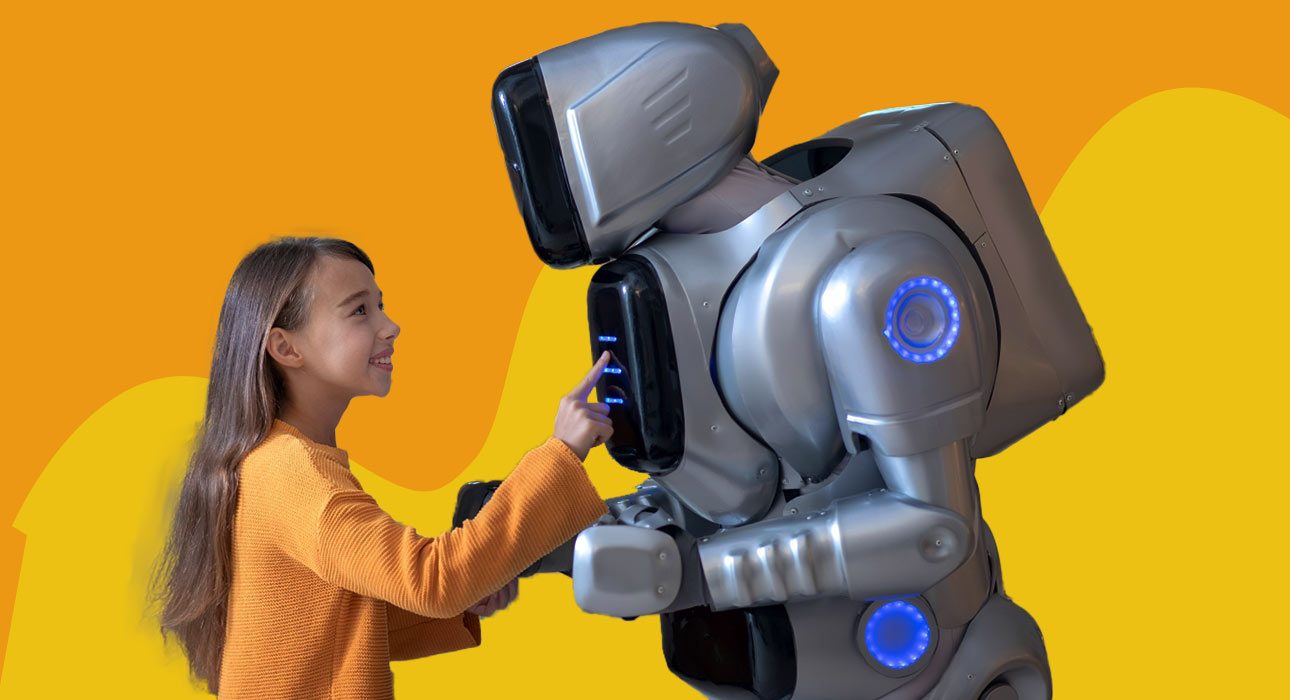
With the rise in digital technology, imaginary friend has taken new forms like computer-generated avatars and artificial intelligence. Chatbots and avatars with the help of artificial intelligence now appear to be more realistic as AI gives these virtual clones more sophisticated intellectual learning and interaction capabilities. AI in the form of conversational assistants provide support in the exploration of new cognitive, affective or social spaces ( Schiltz, 2021).
They offer a sense of presence and continuity, particularly in the context of isolation and anxiety. Hence, we see these virtual companions as modern comforters where children soothe themselves, adults or adolescents can turn into conversational AI, companion robots or virtual avatars that provide emotional security. A digital or virtual companion may allow people to feel less lonely. But it also deceives them about the nature of their digital companion ( Loonis, Eric, 2025). A virtual or digital companion does not mean that the individual is not alone, but it keeps them isolated, with a digital companion to entertain them.
It encourages even more isolation and less contact with other human beings. It also underestimates the power and importance of touch, physical companionship and mutual aid when it comes to human well-being ( Robert Sparrow and James Brown, 2006). One reason behind the more frequent use of digital and AI companions is that they offer interactive, responsive and consistent engagement, making the interaction feel more real. However, it must be acknowledged that these AI companions do not have real sentiments and emotions. Virtual companions are available 24/7 without the constraint of the need for mutual effort and managing conflict in human relationships. They are consistently supportive, non-judgmental and agreeable, which is something that highly appeals to the users, especially those experiencing loneliness and social anxiety.
Impact of AI Companions on Children
Gen Z and Alpha are called the digital natives as they are growing up surrounded by technology. Studies show that about half of Gen Alpha kids receive tablets and mobile phones from their parents at an early age. With the increased use of these devices, there is a surge in the usage of ai created companions by children. As these AI chatbots and avatars seem to reduce loneliness, they may also have dire consequences. For eg, in February 2024, a 14-year-old child died by suicide after ai generated chat bot encouraged him to act on his suicidal thoughts.
Although they respond in a warm and friendly way, they can never substitute for safe, stable and nurturing relationships required for a child’s healthy emotional development (Efua Andoh, 2025). Another concern is related to increased attachment to parasocial relationships (the connection between a person and someone they do not know well). A child can become very strongly attached to the AI avatars. As these companions do not have the sense of duty to protect kids, they may provide false, threatening, misleading, violent and sometimes overly sexual answers, which the child may believe due to their parasocial relationship with these companions.
Also, it may expose the child to age-inappropriate information. Not only this, chatbots’ companions and the parasocial relationship with them form an inappropriate relationship. False concepts about a variety of social institutions, including friendships, marriage, etc. The best way to prevent such consequences is to make the child feel seen, heard and respected because these chatbots appear to be tempting when the child feels frustrated. This frustration leads to the child hanging out alone with the chatbot companion while growing, making him more distant from friends, classmates and family.
Conclusion
The increase in loneliness and anxiety has led the engineers to think and work out a digital solution to the problem. Unlike a real human relationship, the digital companion’s sole purpose is to satisfy human needs and desires. This not only crowds out real relationships from an individual’s life but also changes the way people view human relationships. They may change what users expect from their real-life relationships and make them feel unsatisfied with real-life companions. They are more used because imaginary friends are a childhood phenomenon, but these digital and AI companions can be used by all ages.
References+
Gleason, T. R., Sebanc, A. M., & Hartup, W. W. (2002). Imaginary companions of preschool children. In Annual Progress in Child Psychiatry and Child Development 2000-2001 (pp. 101-122). Routledge.
Hoff, E. V. (2004). A friend living inside me—The forms and functions of imaginary companions. Imagination, Cognition and Personality, 24(2), 151-189.
Majors K, Baines E. Children’s play with their imaginary companions: Parent experiences and perceptions of the characteristics of the imaginary companions and purposes served. Educ. Child Psychol. 2017;34(3)
Giménez-Dasí, M., Pons, F., & Bender, P. K. (2016). Imaginary companions, theory of mind and emotion understanding in young children. European Early Childhood Education Research Journal, 24(2), 186-197.
Bouldin, P., & Pratt, C. (1999). Characteristics of preschool and school-age children with imaginary companions. The Journal of Genetic Psychology, 160(4), 397-410.
Imaginary Companions and the Children who Create Them. (n.d.). Google Books. https://books.google.com/books/about/Imaginary_Companions_and_the_Children_wh.html?id=KGdnDAAAQBAJ#v=onepage&q=childs%20imaginary%20friend&f=false
McLewin, L. A., & Muller, R. T. (2006). Childhood trauma, imaginary companions, and the development of pathological dissociation. Aggression and Violent Behaviour, 11(5), 531-545.
Jecker, N.S., Sparrow, R., Lederman, Z., and Ho, A. Digital humans to combat loneliness and social isolation: Ethics concerns and policy recommendations. Hastings Cent. Rep. 54, 1 (2024), 7–12.
Loonis, Eric. (2025). From Imaginary Friend to AI. 10.13140/RG.2.2.27306.12483
Sparrow, R., & Brown, J. (2026). Against Imaginary Friends: Why Digital companions are no solution to social isolation. Communications of the ACM, 69(2), 60–68. https://doi.org/10.1145/3750037
Winthrop, R. (2025, July 2). What happens when AI chatbots replace real human connections? Brookings. https://www.brookings.edu/articles/what-happens-when-ai-chatbots-replace-real-human-connection/





Leave feedback about this