






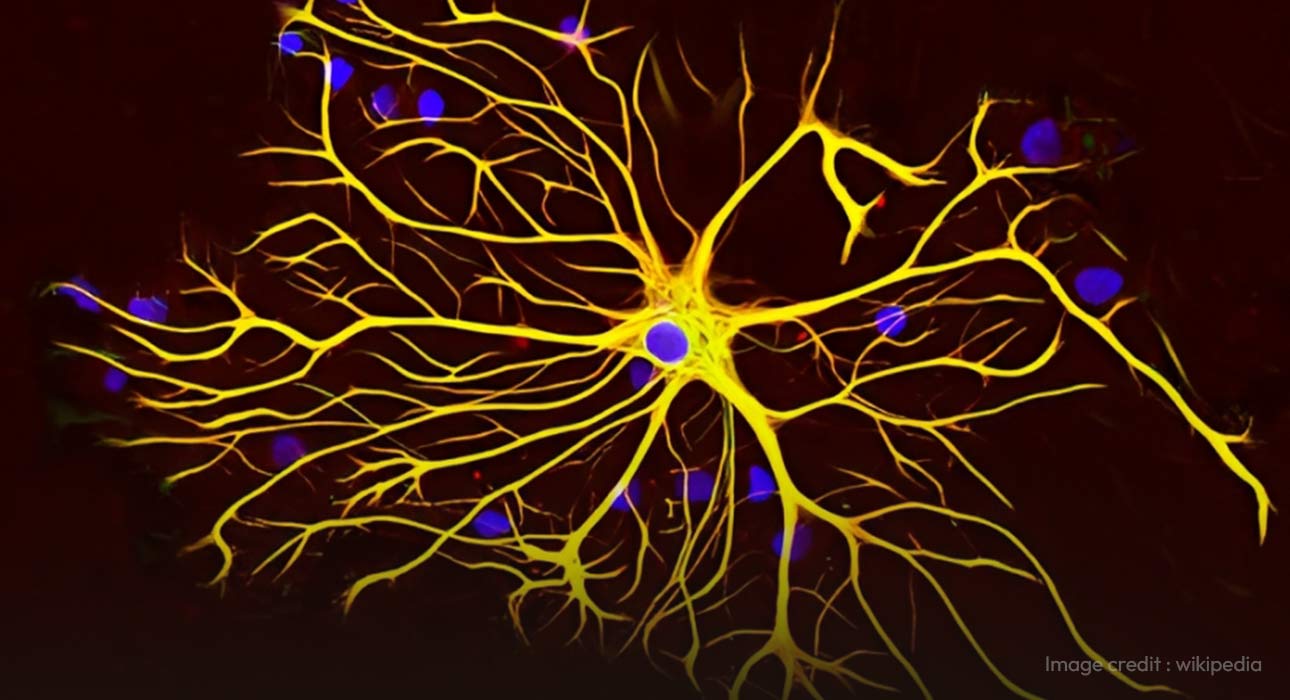
The adult mammalian brain has been thought to have a very poor ability to regenerate cells in the aftermath of damage by disease or injury. This is especially critical for the function of astrocytes (a type of star-shaped glial cell), which form supportive structures for neurons through various mechanisms that regulate their nutrient and oxygen supply, chemical conditions, and electrical environment. The loss of astrocytes may lead to collapse of the local environment even if the neurons are still intact.
A new study from the University of Zurich calls into question the idea that mature networks of astrocytes cannot be substantially regenerated. Researchers discovered that in mouse models of a specific focal loss of astrocytes, a specialised mechanism of regeneration occurs when existing, nearby astrocytes migrate to occupy and repopulate the injured area. The discovery could revolutionise the scientific conception of what kind of recovery is possible following brain injury or astrocyte-specific autoimmune disease.
Role of Astrocytes in Supporting Neurons
The term “support cells” used to describe astrocytes may actually downplay the role. They do assist in metabolic support to the neuron, control blood flow in a local area by covering blood vessels with end-feet, buffer ion concentrations, and promote tonic communication at the synapse. As such, loss of astrocytes can disrupt the general environment for the survival and function of a neuron.
Astrocytes frequently become activated after central nervous system injury, becoming activated, altering shape and changing gene expression, and mediating site containment. Until now, however, their potential was viewed with some doubt, particularly their ability to create new astrocyte networks in the adult brain to replace lost sites. The main idea in this paper is to show that certain mature astrocytes possess the ability to take on more regenerative, progenitor-like properties in the case of circumscribed loss of local astrocytes, to the point that they are doing more than merely reacting at the site of the injury periphery; they’re rebuilding the vacant terrain.
This concept will be important in, for example, the context of an autoimmune disease called neuromyelitis optica spectrum disorder (NMOSD), in which the body’s immune system, via antibodies, attacks aquaporin-4, a protein highly enriched in astrocytes. In fact, inflammation or injury following conditions such as stroke, traumatic brain injury, and inflammatory disease might damage the astrocyte network. The task of restoring local brain homeostatic balance after injury could involve making sure the astrocyte network can be reconstructed.
Experimental design
This work by Bruno Weber’s group at the University of Zurich has analysed the consequences in the somatosensory cortex of a focal loss of astrogliosis. An animal model in which astrocytosis was induced by aquaporin-4 antibody-mediated ablation of astrocytic cells; the implications for astrocytopathy, such as in NMOSD, are clear.
The researchers coupled longitudinal in vivo two-photon microscopy with spatiotemporal transcriptional mapping. The two-photon microscopy images tracked changes in astrocyte morphology and movement, as well as their migration patterns, at multiple time points throughout the weeks of repair in live mouse brains. With the genetic mapping, they determined which gene programs were most active within cells during the repair process.
But their goal wasn’t to see whether astrocytes get excited by an injury. It was about how the adult brain regenerates an astrocyte network when one defined spot no longer contains any astrocytes. This matters because in broader tissue injury, one may see scar tissue and inflammation. Whereas here, removing only astrocytes would demonstrate how the neighbour’s astrocytes adapt when a neighbouring compartment is vacant.
How astrocytes are involved in the recovery process after a lesion
It revealed a pervasive remodelling response in the astrocytes at the edge of the lesions. These perilesional astrocytes divided rapidly, their processes encroached into the lesion, and they slowly repopulated areas formerly devoid of astrocytes.
An interesting finding that stood out among the data was that the astrocytes in those injured parts didn’t seem to rely just on larger entire astrocytes “walking” to the injury. Rather, novel “daughter” nuclei were moving relatively long distances through relatively long extensions of the mother astrocyte processes; in a way, it felt like the whole astrocyte seemed to extend its cell body (represented by the stretched nucleus) into the injury and then used those processes to shuffle daughter nuclei into their own new territory.
Researchers noted a sustained multinucleated state. This implies an unexpected cellular strategy for regeneration in that a fully grown astrocyte appeared to split into daughter cells that temporarily could retain multiple nuclei, extend processes towards the injury, and reposition their daughter nuclei into unused space elsewhere in the tissue, rather than the scenario of cells splitting near the original cell.
Molecularly, spatially transcriptomic studies at the molecular level have identified transient changes in expression in genes associated with injury. But most of those effects decreased along with rebuilding astrocyte networks, indicating that a “regenerative” state was indeed labile. In essence, the results link macroscopic structural rebuilding with the rebuilding of cellular gene regulatory networks.
Because the study did not quantify psychological results, behaviours, cognition, or clinical recovery in human patients, its merit is mechanistic. It pinpoints a cellular mechanism that, although it does not assess the recovery of function directly, might play a role in recovery by regenerating the astrocyte support infrastructure, which is indispensable for functional neuronal activity.
Author’s insights
The authors take their data to show that the adult mammalian brain can do far more by way of astrocyte-network repair than people previously knew. It seems that as astrocytes mature and specialise in maintenance, some can also switch on a repair mode that looks and functions like progenitor cells do in some contexts, provided that only a small local group of astrocytes die.
It is crucial to note that not all brain injury or neuroimmune disease is thus readily reversible. The research was carried out in mice; it studied only one type of focal astrocyte ablation and observed cellular regeneration, not full restitution of complex human brain functions. Further studies on other disease models and subsequent trials in human tissue and clinical situations are necessary in order to progress towards clinical treatment.
Still, the researchers acknowledge that the genes activated and pathways turned on in astrocyte networks following repair might suggest targets for later therapeutic development. If they could figure out how to bolster this regenerative astrocyte response without triggering potentially problematic side effects, they may someday be able to bolster regeneration of damaged astrocyte networks in cases of traumatic injury or in the context of losing astrocytes to autoimmunity, offering a treatment to be used along with those targeting neurons, inflammation, and the immune system.
Conclusion
The study shows that the boundaries formed by adult astrocytes to surround injury sites don’t have to be just scar tissue. In live mice, other specialised astrocytes bordering a lesion proliferated and reached into this area, moving recently divided nuclei through long structures called processes and using them to reform areas of lost astrocytes. In fact, the critical implication is that loss of astrocytes isn’t always a loss for the support system of the brain in an adult animal. Researchers have provided a new source for glial support following injury, another avenue for therapy for NMOSD, for brains subject to injury, and for therapy restoring balance in local brain networks.
References +
- Neuroscience News. (2026, August 10). Regenerative astrocytes repair brain damage. Neuroscience News. https://neurosciencenews.com/regenerative-astrocytes-brain-repair-31204/
- Herwerth, M., Wyss, M. T., Schmid, N. B., Condrau, J., Ravotto, L., Mateos Melero, J. M., Kaech, A., Bredell, G., Thomas, C., Stadelmann, C., Misgeld, T., Bennett, J. L., Saab, A. S., Jessberger, S., & Weber, B. (2024). Astrocytes adopt a progenitor-like migratory strategy for regeneration in adult brain bio. Rxiv: The Preprint Server for Biology, 2024.05.18.594292. https://doi.org/10.1101/2024.05.18.594292
- The adult brain can repair itself better than scientists thought. (2026). ScienceDaily. https://www.sciencedaily.com/releases/2026/08/260812015158.htm
- Hanks, M. (2026, August 12). Secret self-healing powers of the brain revealed in landmark study, upending past thinking on adult brain’s regenerative abilities. The Debrief. https://thedebrief.org/secret-self-healing-powers-of-the-brain-revealed-in-landmark-study-upe nding-past-thinking-on-adult-brains-regenerative-abilities/
- Weber, Prof. Dr B. W. (2026, August 10). The brain possesses greater self-repair capacity than previously assumed. News.Uzh.Ch. https://www.news.uzh.ch/en/articles/media/2026/regenerative-astrocytes.html
- Collyer, E., & Blanco-Suarez, E. (2023). Astrocytes in stroke-induced neurodegeneration: A timeline. Frontiers in Molecular Medicine, 3. https://doi.org/10.3389/fmmed.2023.1240862 7.
- Chiareli, R. A., Carvalho, G. A., Marques, B. L., Mota, L. S., Oliveira-Lima, O. C., Gomes, R. M., Birbrair, A.,Gomez, R. S., Simão, F., Klempin, F., Leist, M., & Pinto, M. C. X. (2021). The role of astrocytes in the neurorepair process. Frontiers in Cell and Developmental Biology, 9. https://doi.org/10.3389/fcell.2021.665795
- Tan, R., Haseloff, R. F., Mo, Y., & Zhang, J. (2023). In situ neuronal regeneration: The potential of astrocytes. Life Medicine, 2(5), lnad036. https://pmc.ncbi.nlm.nih.gov/articles/PMC11749267/
- Alhadidi, Q. M., Bahader, G. A., Oiva Arvola, Kitchen, P., Shah, Z. A., & Salman, M. M. (2023). Astrocytes in functional recovery following central nervous system injuries. The Journal of Physiology. https://doi.org/10.1113/jp284197
- Peng, Z., Lu, H., Yang, Q., & Xie, Q. (2022). Astrocyte reprogramming in stroke: Opportunities and challenges. Frontiers in Aging Neuroscience, 14. https://doi.org/10.3389/fnagi.2022.885707



Leave feedback about this