







Sheetal is a 21-year-old B.Tech graduate student. She is currently in her 4th year and is focused on bagging a placement. Twelve companies have already completed their interview for the placements, out of which Sheetal was not even eligible for 4 interviews and has not performed well in the rest of them. Yesterday, when she was on a phone call with her parents, she received the bad news that her parents have decided to split after 24 years of marriage.
Today, while she was in a lift, she felt a sudden restlessness. She tried to hold the handle only to realise that her hands were shaking. She had a panic attack. Not just Sheetal, but many people face this, where they have insight into their issues but are stuck there, and they don’t know how to move forward. The article further discusses why one panics
What is a Panic Attack?
Panic Attacks consist mainly of the following four symptoms: heart palpitations, Shortness of breath, Chest pain, Dizziness, Trembling, Nausea, choking, fear of losing control, fear of dying, chills or heat sensations, Paresthesias, and depersonalization. It starts with a sudden restlessness and fear with an abrupt increase in intensity within a few minutes and can last for up to 30 minutes.
In general, it is common for people to have one or two panic attacks in their whole life under extreme stressful conditions. However, when the frequency of attacks increases up to 4-5 in a year, along with at least one attack followed by roughly ≥ 1 month of persistent worry about future attack, along with maladaptive changes such as avoidance of stressful situations. (Trull, Ebner-Priemer, Brown, Tomko, & Scheiderer, 2012)
Read More: A Guide to Handling Panic Attacks, According to a Psychologist
What is Interoceptive Prediction Error?
Interoception can be broadly defined as the sense of signals originating within the body. It is also responsible for taking into account how people attend to, appraise and respond to these sensations (Vaitl, 1996; Cameron, 2001; Verdejo-Garcia et al., 2012). An interoceptive prediction error occurs when there is a mismatch between what an individual’s brain expects to feel inside their body and the actual signals it receives. In an average person, these minor errors are discarded as noise, while in panic disorder, the brain tends to mark and deal with these errors with precision. This often gets triggered by minor inconveniences, treating them as a priority and, in response, activating the insular cortex.
What is the Insular Cortex?
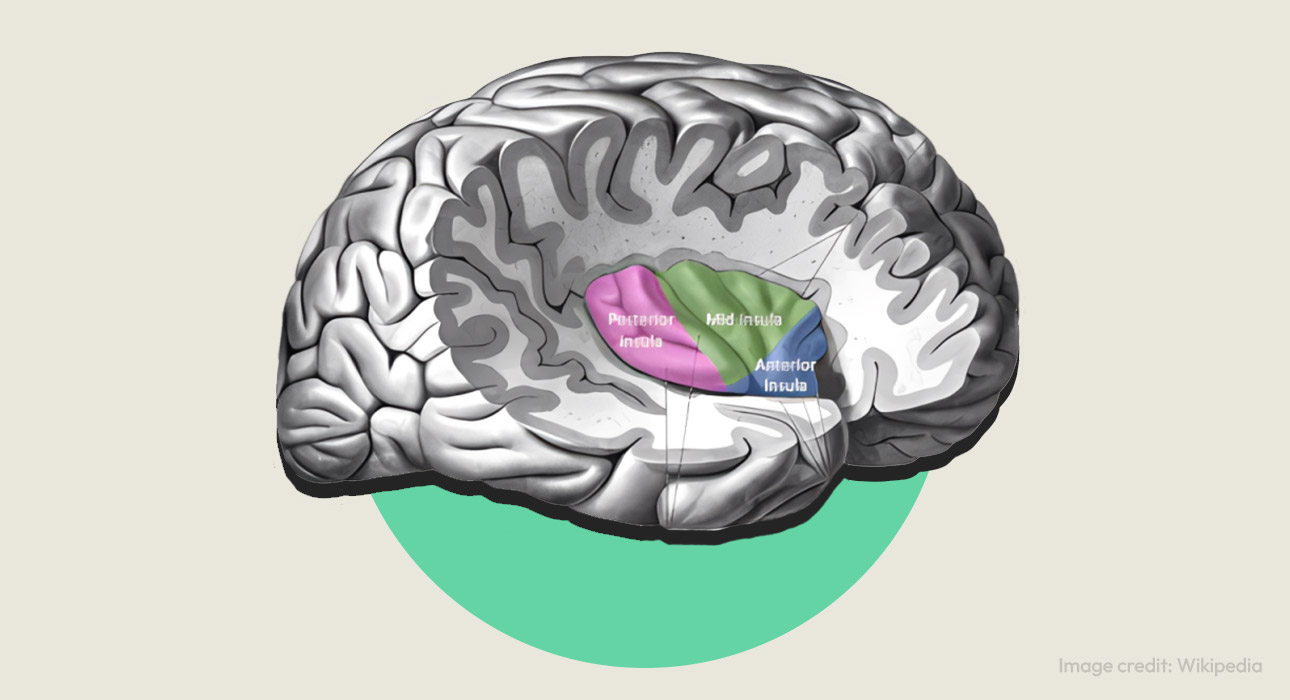
The insular cortex, also known as the insula, plays an important role in various sensory and cognitive processes, such as basic functions including sensory processing, bodily homeostasis, emotions, motivation, and decision-making, along with maladaptive conditions including chronic pain, anxiety, depression, addiction, and eating disorders (Zhang, Deng, & Xiao, 2024). It mainly consists of three parts :
- The anterior insular cortex is associated primarily with emotional processes and cognitive control.
- The medial insular cortex is a less studied region compared to the other two parts. However, it is theorised to play the function of assimilation of the other parts.
- The posterior insular cortex is located close to the primary sensory regions (somatosensory cortices, visual cortex, and auditory cortex). Its function involves sensory processing, primarily exteroception and pain perception. (Zhang, Deng, & Xiao, 2024).
A recent study has shown that activation or inhibition of the insula-BLA (anterior Insular Cortex – basolateral Amygdala) pathway enhances or diminishes the intensity of observational pain. (Zhang, Geng, Chen, Wang, Wang, & Qiu XT, et al 2022)
The Predictive Processing Framework
According to the Predictive Processing model, the brain constantly generates “top-down” predictions about what is happening to the body (interoception). This information is then compared against the”bottom-up” sensory data from the heart, lungs, and gut. Such as
- Prediction: “I am at my home; my heart should be beating at 70 bpm.”
- Sensory Input: The heart beats at 85 bpm due to heavy lifting.
- Prediction Error: The difference between the expected 70 and the actual 85.
In a healthy system, this error is resolved easily.
Like, I have just run a mile, of course, the heart is beating fast.
In Panic Disorder, the system error becomes magnified and hence is not resolved. Research by Donald Klein and later expanded via neuroimaging suggests that individuals suffering from panic disorder have a hypersensitive “CO2 sensor” in the brainstem and insula. Various computational models have shown that these patients have a lower threshold for “prediction errors” related to breathlessness.
Computationally, panic is a “positive feedback cycle” where the brain’s attempt to minimise prediction error actually increases it. By predicting a disaster, the brain prepares the body for one (fight-or-flight), which generates the very sensations the brain was trying to explain, confirming the error as a reality. (Khaleghi, Mohammadi, Shahi, Nasrabadi, 2022)
Read More: Distinguishing Panic Attacks from Heart Conditions
Clinical Implications
Various pharmaceutical drugs like SSRIs and benzodiazepines may help an individual manage their symptoms. They work by reducing sensory input or reducing the “gain” on the prediction error signals in the insula. Though they require a prescription, they might provide a quick solution for urgent situations. Tools that visualise heart rate variability (HRV) help patients align their subjective feelings with objective data, bridging the gap between prediction and reality.
Interoceptive Exposure (CBT) also helps an individual train their mind, and hence, over time, reduces the symptoms. Individuals are made to perform certain activities in a controlled environment. These activities, such as spinning in a chair or breathing through a straw, patients intentionally create prediction errors in a safe environment. Over time, the brain learns to “down-weight” the precision of these signals.
Conclusion
Panic Disorder is a perceptual distortion where the insular cortex makes mistakes while interpreting the body’s state. When the insular cortex assigns excessive importance to minor bodily fluctuations, it creates a high-precision interoceptive prediction error that the brain cannot ignore. The resulting catastrophic appraisal loop is a biological feedback cycle that the brain attempts to “explain” any uncertainty, which actually accelerates the physiological symptoms that create fears.
Through interventions like interoceptive exposure and biofeedback, patients can train their insula and brain to reduce the frequency of the false alarms, eventually teaching the brain to actually distinguish between a major glitch and a minor alarm.
Question Explained by Experts
Question: Can changing thought patterns actually rewire the brain?
According to Clinical Psychologist Shweta Parmar, A panic attack is essentially a prediction error where your brain’s internal monitoring system gets a false alarm. Your brain constantly predicts how your heart, lungs, and stomach should feel; however, in panic disorder, the brain becomes hypersensitive to any mismatch. If your heart rate dips or your breathing shifts slightly, and the brain didn’t “schedule” that sensation, it flags the mismatch as a major emergency. Instead of ignoring the tiny change, the brain over-amplifies it, causing the intense physical surge we recognise as panic.
Clinically, this means the brain is making a catastrophic guess to explain a harmless sensation. Because it cannot find an immediate reason for the physical change, it assumes the worst—like a heart attack or a loss of control. Therapy works by retraining the brain to “expect” these sensations again. By repeatedly experiencing these feelings in a safe environment, you update the brain’s data, teaching the internal forecaster that these physical shifts are normal and don’t require an emergency response.
Question: How can friends or family support someone experiencing panic attacks?
According to Counselling Psychologist & Psychotherapist Dr Navya Pande, if family members are sure that it is a panic attack, and medical factors have been ruled out by previous investigations, the most important thing they can offer is a calm and safe presence. Sometimes, an observer might raise their voice, change their tone or body language just because they want the other person to calm down or because they are concerned, but this is an absolute ‘no-no.’ A person experiencing panic is very sensitive to external cues, and any such change in voice or body language can be perceived as threatening. Instead, they should remain calm and remind the person that they are safe and not alone. That’s the most important thing that they can do.
The family member might say something like: ‘I understand that this feels really unpleasant right now, but remember that it will pass. Anxiety comes in waves. I know it feels very real and uncomfortable, but this is just your brain misinterpreting your body’s signals. Please tell me what you need or how I can support you right now.’ The family members or friends can also say- ‘Would you like to try some gentle breathing with longer exhales? We can do it together. There’s no hurry… just gently.’
Family members can also encourage the person to scan their physical environment for cues of safety. They might help the person to focus on natural elements like trees, plants, or water. If the person experiences a panic attack while they are indoors, the family member may help them to slowly scan the whole room by looking at a distance and noticing the objects around them.
If those steps feel too complex in the moment, the family member can simply encourage the person to wash their hands and face with cool running water, or have them hold and feel the cold sensation of an ice cube in their hands to help bring them back to the present.
FAQs
1. Why is the Insular Cortex so important in panic attacks?
It receives raw data from the organs (heart, lungs, stomach). In people with Panic Disorder, the insula is often hyper-reactive. It reports a fast heartbeat along with adding an emotional component to it, creating the feeling of fear, which collectively leads to fear of death.
2. What is the main difference between Interoceptive Accuracy and Panic?
Research on the past has shown that people with Panic Disorder are often less accurate at actually counting their heartbeats than healthy individuals, even though they are more worried about them.
3. Can the brain be trained to stop these prediction errors?
Yes, with the help of therapies like exposure, one can train one’s brain. By repeatedly and safely triggering the physical sensations of panic, the brain can be exposed to new data, hence acting accordingly.
References +
- Namkung H, Kim SH, Sawa A. The Insula: An Underestimated Brain Area in Clinical Neuroscience, Psychiatry, and Neurology. Trends Neurosci. 2017 Apr;40(4):200-207. doi: 10.1016/j.tins.2017.02.002. Epub 2017 Mar 15. Erratum in: Trends Neurosci. 2018 Aug;41(8):551-554. doi: 10.1016/j.tins.2018.05.004. PMID: 28314446; PMCID: PMC5538352.
- Zhang R, Deng H, Xiao X. The Insular Cortex: An Interface Between Sensation, Emotion and Cognition. Neurosci Bull. 2024 Nov;40(11):1763-1773. doi: 10.1007/s12264-024-01211-4. Epub 2024 May 9. PMID: 38722464; PMCID: PMC11607240.
- Mazzola L, Royet JP, Catenoix H, Montavont A, Isnard J, Mauguière F. Gustatory and olfactory responses to stimulation of the human insula. Ann Neurol 2017, 82: 360–370.
- Chouchou F, Mauguière F, Vallayer O, Catenoix H, Isnard J, Montavont A, et al. How the insula speaks to the heart: Cardiac responses to insular stimulation in humans. Hum Brain Mapp 2019, 40: 2611–2622.
- Lu C, Yang T, Zhao H, Zhang M, Meng F, Fu H, et al. Insular cortex is critical for the perception, modulation, and chronification of pain. Neurosci Bull 2016, 32: 191–201. https://www.psychiatryinvestigation.org/m/journal/view.php?doi=10.4306/pi.2016.13.1.146&hl=te-IN
- Khaleghi A, Mohammadi MR, Shahi K, Nasrabadi AM. Computational Neuroscience Approach to Psychiatry: A Review of Theory-driven Approaches. Clin Psychopharmacol Neurosci. 2022 Feb 28;20(1):26-36. doi: 10.9758/cpn.2022.20.1.26. PMID: 35078946; PMCID: PMC8813324.
- Trull, T. J., Ebner-Priemer, U. W., Brown, W. C., Tomko, R. L., & Scheiderer, E. M. (2012). Clinical psychology. In M. R. Mehl & T. S. Conner (Eds.), Handbook of research methods for studying daily life (pp. 620–635). The Guilford Press




Leave feedback about this