







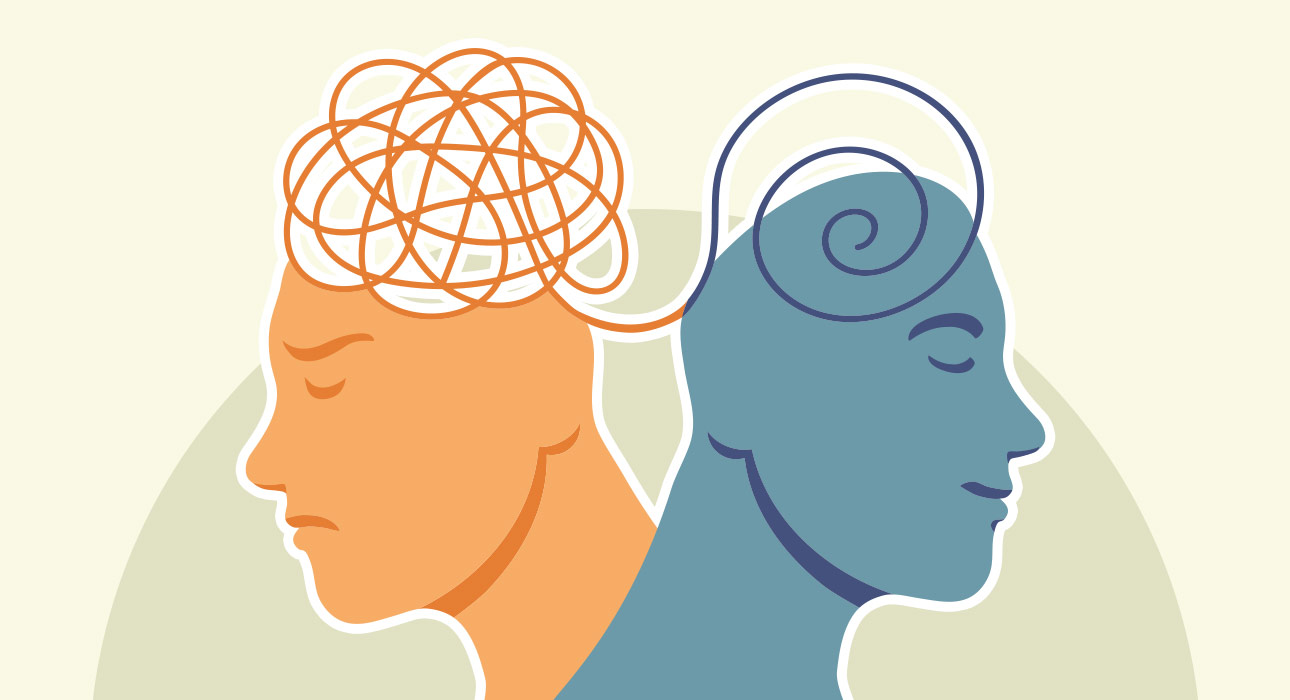
Choose two neighbors who disagree on immigration, or religion, or climate policy, each one holds a view the other finds troubling, and each might defend it pretty passionately. Most of us would just call that disagreement. Nobody would say either neighbor is unwell. And yet, somewhere along the way, public debate often slides from “I strongly disagree with that view” to “that person must be mentally ill.” That shortcut is easy to take, but it is wrong. Ideological ideas, radical views and clinical mental health issues are three distinct entities, and treating them as one creates a lot of misunderstanding. What follows looks at how psychologists actually tell them apart, and why a controversial or even harmful belief, on its own, doesn’t establish mental illness.
Three Different Things
Ideology is a belief system about how society should be run, economic issues, justice and national identity. They are learnt and shared and often influenced by your family, culture and community. An extremist is a radical viewpoint which is far from mainstream. Often rigid or accepts violence. A person is considered to have an illness when their thoughts, feelings or moods are badly affected causing them big trouble. The approach is very strict. Accepts aggressive behavior.
A person is considered to have an illness when their thoughts, feelings or moods are badly affected causing them big trouble. Sure, these categories can overlap. Nevertheless, it is not true that they are same. Having a radical ideology does not mean you fall into a diagnostic category. Whilst there may be cases where an individual has both an extremely radical ideology and mental illness, this should be considered on a case-by-case basis.
What Actually Makes Something a Mental Disorder
Jerome Wakefield, a philosopher and psychologist, said that mental disorders have two parts. They must cause a negative effect, and they must be dysfunctional. This means that the psychological process is not doing the function which it naturally evolved to do (Wakefield, 1992). The harm must be actual, not only disapproved of by society. This “harmful dysfunction” idea explains why a belief other people find offensive isn’t automatically a disorder. Offensiveness is a social judgment. Dysfunction is about an internal process failing at its task. Wakefield also notes that defining disease requires both scientific data and value judgements, which is a significant reason conversation about mental health get so heated so quickly.
Wakefield’s harmful dysfunction account is one influential theoretical account of mental disorder, not a universally accepted definition. However, in practice, diagnosis is not based purely on this model. Clinicians will consider several factors when assessing the symptoms. This will include the nature and duration of the symptoms, how much distress they are causing and whether there is an alternative cause. Diagnostic manuals including the DSM-5-TR can provide a list of criteria to consider when diagnosing(American Psychiatric Association, 2022). Therefore, the difference between ideology and mental illness would be made on a case by case basis.
Identity and the Need to Belong
Social identity theory (Henri Tajfel) suggests that individuals gain elements of their self-concept from the groups they belong to (Tausch et al., 2011). People generally prefer their ingroup. If they have developed a belief that is tied to their group identity, it can appear that to change this belief would be akin to losing part of themselves. Norms are communicated through shared language, symbols and prototypical exemplars, meaning individuals will conform to the typical viewpoints of the group (Hogg & Reid, 2006). Social identity theory provides an explanation for this. Beliefs can appear to form part of an individual’s identity; therefore, losing a belief can feel like losing part of their group. Often strongly held beliefs can reflect more about an individual’s group membership than their individual thoughts.
Read More: The Role of Social Identity in Group Dynamics
The Pull of the Group
Social influence is powerful. Cialdini and Goldstein concluded that people often conform to the views and actions of those around them to gain acceptance or due to an ambiguous situation (Cialdini & Goldstein, 2004). Online platforms can further increase conformity by repeatedly exposing people to similar views, creating a sense of widespread agreement. This research into conformity has provided another explanation for why we feel pressured to conform to those around us at a specific point in time, to gain acceptance or because of an ambiguous situation. This is different to social identity theory as it does not involve a group being an important part of your identity.
Biased Reasoning, Group Edition
Everyday reasoning is full of bias. Ziva Kunda’s review showed that people use goal driven reasoning, seeking information that supports their conclusions (Kunda, 1990). A study by Taber and Lodge showed that people were more sceptical towards political arguments that opposed their views, and were more likely to accept information that supported their views(Taber & Lodge, 2006). Kahan and colleagues showed that people with high cultural identities did not have less disagreement about climate risk with increased science literacy. In fact, those with high numeracy often interpreted the data in ways that favored (Kahan et al., 2012).
These biases occur throughout the political spectrum. This is a human way of thinking that stems from specific topics (political argument and climate risk) and sample. This means it shows how biased reasoning can occur but does not prove that all ideological beliefs will work the same way on all topics.
Distress and Extreme Views
Feelings of distress can sometimes contribute to the development of extreme views. In particular, Fathali Moghaddam’s staircase model has shown that individuals with feelings of unfairness may progress step by step to extreme actions due to their perception of injustice, group attachment and low alternative options (Moghaddam, 2005). Research has shown that there is a strong desire for individuals to feel personally meaningful, leading them to join extreme groups (Kruglanski et al., 2014). However, this shows the psychological processes many individuals go through without developing any issues. Distress may cause a change in ideologies however, they are two separate concepts and do not necessarily confirm each other.
Read More: Is Emotional Distress Being Overdiagnosed in Youth?
Why Harmful Beliefs Alone Don’t Prove Illness
Some beliefs do cause real hatred, violence, discrimination. But harm alone doesn’t establish mental illness. A belief that is socially controversial or unpopular is also not the same as a belief or action that causes demonstrable harm, such as violence or discrimination, and the two should not be treated as if they were. Wakefield’s framework requires a dysfunction in a psychological mechanism, not just a bad outcome (Wakefield, 1992).
Haslam describes the broader trend as “concept creep” – the progressive extension of psychological terminology such as trauma, abuse and disorder to cover an ever-wider spectrum of experiences and opinions (Haslam, 2016). If we lose sight of what the word means, and anything that someone doesn’t like becomes a symptom then it becomes harder to identify those who need care. By separating the issues of negative beliefs and mental illness we allow cultures to challenge dangerous ideas through debate, legal means and responsibility whilst still acknowledging the importance of mental health.
Conclusion
Extreme ideas, ideology and mental illness are different things. Gluing them together does no one any good. It is possible to believe something that most people find scary and nevertheless be psychologically healthy. But a person with a diagnosable condition might not have any extreme opinions at all. And the distinction counts in how individuals respond: beliefs can be countered by evidence, talk, and appropriate consequences for harmful actions, and mental health disorders by assessment and care.
Two questions should be kept separate, “Is this belief unpopular, or is the behavior that follows from it harmful, and how should it be challenged?” is a question about evaluating beliefs and behavior. Is this person clinically diagnosed with a mental disorder? This is a clinical question. However, whether there are negative consequences does not mean that they have a disorder. Not all diagnosable disorders cause distress. We should consider these two questions separately to keep our thinking clear.
Reference +
- American Psychiatric Association. (2022). Diagnostic and Statistical Manual of Mental Disorders. Diagnostic and Statistical Manual of Mental Disorders. https://doi.org/10.1176/APPI.BOOKS.9780890425787
- Cialdini, R. B., & Goldstein, N. J. (2004). Social influence: Compliance and conformity. Annual Review of Psychology, 55(Volume 55, 2004), 591–621. https://doi.org/10.1146/ANNUREV.PSYCH.55.090902.142015/CITE/REFWORKS
- Haslam, N. (2016). Concept Creep: Psychology’s Expanding Concepts of Harm and Pathology. Psychological Inquiry, 27(1), 1–17. https://doi.org/10.1080/1047840X.2016.1082418
- Hogg, M. A., & Reid, S. A. (2006). Social Identity, Self-Categorization, and the Communication of Group Norms. Communication Theory, 16(1), 7–30. https://doi.org/10.1111/J.1468- 2885.2006.00003.X
- Kahan, D. M., Peters, E., Wittlin, M., Slovic, P., Ouellette, L. L., Braman, D., & Mandel, G. (2012). The polarizing impact of science literacy and numeracy on perceived climate change risks. Nature Climate Change 2012 2:10, 2(10), 732–735. https://doi.org/10.1038/nclimate1547
- Kruglanski, A. W., Gelfand, M. J., Bélanger, J. J., Sheveland, A., Hetiarachchi, M., & Gunaratna, R. (2014). The psychology of radicalization and deradicalization: How significance quest impacts violent extremism. Political Psychology, 35(SUPPL.1), 69–93. https://doi.org/10.1111/POPS.12163;SUBPAGE:STRING:ABSTRACT;WEBSITE:WEBSITE:PERI CLES;REQUESTEDJOURNAL:JOURNAL:14679221;ISSUE:ISSUE:DOI
- Kunda, Z. (1990). The case for motivated reasoning. Psychological Bulletin, 108(3), 480–498. https://doi.org/10.1037/0033-2909.108.3.480
- Moghaddam, F. M. (2005). The staircase to terrorism a psychological exploration. American Psychologist, 60(2), 161–169. https://doi.org/10.1037/0003-066X.60.2.161
- Taber, C. S., & Lodge, M. (2006). Motivated skepticism in the evaluation of political beliefs. American Journal of Political Science, 50(3), 755–769. https://doi.org/10.1111/J.1540- 5907.2006.00214.X;SUBPAGE:STRING:ABSTRACT;WEBSITE:WEBSITE:PERICLES;JOURNAL:JO URNAL:15405907;WGROUP:STRING:PUBLICATION
- Tausch, N., Hewstone, M., Schmid, K., Hughes, J., & Cairns, E. (2011). Extended contact effects as a function of closeness of relationship with ingroup contacts. Group Processes and Intergroup Relations, 14(2), 239–254. https://doi.org/10.1177/1368430210390534;PAGEGROUP:STRING:PUBLICATION
- Wakefield, J. C. (1992). The concept of mental disorder: On the boundary between biological facts and social values. American Psychologist, 47(3), 373–388. https://doi.org/10.1037/0003-066X.47.3.373





Leave feedback about this