








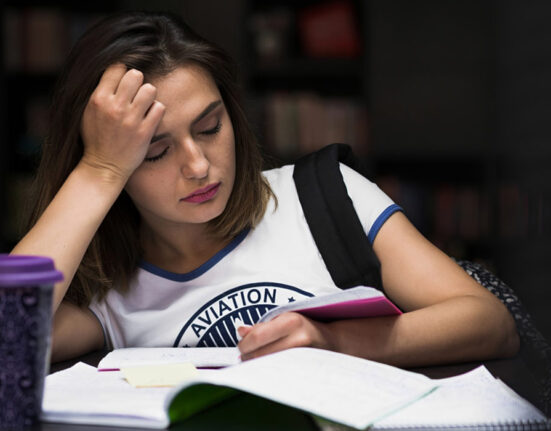
It was late, and a student was looking over an essay that seemed unusually polished. One of my classmates has already said they use an AI application to outline their work and another one appears to turn in perfect work every week. The simple, but hefty, question that keeps coming back is: am I falling behind? Many learning platforms, writing helpers and study applications now include artificial intelligence.
It can teach complex topics, produce practice problems and write material in seconds. For student already anxious about academics, such speed might seem less like aid and more like a standard they can’t meet. Many students say this is a normal sensation, but very few speak about it. This article examines the impact of AI in education on academic anxiety, self-confidence and fear of falling behind, and provides practical responses to these in the form of clarity rather than panic.
AI Invades the Classroom
Using AI technologies offers actual advantages, such the ability to provide personalized feedback, quicker access to explanations, assistance for students who study at various paces and linguistic support for students writing in a second language. But those same traits might also cause pressure. Kasneci and others talk about the pedagogical possibilities of massive language models. But also about difficulties related to over-reliance, fairness and academic integrity (Kasneci et al., 2023).
A systematic review of AI in higher education adds a more specific concern, research has focused on a few applications such as assessment and prediction, whereas pedagogical and ethical problems have been comparably little studied (Zawacki-Richter et al., 2019). This gap matters for students, because the rule about what counts as acceptable AI use often change faster than a course can explain them. A further issue is that pupils lacking clarity on the regulations may assume that their peers are well-versed in them.
Why Exams Make Us Anxious
Academic anxiety is more than just the usual jitters. It is an emotion associated with dread of failure and pressure on outcomes. According to Pekrun and colleagues, academic emotions such as anxiety have strong effects on learning and motivation, effort, and self-regulation (Pekrun et al., 2002). Specifically, cognitive test anxiety is characterized by concern about performance, which takes up brain space that may otherwise be used for problem solving (Cassady & Johnson, 2002).
Meta-analysis covering over 30 years has shown that test anxiety is consistently related with worse academic success (von der Embse et al., 2018). Test anxiety includes worried thoughts and physiological symptoms like an increase in pulse or stomach tightness. This kind of worry does not stay in exam room, and the rise of AI adds a new layer of uncertainty to it.
Students may ask what is good, fair, or less effort, that the issue may magnify pre-existing stress. For many students, this uncertainty comes at the same time as increased workloads, and each assignment seems like a test of character as much as intellect.
Social Comparison in the Digital Classroom
People assess their talents by comparing themselves with others. Festinger’s thesis suggested that in the absence of objective standards, people turn to comparable others for direction (Festinger, 1954). This is a simple comparison in classrooms. Grades, quickness and polish are out there. Upward comparison mean looking at people who seem better off. While downward comparison mean looking at those who seem worse off. Comparisons may improve or worsen mood depending on whether individuals compare themselves to others who appear better off or worse off, according to Wood’s review (Wood, 1989).
Comparisons are also disseminated via group conversations and social media where students post outstanding marks and polished projects. But seldom mention the hours of work that went into them. AI makes comparisons difficult to interpret. Aisha reads an essay by a student. It has a clear structure and strong vocabulary, and she thinks it was written alone. She doesn’t know how much assistance was employed, so the easy way may give her an inaccurate benchmark. An unverified imagined standard may increase her concern, but not every student would react this way.
Self-Esteem and Self-Confidence
Confidence in one’s abilities influences how pupils react to hardship. Self-efficacy is not the same as self-esteem. Self-esteem is a broad sense of a personal worth, whereas self-efficacy refers to beliefs about one’s ability to perform particular tasks. Bandura’s self-efficacy hypothesis states that ideas about one’s capacity to perform at certain levels determine effort, tenacity, and emotional responses to problems (Bandura, 1977). If AI is giving answers instantaneously, a student could start considering if their own thinking is good enough.
As a second-year student, Daniel starts to believe that every concept he has is already in a tool and therefore his work is futile. Research indicates people whose self-esteem depend on their achievements experience more stress and less focus on learning of its own sake (Crocker & Park 2004). This contingent self-esteem differs from the tasks-specific confidence, a student may feel capable of solving a particular problem while still feeling worthless after a poor grade. For learners like Daniel, a poor grade may appear to represent their personal lack rather than comment on a special skill. A more effective approach is to ask, “which stage encountered an issue?” For example, poor planning, bad reasoning, or a hasty review. That query converts a judgement into facts he can use.
Fear of falling behind and job insecurity
Fear of falling behind tends to be a combination of current strain and future dread. Concern about AI add a specific layer to this uncertainty, since student may wonder whether the skills they build now will still be valued as AI changes professional work. Students are wondering whether their talents will count in a work market that appears to change every year. Career adaptability refers to the psychological resources individuals use to navigate and cope with changes in the work environment. It consists of concern about the future (planning ahead), a sense of control (believing one can shape one’s career), curiosity about personality (exploring options), and confidence in resolving challenge (believing one can solve problem) (Savickas & Porfeli, 2012).
Building these resource may help students learn to see change as an opportunity, not a threat, which reduce the fear that falling behind today mean falling behind for good. The aim isn’t to be able to forecast every professional move that’s impossible. But to cultivate adaptable abilities and a hunger for further learning. To do this, students might research the development of their chosen industry, speak to specialists and choose programs that will help them develop transferable skills such as writing, analysis and communication.
Adjusting to Changing Expectation
Learners struggle with changing expectations, because the same AI tool may be encouraged in one course and banned in another. This inconsistency may encourage students to overthink, which is exhausting. Students adapt better when they know what is allowed, why, and how they will be graded. Confusion, however, fosters self-doubt and comparison, and the difficulties of fast changing academic contexts are a primary source of such confusion (Kasneci et al., 2023).
Practical Steps for Students
This burden may be lessened by using a number of different approaches. Ask the instructor to write down the explanations of AI laws, so students have real standards to base their expectations on, not rumors. Being open about the use of AI, and about how ideas are generated, may assist foster confidence and eliminate the secrecy that causes worry. Students can use AI as a tutor, for example by asking it to explain a concept or check a draft. Then attempt the task themselves before reading the answer, so the tool support learning instead of replacing it. If you focus on mastery, for example knowing an idea well enough that you can describe it. Then you move away from comparison and toward progress.
Bandura’s study shows that confidence is best enhanced by successful experiences of mastery. Thus doing minor tasks independently and recognizing development might restore self-efficacy over time (Bandura, 1977). Physical wellbeing matters too, since anxiety is partly a bodily state. Adequate rest, brief breaks during study session, and exercise reduce the physiological arousal that fuel anxiety. Learners suffering from worry that impacts their sleep, dietary patterns, or daily activities need to see a campus counsellor or healthcare provider. Requesting assistance demonstrates sound discernment, not frailty.
Conclusion
With artificial intelligence transforming education, it’s only natural that students are going to have questions about what this means for their grades and prospects. Scholarly anxiety rises when evaluations are seen as uncertain, assessments seem unfair, and predictions are always shifting. But anxiety is not a skill evaluation. Clear rules, honest use of resources, mastery-focused learning, and constant self-efficacy may transform a vague dread of falling behind into a doable problem.
Students don’t compete against some phantom computer. They’re learning abilities that will be valuable when the tools change. A basic practical first step to act this week, ask one faculty member how AI may be used on a particular project, write down one concept you can explain without assistance.
Reference +
- Bandura, A. (1977). Self-efficacy: Toward a unifying theory of behavioral change. Psychological Review, 84(2), 191–215. https://doi.org/10.1037/0033-295X.84.2.191
- Cassady, J. C., & Johnson, R. E. (2002). Cognitive Test Anxiety and Academic Performance. Contemporary Educational Psychology, 27(2), 270–295. https://doi.org/10.1006/CEPS.2001.1094
- Crocker, J., & Park, L. E. (2004). The costly pursuit of self-esteem. Psychological Bulletin, 130(3), 392–414. https://doi.org/10.1037/0033-2909.130.3.392
- Festinger, L. (1954). A Theory of Social Comparison Processes. Human Relations, 7(2), 117–140. https://doi.org/10.1177/001872675400700202
- Kasneci, E., Sessler, K., Küchemann, S., Bannert, M., Dementieva, D., Fischer, F., Gasser, U., Groh, G., Günnemann, S., Hüllermeier, E., Krusche, S., Kutyniok, G., Michaeli, T., Nerdel, C., Pfeffer, J., Poquet, O., Sailer, M., Schmidt, A., Seidel, T., … Kasneci, G. (2023). ChatGPT for good? On opportunities and challenges of large language models for education. Learning and Individual Differences, 103, 102274. https://doi.org/10.1016/J.LINDIF.2023.102274
- Pekrun, R., Goetz, T., Titz, W., & Perry, R. P. (2002). Academic Emotions in Students’ Self Regulated Learning and Achievement: A Program of Qualitative and Quantitative Research. Educational Psychologist, 37(2), 91–105. https://doi.org/10.1207/S15326985EP3702_4
- Savickas, M. L., & Porfeli, E. J. (2012). Career Adapt-Abilities Scale: Construction, reliability, and measurement equivalence across 13 countries. Journal of Vocational Behavior, 80(3), 661– 673. https://doi.org/10.1016/J.JVB.2012.01.011
- von der Embse, N., Jester, D., Roy, D., & Post, J. (2018). Test anxiety effects, predictors, and correlates: A 30-year meta-analytic review. Journal of Affective Disorders, 227, 483–493. https://doi.org/10.1016/J.JAD.2017.11.048
- Wood, J. V. (1989). Theory and Research Concerning Social Comparisons of Personal Attributes. Psychological Bulletin, 106(2), 231–248. https://doi.org/10.1037/0033-2909.106.2.231
- Zawacki-Richter, O., Marín, V. I., Bond, M., & Gouverneur, F. (2019). Systematic review of research on artificial intelligence applications in higher education – where are the educators? International Journal of Educational Technology in Higher Education 2019 16:1, 16(1), 39-. https://doi.org/10.1186/S41239-019-0171-0



Leave feedback about this