







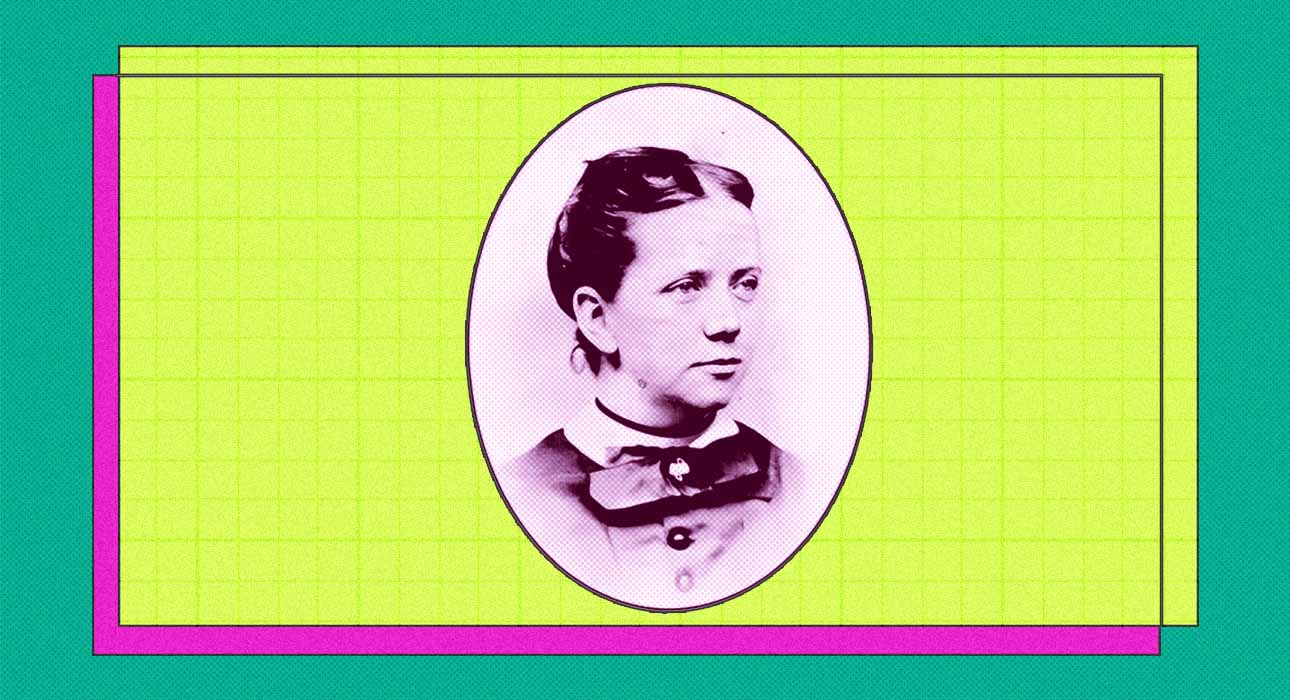
Christine Ladd-Franklin attended Johns Hopkins University in the late 1800s, and as a woman, she frequently did not have a place in classes that contained almost all men. As a result of this, she submitted an application which included her first initial only, C. L.” As a result, the university recognised her as a woman when he first entered their school but continued to honour Christine Ladd-Franklin’s credentials because of how well she performed previously. After completing her PhD coursework, she continued to have trouble obtaining her PhD after many years due to her gender (Furumoto, 1992).
In spite of the negative attitudes about women in the sciences that prevented her scientific inquiries from being accepted, Christine Ladd-Franklin transformed her experience of exclusion into a strong intellect. Christine Ladd-Franklin made significant contributions to experimental psychology and the science of vision during a time period in which women did not have access to laboratories, creating one of the earliest theories on colour vision in early cognitive science.
Christine Ladd-Franklin’s life story encompasses more than simply being a scientist; her life shows how determined she was to push through many ordinary prejudice barriers placed on women. In the late 1800s, at a time when women were generally excluded from education in the sciences, she made major contributions to the fields of psychology, logic, and perceptual research (Scarborough & Furumoto, 1987). Many of her achievements were eclipsed by those of male psychologists like Wilhelm Wundt and Hermann von Helmholtz. Still, today she is considered a key historical figure within the fields of cognitive and experimental psychology who helped to lay the groundwork for modern research in those same areas (Furumoto, 1992).
The most significant contribution from Ladd-Franklin was her theory of colour evolution through stages of development – black/white, blue/yellow and finally red-green (Ladd-Franklin, 1892). Ladd’s was the first to relate colour vision to biological evolution and also explained the greater prevalence of red/green colour blindness (Hurvich, 1981).
Read More: The Role of Women in the Early History of Psychology
Evolutionary Theory of Colour Vision
The notable part of Ladd-Franklin’s work is her evolutionary theory of colour vision. She claimed the evolution of the three parts of the human eye works like this: first, the simplest part of the human eye was just being able to see light and dark (this is visually supported by people being able to see objects in peripheral vision in grayscale with little illumination). Also, according to Ladd-Franklin, this type of vision is how we perceive peripheral vision; night vision has little colour. Secondly, was our ability to discriminate between the colours of blue vs yellow, and lastly, to see the colours of red vs green. Thus, it explains that from an evolutionary standpoint, red vs green defects are more prevalent than blue vs yellow. Because red and green evolved after the other systems, and thus were more subject to defects. (Hurvich, 1981)
This description of evolution had an important impact as it related Psychology to biology/neuroscience. Ladd-Franklin believed that perceptions could not be understood purely through philosophical arguments, but needed to be studied scientifically through the functioning of the nervous system and through evolutionary adaptations. She anticipated later cognitive theories that saw perception as an active ‘doing’ by the brain in response to the demands of the environment (Boring, 1950). Most of the same issues related to colour perception have been addressed by modern neuroscience. However, the part of Ladd-Franklin’s work that is still time-consuming is its combination of elements of physiology, evolution and cognition into an overall explanatory model.
Read More: Cultural Impact on Colour Perception: Why It Matters
Contributions to Cognitive and Experimental Psychology
Ladd‐Franklin not only contributed enormously to our understanding of colour vision but also played an important part in the formation of Experimental psychology. She studied with some of the most prominent European psychologists at the time and became fascinated with the way in which our minds organise the sensory information we receive. Much of her research expressed an early cognitive perspective, indicating that perception is much more than just the passive reception of sensory input. Instead, it is the result of the cognitive processing that occurs after the receipt of the sensory input (Benjamin, 2000). In addition, she believed that visual perception is based on both the mechanisms used to receive sensory input and the way in which we interpret that input. It is an idea that predicted the future emergence of cognitive psychology and Gestalt principles.
Ladd-Franklin disapproved of scientific theories without a basis of empirical evidence. She thought that psychology ought to be based on experimentation rather than speculation. Her commitment to science was such that psychology was eventually accepted as an authentic laboratory science through the use of the scientific method, even at a time when it was having trouble gaining any credibility within the confines of academia (Furumoto 1992). She did give lectures, write articles, and participate in international debates on scientific topics despite being subjected to systemic discrimination.
Read More: The First Experimental Psychology Laboratory
Struggle for Recognition and Lasting Legacy
Christine Ladd-Franklin achieved a remarkable amount in her lifetime. Yet she was not recognised for these achievements until essentially the end of her life. She completed all formal requirements for her doctorate at Johns Hopkins in the late 1800s. But the university denied her a degree simply because she was a woman. Christine received formal recognition for her work over 40 years later, at almost 80 years of age, and this delayed recognition is a reflection of the larger issues women experienced during this time period, trying to get into science or academic careers (Scarborough & Furumoto, 1987).
In addition, she helped to establish behaviourism as a legitimate branch of science by supporting the notion that one can maintain a sound mind in environments where they are excluded, and she also contributed to the establishment of vision science as a broad field of research by broadening its definition to include biology, psychology, and cognition. Christine Ladd-Franklin was able to envision things much more clearly than the society around her was able to do so. She recognised that human perception continues to change, develop, and adapt, just as the world continues to progress toward creating equal opportunity and recognition for every individual.
Conclusion
Christine Ladd-Franklin represented much more than a psychologist researching colour vision; she generally represented tenacity, intellect and courage in academia. During a period in which women were denied equal rights in higher education and research. She continued to produce groundbreaking theories in both psychology and vision science (Scarborough & Furumoto, 1987). The colour vision evolutionary theory she developed advanced not only the comprehension of perception. But it was also an innovative link between psychology, biology and neuroscience (Ladd-Franklin, 1892).
Although she suffered from discrimination and a slow process of being recognised, her theories provided foundational work for subsequent research in cognitive and perceptual psychology (Boring, 1950). As one of the first women to pioneer and contribute greatly to the field of experimental psychology, Ladd-Franklin’s accomplishments will be forever remembered as a source of inspiration for future female scientific and academic leaders (Furumoto, 1992).
References +
- Benjamin, L. T. (2000). A history of psychology in letters. Blackwell Publishers.
- Boring, E. G. (1950). A history of experimental psychology (2nd ed.). Prentice-Hall.
- Evans, R. B., Sexton, V. S., & Cadwallader, T. C. (1992). The American psychological association: A historical perspective. American Psychological Association.
- Furumoto, L. (1992). Christine Ladd-Franklin (1847–1930). In A. N. O’Connell & N. F. Russo (Eds.), Women in psychology: A bio-bibliographic sourcebook (pp. 206–221). Greenwood Press.
- Goodwin, C. J. (2015). A history of modern psychology (5th ed.). Wiley.
- Hurvich, L. M. (1981). Colour vision. Sinauer Associates.
- Ladd-Franklin, C. (1892). Colour and colour theories. Psychological Review, 1(4), 311–320.
- Leahey, T. H. (2018). A history of psychology: From antiquity to modernity (8th ed.). Routledge.
- Scarborough, E., & Furumoto, L. (1987). Untold lives: The first generation of American women psychologists. Columbia University Press.
- Schultz, D. P., & Schultz, S. E. (2016). A history of modern psychology (11th ed.). Cengage Learning.
- Wertheimer, M. (1987). A brief history of psychology (3rd ed.). Holt, Rinehart & Winston.



Leave feedback about this