







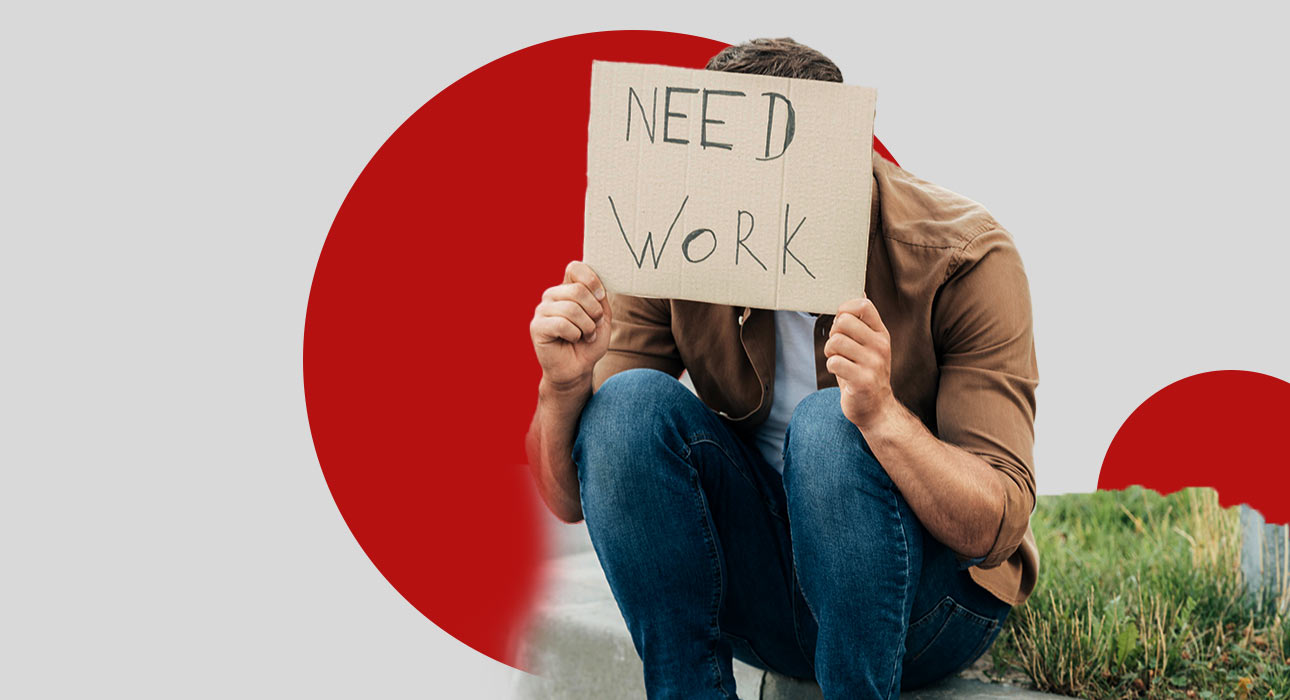
While unemployment is often discussed in terms of statistics and GDP, the actual psychological pain it causes is far more personal. It usually starts with small, stinging moments. It’s the relative at a wedding asking, ‘Are you still just looking?’ or the neighbour’s curious look when someone is seen at home during the middle of a workday. These subtle taunts and hushed gossip within social circles are often the first steps toward psychological exhaustion. These external pressures gradually erode a person’s sense of self-worth, making the mental toll of unemployment far more profound than it first appears.
The Identity Crisis: Why Work Matters
A career is a lot more than a monthly paycheck. It gives us an important sense of who we are and why we matter. In many cultures, a person’s social status is actually determined by their professional title. In actuality, the majority of people consider your occupation to be a synonym for who you are. Think of it this way: losing your job feels like losing a part of yourself.
It goes way beyond the paycheck; you are also losing that daily rhythm and the social circles that keep you going. Just look at any social gathering, the very first thing people ask is usually, ‘What do you do?’ as a first question. Without the structure of a workplace, individuals may begin to doubt their abilities and question their value in the world. This decline in self-esteem can happen quickly, leading to a painful ‘Identity Crisis’ and feelings of worthlessness.
Read More: First Paycheck, First Freedom: How Financial Independence Impacts Emotional Well-Being
Applying Jahoda’s Theory to Global Mental Health Perspectives
Back in the 1980s, Marie Jahoda came up with a theory that explains exactly why we feel so lost without work. She argued that a job gives us ‘latent benefits’, things we don’t even realise we’re getting until they’re gone. First, it provides a time structure for the day. Second, it offers social contact outside the family. Third, it links an individual to goals beyond their own needs. Fourth, it defines personal status and identity. Finally, it enforces regular activity. Unemployment removes these benefits. Consequently, the individual feels a deep void in their daily life.
According to a global study by Yang et al. (2024), unemployment is significantly linked to an increase in mental disorders, specifically anxiety and depression, across 201 countries. The researchers found that the resulting financial strain and social pressures act as potent stressors that deteriorate individual well-being and increase the risk of long-term psychological distress.
Read More: From Job Loss to Mental Distress: Unemployment Impacts on Mental Health
The Digital Strain and Social Comparison
Psychologist Leon Festinger, in his Social Comparison Theory (1954), suggested that individuals determine their own worth based on their evaluation against others. In the past, this comparison was limited to neighbours or friends. However, the digital age has expanded this circle. Today, professionals compare themselves to thousands of others globally. This constant comparison can be devastating for a person without a job.
LinkedIn is an excellent resource for networking, but at the same time, it can be a source of stress. As they scroll through their feeds, users are met with a constant stream of updates about new roles and career success. It’s hard to escape. This often causes what many job seekers refer to as “Professional FOMO” (Fear of Missing Out). Many unemployed people feel this way.
Every time a ‘New Job’ alert or a work anniversary appears on LinkedIn, it can make a job seeker feel like they are falling behind. It’s hard to ignore that feeling. This digital pressure makes being unemployed even more painful. It isn’t just about the struggle to find a paycheck anymore; it’s about the struggle to feel “enough” when everyone else seems to be winning online. This shows the need to be careful about how much time is spent on social media while looking for work.
On top of that, the way AI is changing jobs is creating a new kind of stress. Researchers call this “anticipatory rumination” (Sharma et al., 2025). It’s a future-oriented worry and a deep, constant fear that an individual’s skills might never be needed again. It’s the thought that the world is moving on and leaving them behind. This type of anxiety is actually quite distinct. It isn’t just about mourning a job that was lost in the past. Instead, it’s a deep-seated fear of being ‘shut out’ of the future entirely. It is the persistent worry that in a world of rapid change, specific skills might simply no longer have a place.
Read More: Social Media’s Role in Redefining Personal and Societal Values
The Silent Battle: Family and Social Class
Family support is tricky during job loss. Parents and partners definitely mean well, but their constant anxiety often feels like an added weight. A simple question like, ‘Any updates on the job?’ can start to feel more like an interrogation than actual care. Over time, this just creates a silent distance between everyone. To deal with this pressure, a person looking for work might just start skipping family dinners or avoiding gatherings altogether. It’s an easy way to dodge those uncomfortable conversations.
It is vital to understand this dynamic. The research by Vinokur and van Ryn (1993) really emphasises that the ‘type’ of support someone receives is what counts, not just the amount. There is a difficult truth here: financial aid doesn’t mean much if it’s tied to ‘Social Undermining.’ If family help is paired with constant pressure or criticism, it stops being helpful. In fact, that kind of environment often does more harm to a person’s mental well-being than no help at all. This shows that family members must be trained to offer ‘Invisible Support’, helping without making the person feel like a burden.
The meaning of unemployment is not the same for everyone. According to a study by Dougherty, Rick, and Moore (2017), our social class significantly changes how others perceive our joblessness. Society often views a typical unemployed person as “pathologically lazy.” This means people believe the individual is naturally unmotivated to work. However, this label changes depending on one’s social standing.
For instance, the study reveals that upper-class individuals without jobs are often judged for their privilege. People assume they do not need to work because of their background. On the other hand, the middle-class unemployed usually face less judgment. However, the most severe stigma is often directed toward the lower class. Society frequently assumes that their unemployment is preventable. They believe that if these individuals simply “worked harder,” they would find a role. This unfair perception adds immense pressure to the job seeker.
Self-Isolation as a Defence Mechanism
It’s honestly exhausting to live under that kind of constant judgment. To get away from those harsh comments, a lot of people just start pulling away from everyone. In psychology, we call this “social withdrawal.” It usually starts small. Maybe you stop going to family dinners, or you skip a friend’s party because you just can’t face those awkward questions about your career.
Many people end up muting their WhatsApp groups or staying home out of a deep sense of shame. They’re terrified of being labelled as ‘lazy’ when someone asks that dreaded question: ‘So, what are you doing with your life right now?’ (Sharma et al., 2025). The thing is, staying home feels like a relief at first, but it’s a trap. Even before you notice it, you’re stuck in this lonely cycle that’s really hard to break.
Read More: Feeling Shame Is Not Good for Your Mental Health?
Moving Forward: Routine and Upskilling
Let’s be real, getting through the days when you’re unemployed is incredibly tough. Without a 9-to-5, time starts to feel like it’s dragging, and your natural rhythm just disappears. When you lose a job, you lose the “bones” of your day. That lack of direction is exactly what leads to feeling sluggish and anxious.
That’s why creating a personal timetable is so vital. It’s about keeping your sanity. Think of a schedule as a replacement for your work routine; it gives you a solid reason to get out of bed and stay organised. You should carve out time for both personal and professional growth. This is the perfect chance to “upskill”, to learn something new or sharpen what you already know. If you look at this time as a chance to grow rather than a burden, everything changes. By sticking to a routine, you’re basically taking your life back. It stops you from obsessing over the past and keeps your eyes on what’s coming next.
Read More: Creating Workplaces Where Everyone Can Breathe: AI, Assistive Technology, and Inclusive Design
Conclusion
Unemployment is one of the most challenging periods in an individual’s life. The transition between roles or the sudden loss of a job can cause immense psychological difficulties, leaving one feeling deeply uncertain about what the future holds. This emotional weight is often doubled by the constant cycle of “caring” questions from family members and the persistent gossip from the neighbourhood. Such interactions, combined with the underlying stigma shown by society, turn a personal struggle into a public trial.
At the end of the day, decoupling one’s self-worth from a monthly paycheck is perhaps the hardest but most necessary shift to make. AI and the digital era’s competition keep everyone on edge; prioritising mental well-being isn’t just a ‘nice to have’, it is a part of a survival strategy. This transition is really exhausting, but facing it with a clear view of these psychological hurdles can help a person emerge with a much stronger sense of identity that doesn’t rely solely on a job title.
References +
Dougherty, D. S., Rick, J. M., & Moore, P. J. (2017). The communication of social class in job loss: A study of the stigma of unemployment. Journal of Applied Communication Research, 45(4), 395–416. https://doi.org/10.1080/00909882.2017.1355557
Festinger, L. (1954). A theory of social comparison processes. Human Relations, 7(2), 117–140. https://doi.org/10.1177/001872675400700202
Jahoda, M. (1981). Work, employment, and unemployment: Values, theories, and approaches in social psychology. American Psychologist, 36(2), 184–191. https://doi.org/10.1037/0003-066X.36.2.184
Sharma, V., Deb, S., Mahajan, Y., Ghosal, A., & Kapse, M. (2025). Psychological impacts of AI-induced job displacement among Indian IT professionals: a Delphi-validated thematic analysis. International Journal of Qualitative Studies on Health and Well-Being, 20(1). https://doi.org/10.1080/17482631.2025.2556445
Vinokur, A. D., & van Ryn, M. (1993). Social support and undermining in life stressors: Their independent effects on the mental health of unemployed persons. Journal of Personality and Social Psychology, 65(2), 350–359. https://doi.org/10.1037/0022-3514.65.2.350
Yang, Y., Niu, L., Amin, S., & Yasin, I. (2024). Unemployment and mental health: A global study of unemployment’s influence on diverse mental disorders. Frontiers in Public Health, 12, 1440403. https://doi.org/10.3389/fpubh.2024.1440403





Leave feedback about this