







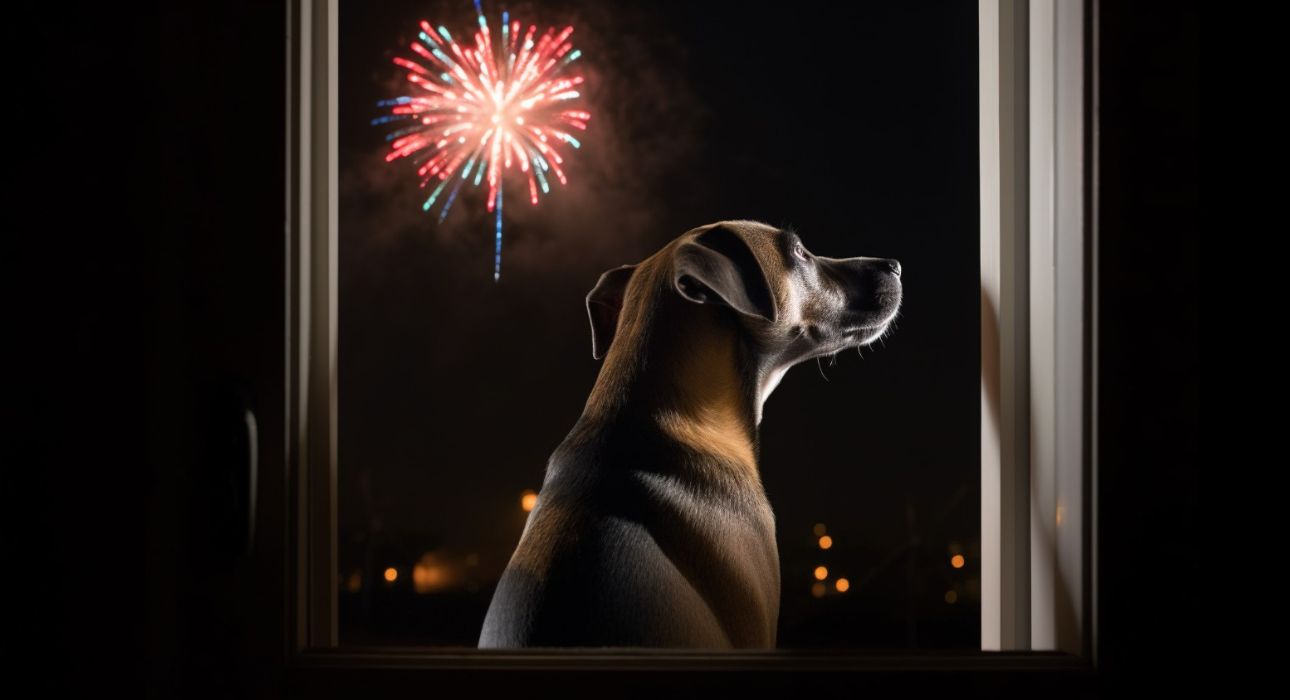
“On the New Year’s party in 2022, Krishika, residing in Noida, celebrated a midnight party with family on her rooftop. But amidst the loud boom and sparkling lights, A golden retriever, Jiffy (pet dog), was nowhere to be found. Startled by the deafening fireworks, Jiffy had panicked, jumped the gate and fled the house. What followed was a night of frantic searching, calls to the shelter and social media posts. She was found 18 hours after: scared, dehydrated and hiding under a parked car several kilometres away.”
Krishika later shared that Jiffy had always been uneasy around loud sounds, but they never imagined how extreme her response could be—the night left Jiffy visibly shaken for weeks, refusing to go outside once the sun set. Jiffy’s experience isn’t unique; every year, thousands of pets suffer intense anxiety, go missing or get injured due to fireworks and loud events. Their distress often goes unnoticed during human celebrations.
Loud Noises; weather from fireworks, thunderstorms, gunshots or even household sounds are more than just a nuisance for animals. For many species, especially domestic pets and wildlife, these sounds trigger deep stress responses, fear and long-lasting behavioural changes. As people prepare for celebrations like Independence Day, New Year’s Eve, Diwali and other occasions that involve loud & Unpredictable noises, thousands of animals experience fear, anxiety, physiological stress and in extreme cases, injury or death.
This article explores how loud noises and fireworks affect the psychological health of animals, why these reactions occur and what we can do to lessen the impact.
Why animals react strongly to loud noises
Animals, particularly domesticated pets, often have more sensitive auditory ranges than humans. Dogs, for instance, can hear higher frequencies and sounds at greater distances than people. Making loud, erratic noises like fireworks seems magnified and alarming (Smithsonian Magazine, 2020).
In a biological perspective, sudden loud noises can activate an animal’s stress response systems, like triggering flight, Fight or freeze behaviours that are associated with fear and survival instincts. Animals cannot easily contextualise unusual sounds like humans, making them more likely to react with panic when confronted with unexpected exposures or bangs.
Behavioural and Emotional Reactions Pets: fear, stress, and avoidance
Fireworks are among the most cited triggers of noise-related fear and anxiety in pets. A survey of thousands of dog and cat owners in the Netherlands found that nearly 80% of animals experience stress and fear in response to fireworks noise, with many showing strong fear behaviours such as hiding, freezing and trembling. ( Herwijnen et al. 2024).
Read More: Can Dogs and Cats Sense Depression?
Typical behavioural responses include:
- Hiding or attempting to escape.
- Shaking or heavy breathing
- Refusing food or avoiding interaction.
- Constant vocalising or distress calls
- Resistance: Going outdoors after noise exposure.
In some cases, stress persists after the noise events have ended, with animals showing avoidance behaviours for up to half an hour or more after the firework cases.
Wildlife and livestock Panic and Displacement
Fireworks and loud noises also have documented impacts on wildlife and livestock. Birds may abandon their nest when a star is startled by explosions, leaving eggs or young vulnerable. Small mammals, reptiles, and nocturnal World Wildlife often flee into Unfamiliar territory due to panic, increasing their risk of vehicle collisions or predation.
Domestic livestock are also vulnerable to noise-induced stress, similarly affected. Horses, particularly, have been reported to become panicked and injure themselves after fireworks exposure, including running through fences to escape perceived danger.
Physiological Stress and Noise Phobias
Beyond observable behaviours, loud noises can trigger significant physiological stress in animals. Research tracking stress-related behaviours in companion dogs indicates that sudden loud stimuli, including fireworks, can activate the hypothalamic-pituitary-adrenal (HPA) axis, leading to elevated stress hormone levels like cortisol, that may persist for extended periods (Grigg et al. 2021)
In extreme cases, repeated exposure to loud noises may contribute to the development of noise phobias, heightened and persistent fear responses that generalise to other environments (Wikipedia Noise phobia in dogs, 2025).
Why do Loud noises affect animals so strongly?
Multiple factors are contributing to the intensity of animals’ reactions, such as:
- Amplified reaction to auditory cues to sound: Some Animals, such as dogs and cats, can hear a wider range of frequencies than humans, so loud sounds may be more intense and potentially painful for them. (Strain, 2003; Heffner, 1983)
- Lack of predictability: Fireworks produce sudden, irregular sounds with no specific pattern, making it impossible for animals to anticipate or acclimate to them. (Sherman & Mills, 2008)
- Evolutionary threat perception: In the natural world, loud noises typically signal danger like thunder or approaching predators, so an animal’s brain is biologically wired to those loud sounds as threats, triggering survival instincts instead of responding with curiosity (Overall 2013).
- Developmental and past experience: Animals that haven’t been exposed to different sounds early in life may be more prone to noise-related fear responses. Those with past trauma can develop heightened sensitivity or panic reactions when exposed to sudden loud sounds (Sherman & Mills, 2008)
Real-life impact: lost pets and Distressed Wildlife
Consider a common scenario: On the 4th of July or New Year’s Eve, owners may wake to find their pet missing, having fled in panic from the loud explosions. Such incidents are reported widely, with shelters and rescue organisations often seeing spikes in lost animals following fireworks celebrations (American Kennel Club [AKC], 2022).
Wildlife rescue centres also frequently admit injured or disoriented animals in the Aftermath of large firework displays due to panic-driven displacement or collisions. (RSPCA, 2021). The psychological impact is not just immediate; animals may exhibit long-term avoidance behaviours, reduced trust in their environment or Reluctance to go outside, even well after the noises have stopped.
Strategies to mitigate harm
Recognising the severe stress fireworks cause to animals, experts and animal welfare organisations recommend several mitigating strategies:
1. Creating safe indoor environments
Keeping pets indoors with familiar comforts can reduce panic reactions. Providing hiding spaces, calming music and destruction can help shield them from abrupt sounds. Ensuring pets have secure identification, like microchips, collars, is also crucial, for fear may drive them to escape in search of safety. (American Veterinary Medical Association [AVMA], 2021).
2. behavioural and medical interventions
Several studies suggest that a combination of behavioural training supplements and environmental enrichment can help reduce fear responses in noise-sensitive animals. For example, supplements containing tryptophan, Valerian and Passiflora significantly reduce stress reactions in dogs exposed to fireworks in controlled studies (Ramos et al., 2023). Behavioural desensitisation- Gradually exposing animals to a mild version of loud noises paired with positive reinforcement may also help produce long-term sensitivity (Overall, 2013).
3. Public awareness and policy measures
Many animal welfare experts advocate for stricter noise regulations around fireworks and promote the use of quieter alternatives to minimise stress on companion animals, wildlife and individuals with sensory sensitivities. Countries have already adopted quieter fireworks to reduce the negative impact on vulnerable populations (Levine et al., 2020). Public education campaigns encouraging centralised displays instead of individual fireworks use can also reduce the duration and spread of loud noise events, limiting exposure to pets and wildlife.
Conclusion
While fireworks and loud celebrations may represent joy and festivity for humans, they can have a deeply distressing impact on animals, ranging from household pets to wildlife. Loud noises trigger fear responses, stress behaviours and physiological strain that may linger well beyond the event itself. Animals’ sensitive hearing, evolutionary threat responses and lack of contextual understanding make them particularly vulnerable to noise trauma.
As awareness grows, it’s increasingly clear that human considerations must be part of community celebrations. Whether through quieter celebrations, Protective strategies for pets or public policy changes, efforts to reduce noise exposure can help ensure that animals who share our forms and ecosystem are not silently suffering in the wake of human festivities.
References +
Arcangeli, G. (2022). Neurobehavioral alterations from noise exposure in animals. International Journal of Environmental Research and Public Health.
de Souza, C. C. F. (2018). Use of behavioural and physiological responses for scoring fireworks sound in dogs. PLoS One.
Grigg, E. K., et al. (2021). Stress‑related behaviours in companion dogs exposed to sudden loud noises. Journal Article, PMC. Gähwiler, S. (2020). Fear expressions of dogs during New Year fireworks. Scientific Reports. Riemer, S. (2020). Effectiveness of treatments for firework fears in dogs. Applied Animal Behaviour Science.
Fireworks Are Frightening to Pets. (2025). Four Paws.
Fireworks (2025). Wikipedia.
Noise phobia in dogs. (2025). Wikipedia.
Animal welfare rescue cases on loud noises. Various news reports.
American Veterinary Medical Association. (2021). Pet firework safety tips. AVMA. https://www.avma.org/resources-tools/pet-owners/petcare/fireworks-safety-pets
RSPCA. (2021). Fireworks and animals. Royal Society for the Prevention of Cruelty to Animals. https://www.rspca.org.uk/adviceandwelfare/pets/general/fireworks
American Kennel Club. (2022). Why dogs are scared of fireworks—and how to help them. https://www.akc.org/expert-advice/health/why-dogs-are-scared-of-fireworks/
Sherman, B. L., & Mills, D. S. (2008). Canine anxieties and phobias: An update on separation anxiety and noise aversions. Veterinary Clinics of North America: Small Animal Practice, 38(5), 1081–1106. https://doi.org/10.1016/j.cvsm.2008.04.012
Overall, K. L. (2013). Manual of Clinical Behavioural Medicine for Dogs and Cats. Elsevier Health Sciences.
Sherman, B. L., & Mills, D. S. (2008). Canine anxieties and phobias: An update on separation anxiety and noise aversions. Veterinary Clinics: Small Animal Practice, 38(5), 1081–1106.
Heffner, H. E. (1983). Hearing in large and small dogs: Absolute thresholds and size of the tympanic membrane. Behavioural Neuroscience, 97(2), 310–318. https://doi.org/10.1037/0735-7044.97.2.310
Overall, K. L. (2013). Manual of Clinical Behavioural Medicine for Dogs and Cats. Elsevier Health Sciences.
Ramos, D., Mills, D. S., Estelles, M. G., & Granell, J. D. (2023). A double-blind, placebo-controlled study on the effectiveness of a nutraceutical product containing L-tryptophan, Valeriana officinalis, and Passiflora incarnata in managing stress in dogs during fireworks. Animals, 13(6), 1101. https://doi.org/10.3390/ani13061101


Leave feedback about this