







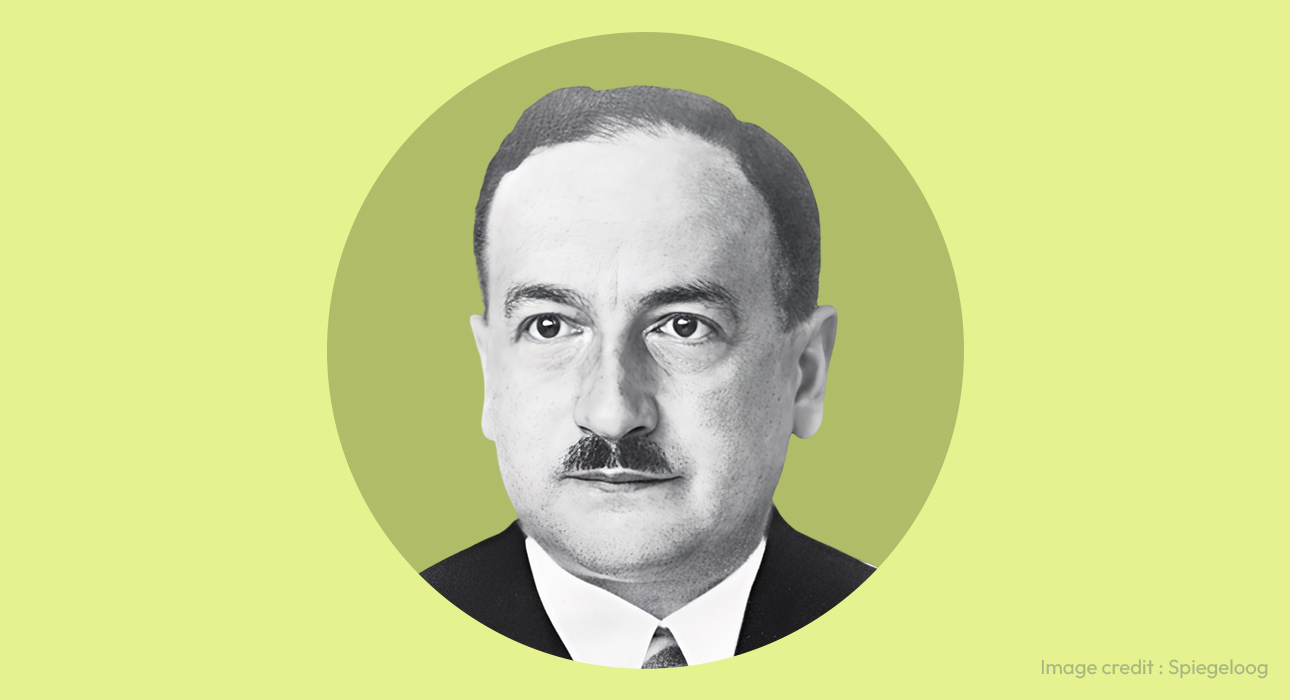
Most psychology students are taught that the cognitive revolution began in the 1950s and was led by such figures as George Miller, Noam Chomsky, and Allen Newell, who managed to reestablish the mind’s place of importance in the scientific realm after decades of behaviourism (Miller, 2003). Few are taught, on the other hand, about the German psychologist who was the first to describe thinking in terms of directed problem solving and mental schemas, the ideas that subsequently gained ground only after the advent of computers gave psychologists the new language to express them.
That psychologist, Otto Selz, never lived to witness the vindication of his ideas because he was murdered by the Nazi regime in 1943 (Herrmann & Katz, 2001). He has been largely forgotten by the general history of psychology, remembered in detail only by a few historians, rather than the field at large (Herrmann & Katz, 2001). This article will look at what Selz proposed, how his career and life were cut short under the Nazi persecution, why he was forgotten decades later when ideas pioneered by him quietly became part of mainstream psychology, and how his work made a comeback via an unlikely channel of the study of chess.
Before the Revolution: Breaking from Associationism
In order to understand what Selz had proposed, it is important to look at what psychology of thinking looked like before him. In the early 1900’s, most of the theories were grounded in associationism, the idea that one idea simply triggers the next, based on learned psychological associations. This is a theory that can be traced to Wilhelm Wundt and refined by such researchers as G. E. Müller, whose “constellation theory” regarded thinking as a series of associations triggered by a stimulus (Herrmann & Katz, 2001).
Wundt himself had pioneered the introspective study of conscious experience since the 1880s, but drew a line around higher-level mental processes such as reasoning and problem solving, considering them too complex for study in the laboratory, leaving them largely to philosophy. Selz, whose work fell under the umbrella of the Würzburg School but ultimately broke away from it, rejected this view, arguing that thinking itself could be studied directly and systematically rather than waved off as unapproachable.
In his 1913 work, Über die Gesetze des geordneten Denkverlaufs (On the Laws of the Ordered Thought Process), he proposed the first non-associationist theory of thinking, arguing that thought is not passive trigger but an active process aimed at arriving to solve for a particular problem (Selz, 1913). This was a significant departure from the norm, as instead of asking what idea leads to the other based on the associations, he was asking what operations a person performs in order to reach a goal, a question that seems obvious today because his answer to it became the very basis of modern cognitive psychology.
Schemas, Problems, and the Machinery of Thought
Selz’s most important contribution to the field was his concept of the schema. However, he used the term differently from how it is commonly understood today. According to ter Hark (2010), Selz drew on the philosopher Alexius Meinong’s theory of relations. He argued that understanding a problem requires forming a structured mental representation, which he called an anticipatory schema. This schema defines what kind of answer would complete the problem, even before the answer is known. Recognising a problem, in other words, is not simply identifying what is missing but building a mental scaffold that already constrains and guides the search for what belongs in the gap.
Based on this, Selz went on to describe thinking as a process of testing possible solutions against the conditions outlined in the schema, distinguishing between reproductive thinking, in which a person applies a method they already know, and productive thinking, when they have to construct a new method because the existing ones do not work (Herrmann & Katz, 2001; ter Hark, 2010). This distinction anticipated concepts that emerged decades later in problem-solving research and early artificial intelligence. These ideas suggested that both humans and machines solve problems through a systematic search for solutions. This search follows the conditions set by a specific goal.
A Career Cut Short: Life under the Nazi Regime
Selz’s academic career, on the surface, has been on a steady ascent. He was born in Munich in 1881 and taught at the University of Bonn. In 1923, he became a full professor of philosophy, psychology, and pedagogy at the Mannheim Business School, now known as the University of Mannheim. He later served as the institution’s rector (Frijda & de Groot, 1981). By the early 1930s, he was an established figure in German academic psychology, actively developing and defending his theory of thinking against his critical counterparts from the Gestalt school, an activity carried out in the pages of the German psychology journals of the time (Herrmann & Katz, 2001).
In 1933, the Nazi regime abruptly ended his academic career by introducing civil service laws that forced Jewish academics out of German universities, regardless of their rank or reputation (Geuter, 1992). Selz lost his professorship and rectorate simply due to his Jewish heritage. This was not an isolated order but part of a sweeping purge that removed Jewish scholars from the German universities almost overnight, regardless of their status and contributions to their fields.
Selz did not leave Germany immediately. His decision to stay had violent consequences following Kristallnacht, a night of anti-Jewish attacks and arrests across Germany. The Nazi authorities imprisoned him in the Dachau concentration camp for five weeks. They released him on the condition that he leave the country (Price, 2011).
He fled to Amsterdam and continued to live there quietly. Former students and the children of his colleagues occasionally visited him. One of these children was a young Nico Frijda, who later became one of the psychologists who worked to restore Selz’s recognition (Frijda & de Groot, 1981). The Netherlands provided only temporary safety. The Nazi regime eventually deported Selz. The Nazi regime killed him in August 1943 while transporting him to Auschwitz (Herrmann & Katz, 2001).
Erased from the Story: Why Selz Was Forgotten
Selz’s fading from the memory of psychology was not simply the result of his death; it was part of a rupture in German academic life that the years under the Nazi regime caused. Geuter (1992) chronicled how the systematic expelling, and in some cases murder, of Jewish psychologists during this period cut off the usual channels of citation, mentorship and discussion that kept ideas circulating from one generation of researchers to the next.
Selz had no surviving students in Germany to continue advocating his framework when the war ended, and the discipline there had little institutional memory of his presence. The geography also contributed to the problem. The cognitive revolution that eventually validated many of his ideas was largely taking place in the English-speaking world during the 1950s, built by researchers such as Miller, Newell, and Herbert Simon, most of whom had little exposure to a German-language dissertation published decades prior by a psychologist deceased in the Holocaust (Herrmann & Katz, 2001).
As Price (2011) put it, Selz’s work laid groundwork for cognitive science during behaviourism’s peak, but virtually none of the people working on the cognitive revolution were aware they were retracing his steps. Consequently, his contributions gradually faded from recognition. Although he had anticipated many of the field’s key questions, people neither acknowledged nor cited his work when they eventually found the answers.
A Quiet Legacy: How Selz’s Ideas Resurfaced
Selz’s ideas did not die; however, they survived thanks largely to one intermediary. The Dutch psychologist Adriaan de Groot, who had known Selz as a child in Amsterdam, applied Selz’s framework of schemas and problem solving to the study of the thought process of chess masters, publishing his findings in 1946 (as “Thought and Choice in Chess” in 1965) (de Groot, 1965).
De Groot found that the strong chess players did not simply calculate more moves than their less skilled counterparts, but were able to instantly identify meaningful patterns on the board, a finding that neatly fit into Selz’s earlier idea of anticipatory schema that guides perception and problem solving before conscious deliberation even begins. De Groot’s research on chess became one of the most widely cited works in the psychology of expertise, and caught the attention of Herbert Simon and Allen Newell, who were building computational models of human problem solving that would help found artificial intelligence as a field.
In this way, Selz’s mechanistic account of goal-directed thought found its way to the founders of cognitive science, filtered through de Groot’s chess studies rather than under his own name. Decades later, historians of psychology began tracing these ideas back to their original source. These efforts included the contributors to Frijda and de Groot’s (1981) tribute volume and, more recently, ter Hark (2010). Their work helped restore Selz’s place in the history of psychology. That process is far from complete; Selz is still much more known to the historians of psychology than to their students. The renewed attention to his life and work aims to correct this.
Conclusion
Otto Selz described goal-directed thinking, anticipatory schemas, and the difference between applying a known method and inventing a new one. He did so decades before these concepts became central to cognitive psychology. Also, he was a working scientist actively building a research programme. He was not an isolated theorist. The Nazi regime killed him in 1943, bringing his work to a premature end. His death also disrupted the academic connections that could have helped others recognise and develop his ideas under his name.
What survived did so indirectly. It survived through the work of a former acquaintance. This acquaintance studied the thought process of the chess masters. He arrived at the founders of cognitive science without the founder’s name attached. The story of Otto Selz is a reminder that scientific credit does not automatically follow scientific priority. This is particularly true when historical violence interrupts a career at its height. Restoring figures such as him is not only an academic curiosity. It is a matter of correcting the historical record. People may credit the 1950s entirely for the emergence of cognitive psychology. They should remember that some of its ideas originated earlier. These ideas were pioneered by a man whose name deserves recognition alongside the other pioneers.
References +
- De Groot, A. D. (1965). Thought and choice in chess. Mouton. https://doi.org/10.1515/9783110800647
- Frijda, N. H., & de Groot, A. D. (Eds.). (1981). Otto Selz: His contribution to psychology. Mouton. https://doi.org/10.1515/9783110816877
- Geuter, U. (1992). The professionalisation of psychology in Nazi Germany. Cambridge University Press. https://www.cambridge.org/core/books/professionalization-of-psychology-in-nazi-germany/ 6EC5C5D1DC7B2ED8BD27D6DC3D197559
- Herrmann, T., & Katz, S. (2001). Otto Selz and the Würzburg School. In L. Albertazzi (Ed.), The dawn of cognitive science: Early European contributors (pp. 225–235). Springer. https://doi.org/10.1007/978-94-015-9656-5_12
- Miller, G. A. (2003). The cognitive revolution: A historical perspective. Trends in Cognitive Sciences, 7(3), 141–144. https://doi.org/10.1016/S1364-6613(03)00029-9
- Price, M. (2011, September 1). The little-known roots of the cognitive revolution. Monitor on Psychology, 42(8). https://www.apa.org/monitor/2011/09/otto-selz
- Selz, O. (1913). Über die Gesetze des geordneten Denkverlaufs [On the laws of the ordered thought process]. Spemann. https://digi.bib.uni-mannheim.de/fileadmin/vl/ubmaosi/59087/pdf/59087.pdf
- Ter Hark, M. (2010). The psychology of thinking before the cognitive revolution: Otto Selz on problems, schemas, and creativity. History of Psychology, 13(1), 2–24. https://doi.org/10.1037/a0017442


Leave feedback about this