







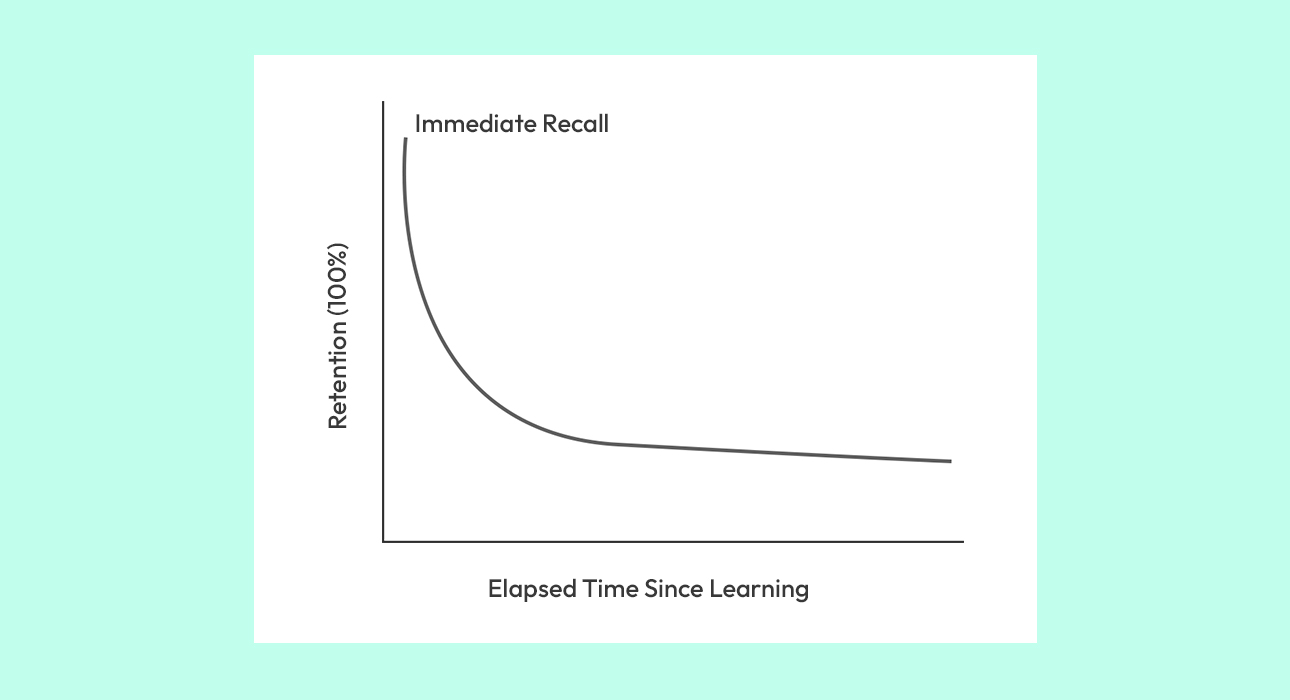
Almost everyone has pulled an all-nighter studying for an exam, believing they knew the material, and failed the test days or weeks later. This happens despite our best efforts to memorise the information, which is why modern psychology includes forgetting as one of the most well-researched phenomena, where no effort leads to rapid loss of recently acquired knowledge (Murre & Dros, 2015). But what exactly is this effort? This essay follows the research on forgetting from its beginnings to modern applications.
The first section recovers the original memory experiments conducted by Hermann Ebbinghaus in the 1880s. The second part examines how the brain holds onto and lets go of information, along with the causes of forgetting that go beyond the simple passing of time (Diekelmann & Born, 2010; Richards & Frankland, 2017). The closing section covers practical suggestions for reducing forgetting, specifically spaced repetition and retrieval practice, together with the evidence supporting them (Cepeda et al., 2008). Researchers take special care to distinguish what their findings genuinely show from what people generally assume about the forgetting curve (Dunlosky et al., 2013).
Read More: Ever Wondered Why You Forget? : The Psychology Behind Forgetting
The First Forgetting Curve
Ebbinghaus (1885) published Memory: A Contribution to Experimental Psychology. The methodology he used for compiling the results presented in the book was unconventional, to say the least. Unable to find any volunteers, he became the sole participant in his experiment and created what would later become known as nonsense syllables. He created these syllables by placing a vowel between two consonants, as he could find no other way to form meaningful linguistic units that carried no conceptual associations.
He conducted the main experiments on forgetting between 1879 and 1880, completing 163 “double tests.” Using a series of 13-syllable lists, he memorised them until he could recite them from memory twice in a row without error and then attempted to relearn them with intervals of approximately twenty minutes, one hour, nine hours, one day, two days, six days, and 31 days in between. Ebbinghaus did not measure immediate recall. Instead, he assessed retention using a method known as savings, which measures the reduction in the time required to relearn material compared with the time spent learning it initially.
Savings help researchers measure how well a person retains information, even when they cannot recall it independently. As a result, a person may no longer remember an entire list but may still relearn it in less time than they originally needed to learn it. According to Ebbinghaus’s findings, the rate of forgetting is exponential, with a particularly steep slope in the first hours after learning. Specifically, one needs to spend about half the effort to relearn the information after one hour compared to the initial learning, two-thirds of the effort after eight hours, about one-third after one day, one-quarter after six days, and nearly one-fifth after a month.
Combined, these results constitute the forgetting curve that is familiar to most students. It is notable that later reinterpretations of Ebbinghaus’s work failed to mention two critical details that undermine the validity of extrapolating his results to modern students’ experiences. Firstly, the logarithmic function approximating Ebbinghaus’s data does not follow the exponential pattern found in many contemporary descriptions of the forgetting curve. Second, the experimental results only describe how people recall nonsense syllables. They do not indicate how quickly a student forgets the content of a lecture they have learned.
Read More: Beyond Memory: How Culture and Patriarchy Persist Despite Cognitive Decline
Does the Curve Still Apply?
There is a reason why the replication was necessary. The memory experiment performed by Hermann Ebbinghaus was truly ahead of its time and was not available to everyone. Consequently, Jaap Murre and Joeri Dros (2015) attempted to replicate Ebbinghaus’s results using the same methodology. During their experiment, participants memorised sequences of meaningless syllables, with gaps of 20 minutes, 1 hour, 9 hours, 1 day, 2 days, and 31 days separating the learning and relearning stages, and they devoted roughly 70 hours to studying the material.
The study’s findings broadly matched Ebbinghaus’s results, so the authors concluded that they had successfully replicated the forgetting curve. Murre and Dros (2015) reported a second interesting finding: the curve they obtained was not entirely smooth. They observed a modest rise between the 1- and 2-day intervals, suggesting that people forgot information more slowly than expected immediately after learning. Ebbinghaus (1885) himself noticed this anomaly, noting that the value for the 24-hour interval appeared “to a certain extent too high in comparison with the following one” (p. X) and that random fluctuations in the conditions influencing memory retention, such as the participant’s sleep or waking, might have shaped the results.
Although the role of sleep in memory consolidation is discussed later, Murre and Dros did not directly test this hypothesis. Most importantly, the replication itself highlights the limitations of the existing research design and the extent to which researchers can apply its findings. In both experiments, a single subject learned nonsense. Murre and Dros (2015) go so far as to ask whether Ebbinghaus’s curve mirrors traits that were unique to him. Their findings closely matched Ebbinghaus’s results, suggesting that the forgetting curve may vary considerably among individuals. This limits the usefulness of applying the same forgetting curve to all students.
Read More: Flashbulb Memories: Capturing the Vivid Recollection of Significant Life Events
How the Brain Retains Information
Memory consolidation, the process that governs how the brain handles new information and moves it from short-term into long-term memory, unfolds over time. Sleep is among the most thoroughly studied factors that shape memory consolidation. Diekelmann and Born (2010), in their review, point to multiple studies showing that sleep enhances memory consolidation.
In particular, slow-wave sleep, the deepest stage of sleep, contributes most to consolidating declarative memories, which are recollections of facts and events (Feld & Diekelmann, 2015). This phenomenon might partly account for the rise in retention observed right after the 24-hour interval in the study by Murre and Dros (2015). Researchers need to conduct further studies to fully understand the specific ways in which sleep contributes to memory.
Nevertheless, these findings suggest that we should not overlook the hours following a learning session, as the brain consolidates memories most actively during this period. Therefore, anyone seeking to maximise retention should not rely solely on all-night study sessions before an exam. Instead, they should consider how evening study sessions and sleep can influence the retention of newly learned material (Feld & Diekelmann, 2015). Researchers cannot determine with certainty whether interference during sleep causes particular memories to become consolidated or lost. This brings us to the next subject: the mechanisms behind forgetting.
Read More: The Fading Affect Bias: Why Time Makes Our Memories Less Painful
Why Memories Fade: Decay, Interference and Helpful Forgetting
The simplest explanation for forgetting is decay; that is, memories become weaker with time. Many early studies supported this idea (Wixted, 2004). However, Ebbinghaus (1885) himself proposed a more complex system in which memories compete with each other for storage in the memory system for retention. Jenkins and Dallenbach (1924) partially supported this theory by demonstrating that the activities participants engaged in after learning significantly influenced their ability to recall information later.
Participants who slept after learning recalled more information than those in the control group, who remained awake for the same period. Subsequent research identified interference, particularly proactive interference, as one of the critical factors affecting forgetting, with interference being a phenomenon in which memories compete with each other, preventing the recall of the target memory (Wixted, 2004). A surprising new perspective on forgetting comes from a review by Richards and Frankland (2017) published in Neuron.
The authors describe transience, the ability of the brain to forget, as no less important than persistence, the ability of the brain to remember, which directly contradicts the previously mentioned views on interference and decay. In particular, forgetting serves to remove unnecessary memories, thus allowing the brain to make room for new, valuable memories. By doing that, the brain ultimately contributes to making better decisions based on memory in the face of uncertainty.
Therefore, when applied to the study process, these findings suggest that students should not necessarily fight forgetting but rather invest effort in ensuring that the correct information remains in their memories. The next section discusses how exactly one can achieve that.
Read More: Elizabeth Loftus: Can Memory Be Trusted? The Science of False Memories
The Most Reliable Way to Combat Forgetting: Spaced Repetition
Forgetting curves show that the longer the period between learning and recall, the less likely there is to remember something. However, the simplest way to mitigate this effect is to review the material before an extended break, and then again before another break, and so on. Researchers call this approach spaced repetition. It works best when learners schedule repetitions at intervals that follow the logarithmic pattern discussed above (Ebbinghaus, 1885).
In their article, Cepeda et al. (2006) analyse the existing research on distributed practice, which is another term for spaced repetition, and find broad agreement on the need for distributed practice to optimise retention based on the length of the retention interval. Specifically, analysing the 839 dependent variables from 317 experiments reported in 184 articles, the authors conclude that the optimal lag between repetitions depends on the length of the retention interval, with longer retention intervals associated with longer lags.
Cepeda et al. (2008) provide more direct evidence of the value of spaced repetition. The authors taught participants the target material and tested their recall over a period of up to 3.5 months. They found that recall probability peaked at specific retention intervals before declining. For all intervals, the optimal lag between repetitions comprised approximately 5–40% of the retention interval, with shorter lags used for shorter intervals.
For example, a student who needs to remember something for a week may try to review the material every 1 or 3 days, and someone who needs to prepare for the exam in a year may space their repetitions every 3 or 5 weeks. The authors also emphasise that learners vastly underestimate distributed practice as a learning tool, as most of the methods they studied proved significantly less effective than spaced repetition.
In their review of ten learning techniques, Dunlosky et al. (2013) confirm distributed practice’s effectiveness, noting that it has been demonstrated across various populations and tasks and applies to most types of material. Furthermore, they observe that distributed practice challenges intuitive understanding of learning, as students often fail to realise that spaced repetition is significantly more effective than massed practice. Overall, research identifies distributed practice, or spaced repetition, as one of the most effective methods for improving retention and reducing the effects of the forgetting curve.
Read More: 5 Most Effective Study Techniques Backed by Psychology Research
Retrieval Practice, and What to Stop Doing
Spaced repetition is simple but powerful: if one knows how long the retention interval is, one can determine when to review the material. But when should one study the material in the first place? Learners can improve retention by testing themselves on the target information, as research has repeatedly shown that this method is much more effective than simply rereading the material. This finding comes from the study by Roediger and Karpicke (2006), in which participants either read a prose passage or tried to recall the information after a 5-minute interval. Overall, the results showed that restudying immediately after learning was more effective than testing.
However, when the authors compared testing with restudying as a preparation strategy for delayed recall, testing proved more effective across all delays. Its benefits became particularly evident after two days and one week. Furthermore, testing benefited retention without negatively impacting subjective assessment of one’s knowledge compared to restudying, which created a false sense of preparedness, thus underscoring the importance of retrieval practice (Roediger & Karpicke, 2006). Dunlosky et al. (2013) highlight retrieval practice as one of the most effective learning techniques that should be used in combination with spaced repetition, while emphasising the limited benefits of rereading and highlighting as the least effective techniques.
As mentioned above, interleaved practice, which refers to alternating between different types of materials or tasks during practice, is effective but only when a student practices with the necessary feedback (Dunlosky et al., 2013). With spaced repetition and retrieval practice, one should also be able to adapt the review schedule. They should also adapt the practice tests according to the current level of performance. This brings us to the final recommendation.
Read More: Project Gua: The Bizarre Experiment of Raising a Chimpanzee and a Human Baby Together
Putting it all Together: A Weekly and Monthly Review Schedule
Combining spaced repetition, retrieval practice, and optimising the sleep schedule is helpful. This is based on the findings on memory consolidation. It leads to the development of a simple weekly and monthly review plan for learning material. First, when introducing the target information, the new material should be studied. Then, it should get well-rested during the following night. This is because sleep plays a critical role in memory consolidation (Feld & Diekelmann, 2015). Second, one should not reread the information. Instead, one should try to recall as much as possible from memory. Then, one can compare the results to the target material (Dunlosky et al., 2013).
Learners can use Roediger and Karpicke’s (2006) study as a model for self-testing. Like the participants in the study, they can try to recall the material after a short interval. They should do this without referring to their notes. Then, they can compare their responses with the correct answers. Third, with spaced repetition, one can set the review schedule based on the length of the retention interval. For example, you may be preparing for an exam in four weeks. One can review the material after roughly one day. Then, one can review it after one week. After that, one can review it after two weeks. Finally, one can review it the day before the exam. The intervals can be determined based on the findings by Cepeda et al. (2008).
Finally, the study process itself can help determine when to schedule the next review. Any material that cannot be recalled accurately or in sufficient detail should be prioritised for further practice. This is essentially how more advanced algorithms utilised by spaced repetition software work. The developers of the MEMORIZE algorithm, Tabibian et al. (2019), for example, demonstrate something important. Their adaptive retrieval scheduling method uses machine learning to personalise the review schedule. It outperformed several human-designed heuristic schedules. This was shown by analysing the performance of users of the Duolingo language-learning application.
Naturally, this was a natural experiment, not a controlled study, and it applies specifically to language learning. However, keep these principles in mind. Any student can develop a personal review schedule based on spaced repetition with retrieval practice. This can optimise their chances of retaining the target information. With these recommendations in hand, one can successfully utilise the forgetting curve to one’s advantage.
Read More: Poor Sleep Responsible For New Type of Depression
Conclusion
Ebbinghaus demonstrated that forgetting follows an exponential pattern. A later replication study confirmed this pattern but identified one anomaly in the curve. Subsequent research explored how memories are consolidated and how the brain actively removes information. While individual variation is significant, the overall trends characterise the forgetting curve. The best way to combat forgetting is through spaced repetition, which optimises review schedules.
A student can combine spaced repetition, retrieval practice, and an optimised sleep cycle. These follow the principles of memory consolidation. In this way, a student can develop a powerful learning schedule. The student can also use the forgetting curve to their advantage. These recommendations are supported by research, but other effective strategies are also available. It is important to consider the latest research when creating a personal or professional schedule that uses the forgetting curve (Dunlosky et al., 2013).
References +
- Cepeda, N. J., Pashler, H., Vul, E., Wixted, J. T., & Rohrer, D. (2006). Distributed Practice in Verbal Recall tasks: a Review and Quantitative synthesis. Psychological Bulletin, 132(3), 354–380. https://doi.org/10.1037/0033-2909.132.3.354
- Cepeda, N. J., Vul, E., Rohrer, D., Wixted, J. T., & Pashler, H. (2008). Spacing effects in learning: A temporal ridgeline of optimal retention. Psychological Science, 19(11), 1095–1102. https://doi.org/10.1111/j.1467-9280.2008.02209.x
- Diekelmann, S., & Born, J. (2010). The memory function of sleep. Nature Reviews Neuroscience, 11(11), 114–126. https://doi.org/10.1038/nrn2762
- Dunlosky, J., Rawson, K. A., Marsh, E. J., Nathan, M. J., & Willingham, D. T. (2013). Improving Students’ Learning With Effective Learning Techniques. Association for Psychological Science – APS. https://www.psychologicalscience.org/journals/pspi/1529100612453266\
- Feld, G. B., & Diekelmann, S. (2015). Sleep smart – optimising sleep for declarative learning and memory. Frontiers in Psychology, 6. https://doi.org/10.3389/fpsyg.2015.00622
- Murre, J. M. J., & Dros, J. (2015). Replication and Analysis of Ebbinghaus’ Forgetting Curve. PLOS ONE, 10(7). https://doi.org/10.1371/journal.pone.0120644
- Richards, B. A., & Frankland, P. W. (2017). The Persistence and Transience of Memory. Neuron, 94(6), 1071–1084. https://doi.org/10.1016/j.neuron.2017.04.037
- Roediger, H. L., & Karpicke, J. D. (2006). Test-Enhanced Learning: Taking Memory Tests Improves Long-Term Retention. Psychological Science, 17(3), 249–255. https://doi.org/10.1111/j.1467- 9280.2006.01693.x
- Tabibian, B., Upadhyay, U., De, A., Zarezade, A., Schölkopf, B., & Gomez-Rodriguez, M. (2019). Enhancing Human Learning via Spaced Repetition Optimisation. Proceedings of the National Academy of Sciences, 116(10), 3988–3993. https://doi.org/10.1073/pnas.1815156116
- Wixted, J. T. (2004). The Psychology and Neuroscience of Forgetting. Annual Review of Psychology, 55(1), 235–269. https://doi.org/10.1146/annurev.psych.55.090902.141555


Leave feedback about this