







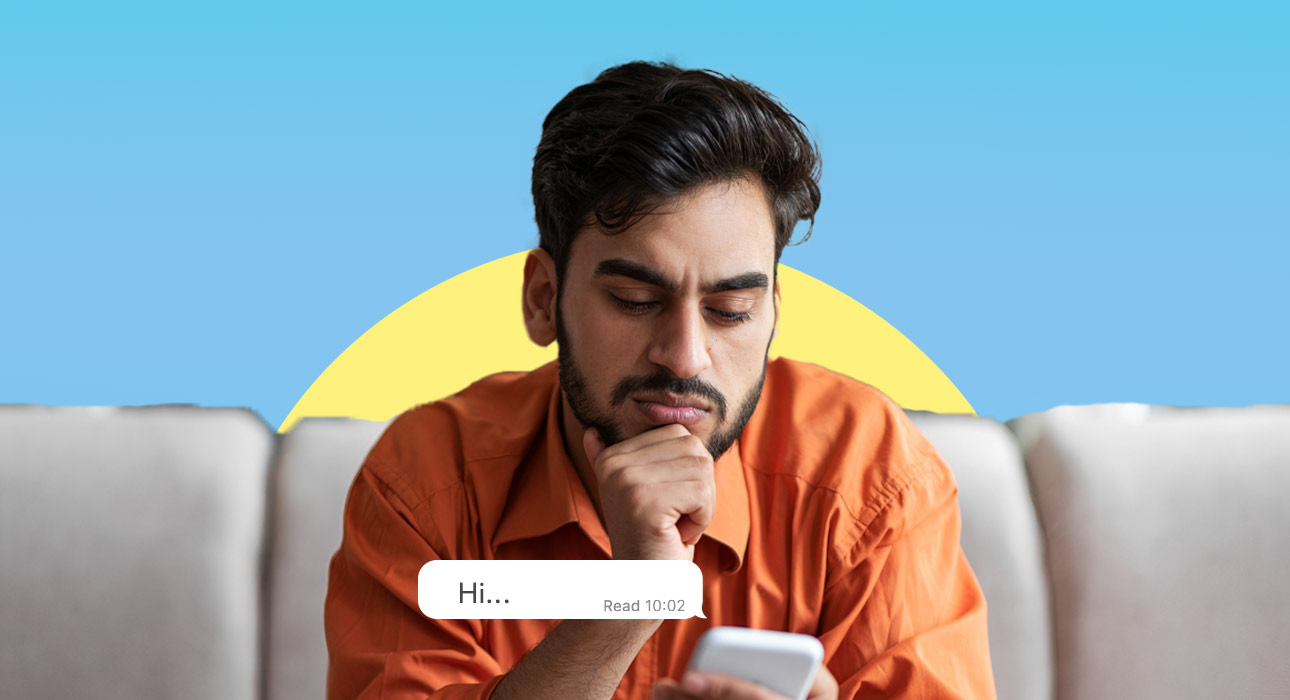
The use of written messages for communication is not a strange phenomenon. Anyone who has a busy routine can relate to running to work, going onto public transportation and sending a quick message to a friend or coworker saying “I’m on my way” through a message service. Or trying to communicate with a relative about something and just calling or going into a chat service and leaving a message like, “call me later.”
That kind of communication is the new normal. Like the traditional model of communication indicates, a sender of the message and a recipient of it. Talk and listen. Just like that. But what happens when that communicational flow breaks? When someone sends a message but no one answers. “Did the message go through? Does that person maybe not want to answer? Something happening?” are common questions that can emerge. But what happens on a deeper level?
Looking Closely at How Digital Communication Works
By talking about digital communication, Hall (2018) points out that there are three dimensions. Digital communication has the dimensions of synchrony, social presence and reach. Synchrony is the time of delay between messages. For example, messages like emails or short written messages on social platforms are asynchronous. Social presence is the degree to which the media cover social cues such as non-verbal communication.
And reach the number of individuals that can receive or send a message (Hall, 2018). Like a meeting, several people gather, and all of them can receive and send messages or a group video call. Considering digital messages, they can be synchronous (like a call or video call or direct messages in real time), with a higher social presence and lower reach, considering calls or direct messages are not social media posts that have a higher reach number.
Feeling Aside: Ostracised
Another component of the situation of being left to read separately from digital communication is being ostracised. When a person is ostracised, it means that a person experiences being excluded and ignored (Büttner, 2026). That experience is not just a normal experience like learning something or tripping on the street while walking. Being ostracised can have long-term consequences for the person.
The consequences can come from an impact on well-being and affect mental health. At the level of mental health, a person can experience: at the extreme of the consequences, the person can experience suicidal situations, school shootings or extremis (Büttner, 2026). Also, another effect shown in studies is that the ostracised person is often isolated from others after that experience (Büttner, 2026).
“Your message was read” is the Feeling After Silence
With 5.83 billion people using mobiles and 73% of the global population being active internet users (We are social, 2026), texting is a common mode of communication. Calling, having video calls, group texting, chat rooms and group chats, connecting with others has become more instant and easy than ever. Now everyone is a text away.
What Happens When no One Responds?
That situation is a form of cyber-ostracism. Like previously discussed… but translated to the online world. For example, when someone sends a text but gets no answer at all, it can happen in a one-to-one or a group chat (Lutz, 2022). Some investigations have explored the negative effects of not receiving a response on chats. Such effects include lower levels of belonging, self-esteem, meaningful experience and control even if the chat was with strangers (Lutz, 2022).
Also, it is reported that message senders can become irritated if the chat partner doesn’t respond in a few minutes or an hour (Lutz, 2022). Even if the recipient of the message takes a few moments to respond, the sender can have a fear of feeling ostracised.
But the feeling of being ostracised can also happen with emails when the sender doesn’t get an answer. And chronic exposure to ostracisation has been reported to lead to feelings of alienation, depression, helplessness and a general feeling of meaninglessness (Zhang & Zhao, 2025). Zhang and Zhao (2025) found that feelings of ostracism can lead people to adopt coping strategies such as social withdrawal and posting negative comments to protect themselves.
Attachment Styles and Cyber Ostracisation
Before jumping to the subject… what is an attachment style? Nowadays, it is normal to hear on social media “insecure or secure attachment”, “anxious attachment style.” Those are psychological terms, yet they don’t answer the previous question. In short, an attachment style is how early interactions shape the way someone handles emotions, relationships or rejections (Imran et al., 2026).
The findings showed that feeling ostracised can activate fears of abandonment and increase anxiety. Similarly, Imran et al. (2026) found that people with anxious or insecure attachment styles are more vulnerable to negative outcomes, such as emotional distress, when others ignore them online. Adding to the social media silence, there are some other factors that seem to play a role as well: rejection sensitivity, rumination and coping mechanisms (Imran et al., 2026).
How Does Someone Respond to the Online Silence?
Zhang et al. (2026) found that people may use smartphone addiction as a coping mechanism to deal with the distress caused by cyber-ostracism. After experiencing digital silence and the resulting feelings of cyber-ostracism, individuals often turn to smartphone use as a form of escapism and immediate gratification. Rumination and cellphone addiction come into this formula. Rumination refers to a way of responding to a stressful situation in which the person repetitively and passively focuses on the distress symptoms and the possible consequences. Smartphone addiction is an excessive and uncontrollable use of smartphones (Zhang et al., 2026).
When people feel ostracised in stressful situations, they tend to ruminate more by excessively focusing on the problem (Zhang et al., 2026). Furthermore, people may rely on escapism to cope with stress by turning to smartphone addiction, using their phones as a constant source of distraction and immediate gratification (Zhang et al., 2026).
But a more radical response can also be a dangerous one in this case. Cyber ostracisation can also lead to aggressive behaviours. Xing & Kuo (2024) researched this particular point. The finding brought to light that aggressive behaviour is a response to cyber ostracisation. After a situation of digital silence, the person tries to understand the situation and socially recover. At that moment, the person can show antisocial behaviour that translates into aggressive conduct that could lead to a sensation of feeling better (Xing & Kuo, 2024).
Conclusion
Being left on read can affect a person’s psychological well-being. Beyond creating anxiety while waiting for a response, cyber-ostracism can make people feel depressed, anxious, alienated, helpless, and meaningless, while also lowering their self-esteem. It can also increase aggressive behaviour among individuals who experience digital ostracism. Some ways to deal with this:
- Mindfulness: the development of mindfulness for the person can make someone less vulnerable to the negative consequences of being exposed to situations of cyber ostracisation (Li et al., 2022).
- Therapy: If someone is exposed to constant situations of cyber ostracisation and shows signs of depression, anxiety, isolation, suicidal conduct and aggressive behaviour, it would be recommended to consult with a psychologist, counsellor, or psychiatrist.
References +
- Büttner, C. M. (2026). Moving ostracism research from the lab into daily life using experience sampling. The Journal of Social Psychology, 166(1), 47-60.
- Hall, J. A. (2018). When is Social Media Use Social Interaction? Journal of Social and Personal Relationships.
- Imran, R., Shahid, R., Naeem, N., Aman, F., & Afzal, D. (2026). The Impact of Social Media Silent Treatment on Attachment Style and Interpersonal Anxiety. ASSAJ, 5(01), 1847-1855.
- Li, X., Mu, W., Wang, Y., Xie, P., Zhang, Y., & Liu, T. (2022). Different roles of rumination and mindfulness among cyber-ostracised adolescents’ psychological well-being. International journal of environmental research and public health, 19(3), 1222.
- Lutz, S. (2022): Why Don’t You Answer Me?! Exploring the Effects of (Repeated Exposure to) Ostracism via Messengers on Users’ Fundamental Needs, Well-Being, and Coping Motivation, Media Psychology, DOI: 10.1080/15213269.2022.2101008
- We are social (2026). Digital 2026 Mid-Year Global Update Report. https://datareportal.com/reports/digital-2026-mid-year-global-update-report
- Xing, J., & Kuo, F. (2024). The effects of cyber-ostracism on college students’ aggressive behaviour: a moderated mediation model. Frontiers in Psychiatry, 15, 1393876.
- Zhang, C., Wang, Z., Hua, W., Lin, J., & Liu, D. (2026). The Relationship Between Ostracism and Mental Health Issues Among College Students: The Chain Mediating Role of Rumination and Smartphone Addiction. Behavioral Sciences, 16(5), 769.
- Zhang, X., & Zhao, J. (2025). Beyond Narrative Relief: Exploring the Impacts of Lacking Feedback and Perceived Cyber-Ostracism Based on the Temporal Need-Threat Model. Health Communication, 40(14), 2901-2912.





Leave feedback about this