







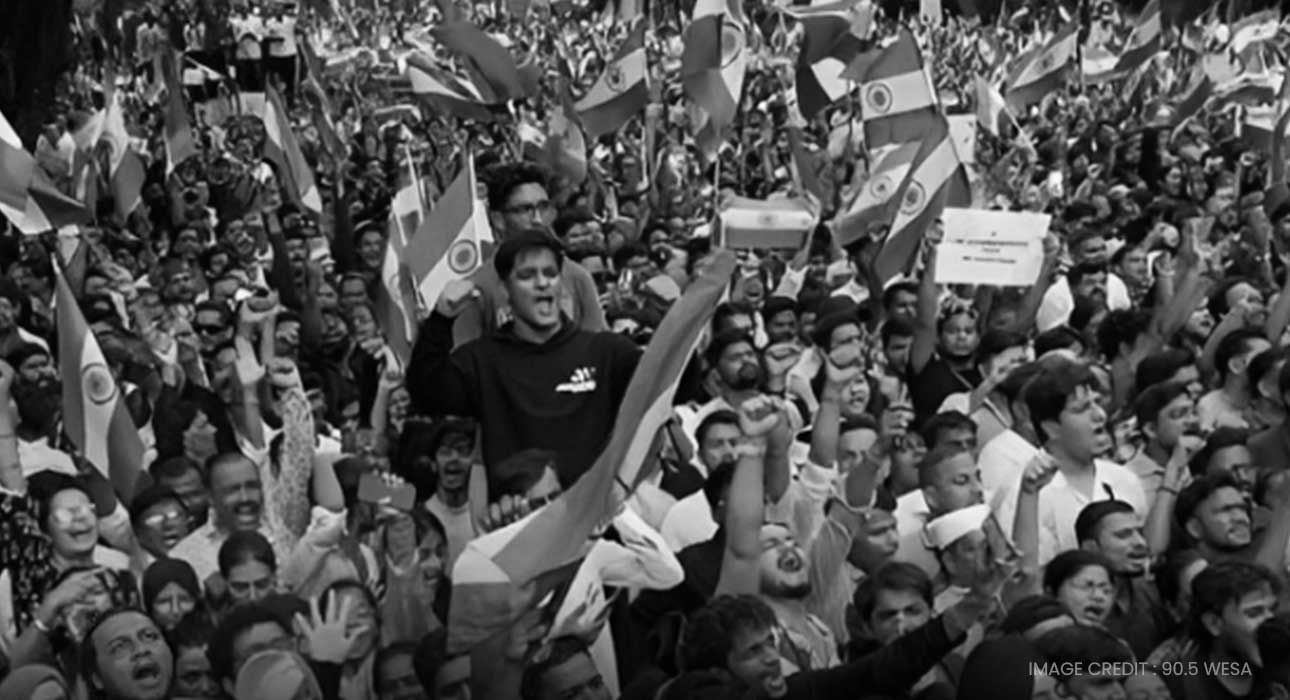
More than 24 lakh Indian students, who appeared for the NEET-UG medical entrance exam in June 2024, have woken up to the possibility that their future is in jeopardy due to a massive paper leak across the country. Protest videos were being shared on social media within hours, hashtags calling for justice were trending on X (formerly Twitter), and student organisations were creating online petitions collecting hundreds of thousands of signatures.
Previously, it took weeks to organise, but this time around it went all the way to every corner of the country within hours (Careers360, 2024). This was not the only time in history. On Indian campuses, a generation of students has learnt that the smartphone in their pockets is another weapon of political action. Whether it’s the anti-CAA protest at Jamia Millia Islamia and JNU or the NEET paper leak protests of 2024 or the Cockroach Janta Party of 2026, digital platforms have emerged as the main infrastructure of student dissent in India. This article explores how, why and with what limitations students are engaging these platforms to call for change.
Read More: NEET Aspirant’s Suicide Sparks Debate Over Rising Academic Pressure
How Digital Tools Have Re-Shaped Student Organising
The student movement has a long history in India; it began with the Quit India Movement of 1942 and continued with the JP Movement of the 1970s and the Mandal agitations of 1990. The reason isn’t different in the digital age; it’s the how. Previously, organising a march involved physical notice boards, people in chains and weeks of coordination. A survey of student movements in India revealed that 85 per cent of the students agreed that social media is the most preferred platform for initiating movements and protests are being organised in hours using WhatsApp, Instagram and X (Kumar et al., 2017).
One of the most effective organising devices of this new landscape is the hashtag. In the context of social media, a hashtag is a word or phrase preceded by the hash symbol, #, that enables users to categorise their posts and then search for them, as well as to join in on a conversation that’s spread across the internet. The hashtags, such as #NEETScam, #StudentsProtest, #SaveEducation, #JusticeForStudents, have been used to rally and broadcast, informing students that they are not alone, and informing the media and government that a constituency is watching and demanding a response (Raghavan, 2024).
The concept of Agenda Setting Theory (McCombs and Shaw, 1972), which explains the role of traditional media in determining the importance of the issue in the public’s agenda, has been re-applied to the field of digital activism. A hashtag that goes viral will get issues onto the political and public agenda that may be dealt with more privately or not at all. For example, the NEET 2014 paper leak happened, led to a parliamentary forum, and was taken up for a Supreme Court decision as social media pressure could not be ignored during the incident, which would have been much harder in the pre-social media era (Kumar et al., 2017).
New petitions, like Change.org, have brought online student advocacy to the next level. A street demonstration is geographically constrained and time-constrained, while an online petition grows signatures over time and offers a visible, quantifiable amount of public support that institutions and governments would be hard-pressed to ignore. Within days of the results of the NEET 2024, petitions initiated by the National Students Union of India (NSUI) drew significant national response, thus transforming a local concern into a national demand for accountability (Free Press Journal, 2024).
Read More: The Psychology Behind Internet Virality
Indian Student Digital Activism Journey
The Citizenship Amendment Act (CAA) protests of 2019-2020 brought a new phase in the use of digital platforms among Indian students. The peaceful protests against the CAA- a law which critics claimed was discriminatory on religious lines- started by students of the Jamia Millia Islamia and Jawaharlal Nehru University (JNU) were live-streamed and recorded, and shared on social media.
That year, videos of police entering campus became some of the most widely shared political content in India, gathering international attention and solidarity protests in Indian communities around the globe. Research on the discourse of these protests revealed that social media was used as a medium for the construction of identity, justice and democratic rights, which would not have been possible in mainstream media (Frontiers in Communication, 2026).
The NEET examination controversies of 2024 saw some of the longest-running student digital activism examples in recent Indian history. Student dissatisfaction grew quickly when results of NEET-UG revealed that 67 students had scored the highest out of a maximum of 400 marks, with some of them coming from the same test centre, leading to questions about the issue of ‘grace marks’ and ‘paper leak’.
The slogan “24 lakh students want exam, not scam” was spread around, and the demand for the removal of the National Testing Agency (NTA) and a Supreme Court investigation was raised. The campaign went all the way to Parliament, where opposition members had used social media to point to students’ grievances and eventually to changes in the NEET-UG results and the formation of a CBI probe (Careers360, 2024).
Reports of additional irregularities in NEET paper leaks and CBSE’s on-screen marking prompted students to launch a social media movement called the Cockroach Janta Party (CJP) in 2026. Although they initially created the movement as political satire and chose the name to provoke discussion, they quickly transformed it into a major political mobilisation. Thousands of students and supporters participated in physical protests at Jantar Mantar in Delhi while simultaneously running a strong social media campaign. The hunger strike at the protest site brought further national attention to the movement, highlighting the interdependence of digital and physical means of action (France 24, 2026).
At the institutional level, TISS, Mumbai, suspended a Dalit PhD scholar because of his activist social media posts. This case demonstrated that social media can support activism while also exposing students to institutional or state scrutiny when institutions or governments monitor online spaces (People’s Dispatch, 2025).
Read More: The Bystander Effect in the Digital Age: Why We Scroll Instead of Help
Digital Platforms Open Opportunities: What They Can Enable
Student movements have some features that were unavailable to previous generations of activists: the ability to be digital. The first advantage is speed. People can capture, disseminate, and react to events within minutes, making it much harder for authorities or other actors to control or suppress information before it reaches a wider audience. Reach also plays a crucial role. Within hours, national media can pick up a protest on a campus in Patna and generate nationwide support for it, whereas previously only local students, student unions, and the protesters’ friends and relatives knew about it (Banerjee, 2023).
Digital platforms also help to reduce the barriers to citizen participation or participatory democracy. Students who have specific financial, disability, location, or fear of reprisal reasons for not attending a physical march may sign a petition, post a comment, make a donation, or join a trending discussion. This inclusion expands the reach of social movements by engaging students whom political processes had previously overlooked (Sharma, 2024).
The third, and not least, is documentation. Students can record and save an evidence record of events (police actions, screenshots of institutional communications, timelines of exam irregularities, etc.) that can help them with future legal proceedings, journalistic investigations and parliamentary debates. As of now, the evidence cited in Supreme Court petitions filed on behalf of students in the NEET 2024 case includes social media documents of anomalies in the results.
Read More: NEET Aspirant’s Suicide Sparks Debate Over Rising Academic Pressure
Finding Out the Things Digital Activism Can’t Do
Digital activism, though powerful, has many key weaknesses that are becoming more apparent in both research and activism. The one that comes to mind is slacktivism. It refers to low-effort online engagement, such as liking, sharing, or signing a petition. It allows users to feel like they have done something, even though they have not brought about any real-world change. Research on the success of online petitions indicates that digital petitions alone rarely produce policy change. They need to be supported by offline efforts. These include legal action, street protests, media attention, and political network building (Gladwell, 2010).
The second limitation is that visibility on social media platforms is not neutral, due to the algorithmic structure of these platforms. Platforms such as X and Instagram use algorithms, or automated systems, to determine which information users see. These algorithms often promote content that evokes strong emotions, regardless of its accuracy.
That is, misinformation can be propagated as quickly as verifiable facts during a protest. This can damage the credibility of a protest movement. One of its impacts is the structural underrepresentation of marginalised voices. These include students from rural areas, lower castes, and non-English-speaking backgrounds. This occurs on platforms that prioritise content from urban areas. These platforms also favour the English language and accounts with high numbers of followers (Frontiers in Communication, 2026).
A third danger is that of surveillance and retaliation. The TISS case of Ramadas Sivanandan demonstrates how digital visibility can amplify protest. In this case, the institute suspended him because it described his social media posts as “evidence of political activism.” It also shows how institutions can subject individual students to institutional or legal consequences. The Information Technology Act in India has provisions to detain people for posts on social media deemed seditious or defamatory. This results in a chilling effect, or a reluctance to speak freely, on students’ digital expression (Peoples Dispatch, 2025).
Lastly, there is a digital divide between those who have easy access to smartphones, data, and digital literacy and those who do not. This skews digital student activism towards the voices of urban, educated, and relatively privileged students. The students of rural colleges, first-generation learners, and students belonging to economically marginalised populations may experience institutional issues. These issues are similar to those faced by students of urban colleges. However, they have fewer tools, resources, and support to document and amplify their grievances (Sharma, 2024).
Read More: The Role of Parental Supervision and Digital Literacy in Preventing Early Exposure
Conclusion
Ever since the country came into existence, Indian students have protested. Now, a generation carries in its pocket the power to document, amplify, and coordinate protests in real time. This allows audiences to witness events that previous generations of activists could only have dreamed of reaching. Whether it is the anti-CAA sit-ins on digitised platforms live-streaming from Shaheen Bagh or the hashtags #NEET trending across every state in India simultaneously. And mocking the political parties, the internet has amplified student civic action in India. It has increased both its extent and its pace.
The digital space is not neutral nor free of charge, however. Algorithms disproportionately amplify some voices. There is the spread of misinformation, along with a genuine grievance. There is private surveillance, and the consequences of it are serious. A hashtag trending on social media does not lead to policy change. It will not bring about institutional response unless there is offline organisation, legal action, and sustained pressure behind it. The best student transportation of this time is not all digital or all physical, but digital-ish and physical-ish. A smartphone is a tool- it’s all in what students decide to create with it.
References +
- Banerjee, R. (2023). Youth movements and digital democracy in India. Samya Publications.
- Brandsynario. (2024, July 2024). Inside Delhi student protests: Demanding education reforms. https://www.brandsynario.com/news/international-news/delhi-student-protest/
- Careers360. (2024, July 3). NEET 2024: Paper leaks, arrests, online exam, student protests, Parliament debate — the story so far. https://news.careers360.com/neet-2024-paper-leaks-supreme-court-cases-arrests-student-protests-new-nta-chief-re-exam-parliament-debate-cbi-probe-story-so-far/amp
- France 24. (2026, July 22). India student protests keep up pressure on Modi government. https://www.france24.com/en/live-news/20260722-india-student-protests-keep-up-pressure-on-modi-government
- Free Press Journal. (2024, June 8). Students protest NEET UG 2024 results amid paper leak controversy; call for re-exam. https://www.freepressjournal.in/education/students-protest-neet-ug-2024-results-amid-paper-leak-controversy-call-for-re-exam
- Frontiers in Communication. (2026). Social media as a platform for resistance: Examining the language of dissent in Indian society. Frontiers in Communication. https://doi.org/10.3389/fcomm.2025.1648587
- Gladwell, M. (2010). Small change: Why the revolution will not be tweeted. The New Yorker. https://www.newyorker.com/magazine/2010/10/04/small-change-malcolm-gladwell
- Kumar, T., Vijay Kumar, V., & Mohapatra, S. (2017). Student movements of India in recent times and the role of digital media in this context. Academia.edu. https://www.academia.edu/33966973
- McCombs, M. E., & Shaw, D. L. (1972). The agenda-setting function of mass media. Public Opinion Quarterly, 36(2), 176–187. https://doi.org/10.1086/267990
- Peoples Dispatch. (2025, March 18). Students fight for democracy at Indian universities as political repression escalates. https://peoplesdispatch.org/2025/03/18/students-fight-for-democracy-at-indian-universities-as-political-repression-escalates/
- Raghavan, M. (2024). India’s youth and the future of democracy. Manan Books.
- Sharma, A. (2024). Youth, social media, and inclusive democracy: Reimagining political participation. International Journal of Research and Scientific Innovation, 12(7). https://doi.org/10.51244/IJRSI
- Sharma, T. (2023). Politics 2.0: Social media and the new Indian democracy. HarperCollins India.




Leave feedback about this