







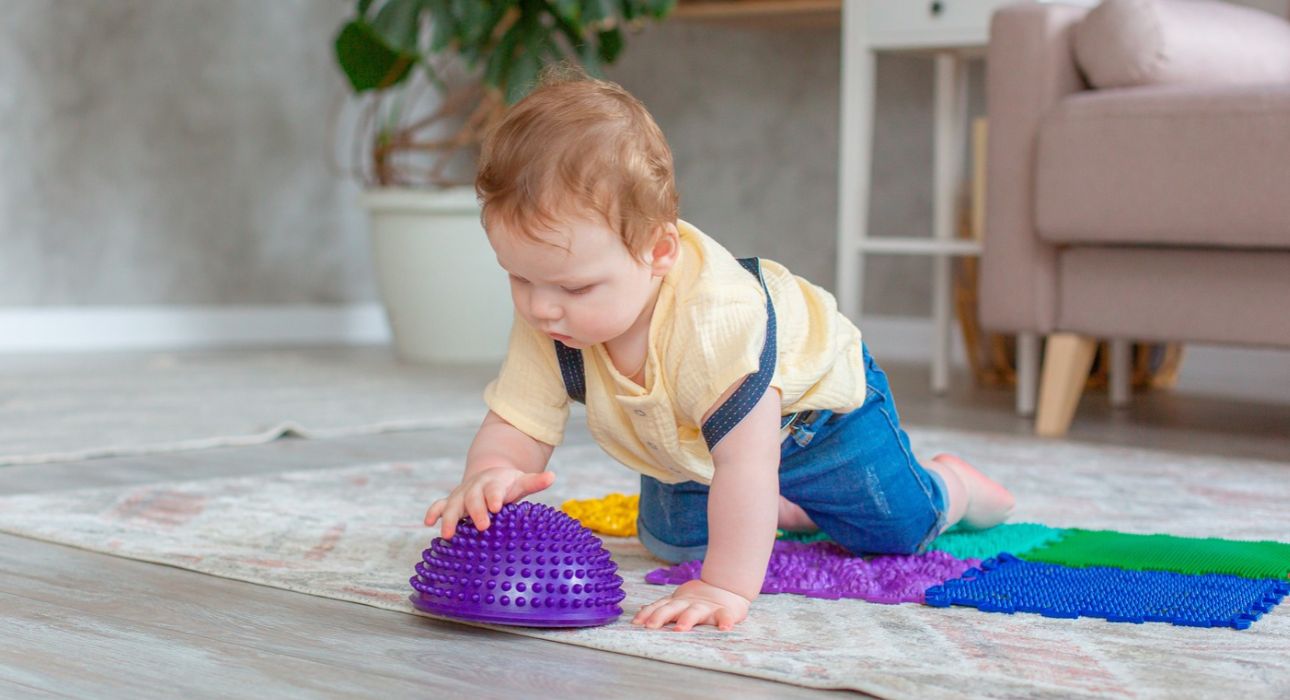
Babies’ minds are not empty at birth, waiting to be filled with information. According to current developmental research, children have some fundamental perceptual skills and preferences from birth, and early learning results from a combination of nature and nurture. Through regular interactions, parents, teachers, siblings, and caregivers help them develop and hone these skills. Mothers and caregivers have engaged in various activities that are essential to a child’s development since birth. These activities, in educational terms, are called sensory play or sensory activities. These activities are age-appropriate, ranging from infancy to toddlerhood. Sensory activities help in learning and the development of the brain and neural pathways. This is a well-known theory discussed in pediatric medicine. According to the American Academy of Pediatrics, role play in early childhood development is very crucial (Yogman et al., 2018).
It is easy to assume that playing with an infant is simply a fun pastime, and that a baby lying on a mat or listening to a lullaby is not really “understanding” anything. This is far from true. In these small, everyday moments, an infant’s brain is actively developing, and neural pathways are being built that shape how they will sense, move, and connect with the world later on.
We will go through some of the activities that new born’s mother’s can use to enhance their child’s sense of touch, sight, sound, and movement. All of the activities discussed here are exploratory in nature or develop sensory awareness among infants. These plays are safe to use under careful observation and are backed by research. Also, some of these sensory activities are used to give meaningful stimulation at home.
Furthermore, we can also use these activities for the development of differently able children. However, children with special needs have additional sensory needs and require adjustment with the intensity or pace of the play.
Read More: “You’re Not Listening!” What Toddler Hitting Is Really a Communication
Touch
The most studied sense in infant development is the sense of touch. There is extensive research on skin-to-skin touch (kangaroo care). From the moment a child is born, they are given skin-to-skin touch by the doctor, nurse, or mother. According to a systematic review, early skin-to-skin touch between parents and the newborn improves physiological balance, supports early attachment, and is beneficial for both preterm babies and full-term babies (Moore, Bergman, Anderson, & Medley, 2016). These activities are not limited to hospitals only; any parents can continue them at home.
Practical Activities
Some practical activities to build a sense of touch are:
- Providing skin-to-skin exposure in the early days.
- Wrap your infant in a soft cloth or use a carrier to give gentle movements.
- Introduce different textures during play, like soft fabric, a hard object, a cold teething cake, or a texture board book.
- Give an oil massage regularly.
Careful observation is needed during these activities as infants easily get irritated, anxious, or restless and start to fidget under touch. There brain get overstimulated easily. This sensory processing difference is common among children who are born prematurely and have developmental delays (Lucas et al., 2023). As compared to other sensations, they are more sensitive to touch. Instead of light touch, they require firm, steady contact, firm massage, and a secure swaddle. Research shows that special children are more relaxed and calm when they are handled with deep, steady pressure (Piller et al., 2025).
Sound
An infant’s hearing system activates long before they are born. Early exposure to a mother’s voice has a remarkable effect on the baby’s brain development. In 2015, a study was carried out using brain imaging, and it found that in comparison to infants who only hear hospital background noise, infants who are introduced to a mother’s voice recording or a heartbeat have a significantly more developed auditory cortex (Webb, Heller, Benson, & Lahav, 2015). It shows that the sound of the caregiver helps in the development of the brain.
Read More: Sensory Play and Brain Development: How Messy Play Builds Healthy Minds
Practical Activities
Listed below are some activities useful for infants’ auditory development:
- Talk out loud during day-to-day activities with your fetus.
- Sing or read poems aloud even if you are not confident about your voice.
- Narrate simple stories, or sing traditional folk songs and lullabies passed down in your own family or culture.
- Play gentle music or use different play mats that have a sound system installed.
All of these are only helpful when done in a manner that does not disturb the child. The loudness of the music can startle a child or even scare them. So, keeping the volume in mind is necessary, especially for children who are special or have a lower sensory threshold. These children prefer quietness, but rather than using both music and conversation, a single thing would be appreciated. This way they may not feel left out.
Sight
Vision holds great importance for adults and children. At birth, vision only works about 20/400. And infants are more attracted to high contrast color then to fine, soft colors in early weeks (Fantz, 1963; Norcia, Tyler, & Hamer, 1990). They put more importance on things or objects that are vibrant in color or have white- and-black patterns.
Practical Activities
Activities that can be used to enhance sight are:
- Holding high-contrast objects and picture cards in front of the baby.
- Small face-to-face talk, while smiling
- Use of slow-moving objects in front of the infant. They will track the objects using their eyes.
- Mirror play are fundamently important for infants as it supports motor skills, visual tracking, and self-awareness.
All of these activities are only helpful when they match the child’s needs. Babies get tired fast. They stop paying attention quickly. Therefore, these actions should be entirely discontinued rather than carried on. Additionally, infants who are sensitive to sensory information get easily overwhelmed. They engage in these activities for brief periods of time, such as 30 seconds of playing cards or staring into someone’s eyes, before losing interest. So managing time here is a crucial element.
Movement
One of the most studied sensory outputs is a child’s movement. Infants who started to crawl or show movement early on tend to be more active. Moving arms and legs, turning sides, grabbing objects, and lying on their tummy all show gross motor skills. A systematic review of thousands of infants shows that infants who are allowed to have tummy time under supervision develop gross motor skills early. After a few months, they start to turn over and later learn to crawl. Hence, these infants are at low risk of flat head syndrome (Hewitt, Kerr, Stanley, & Okely, 2020).
Practical Activities
Some of the activities involved in movement are,
- Supervised tummy time for a short period, allowing the child to adjust as needed.
- Use gentle “bicycle legs” movement during diaper change.
- Placing interesting objects at a short distance from them so that they can push their bodies in order to grab them.
- Holding the infants using different approved positions.
All of these activities are helpful when done under supervision. A flat surface is required for tummy time, and the length of time they can do this also matters. When they start to cry, it’s a signal for you to stop the following activity. These activities are essential for children with developmental differences. But compared to normal infants, they require short sessions. None of these activities require any instrument for play. All of them can be carried out at home, using household objects. And these play activities are found to be more effective in comparison to clinical therapy based activites (Piller et al., 2025).
Conclusion
As we all require sensory stimulation, so does the new born babies. So introducing safe activities for the child’s brain and motor development is essential. All of these activities are safe to use doesn’t require any instruments. Most of them are well-known in every common household. However, the duration and intensity of the session are crucial. Because infants have short limitations, and get tired easily. We are supposed to engage them in these activities for the shortest period of time or according to their comfort.
References +
- Fantz, R. L. (1963). Pattern vision in newborn infants. Science, 140(3564), 296–297. https://doi.org/10.1126/science.140.3564.296
- Hewitt, L., Kerr, E., Stanley, R. M., & Okely, A. D. (2020). Tummy time and infant health outcomes: A systematic review. Pediatrics, 145(6), Article e20192168. https://doi.org/10.1542/peds.2019-2168
- Lucas, C. C., da Silva Pereira, A. P., da Silva Almeida, L., & Beaudry-Bellefeuille, I. (2023). Assessment of sensory integration in early childhood: A systematic review to identify tools compatible with family-centred approach and daily routines. Journal of Occupational Therapy, Schools, & Early Intervention, 17(3), 419–465. https://doi.org/10.1080/19411243.2023.2203418
- Moore, E. R., Bergman, N., Anderson, G. C., & Medley, N. (2016). Early skin-to-skin contact for mothers and their healthy newborn infants. Cochrane Database of Systematic Reviews, (11), CD003519. https://doi.org/10.1002/14651858.CD003519.pub4
- Norcia, A. M., Tyler, C. W., & Hamer, R. D. (1990). Development of contrast sensitivity in the human infant. Vision Research, 30(10), 1475–1486. https://doi.org/10.1016/0042-6989(90)90028-j
- Piller, A., McHugh Conlin, J., Glennon, T. J., Andelin, L., Auld-Wright, K., Teng, K., & Tarver, T. (2025). Systematic review of sensory-based interventions for children and youth (2015–2024). Frontiers in Pediatrics, 13, Article 1720179. https://doi.org/10.3389/fped.2025.1720179
- Webb, A. R., Heller, H. T., Benson, C. B., & Lahav, A. (2015). Mother’s voice and heartbeat sounds elicit auditory plasticity in the human brain before full gestation. Proceedings of the National Academy of Sciences, 112(10), 3152–3157. https://doi.org/10.1073/pnas.1414924112
- Yogman, M., Garner, A., Hutchinson, J., Hirsh-Pasek, K., Golinkoff, R. M., Committee on Psychosocial Aspects of Child and Family Health, & Council on Communications and
- Media. (2018). The power of play: A pediatric role in enhancing development in young children. Pediatrics, 142(3), Article e20182058. https://doi.org/10.1542/peds.2018-2058




Leave feedback about this