







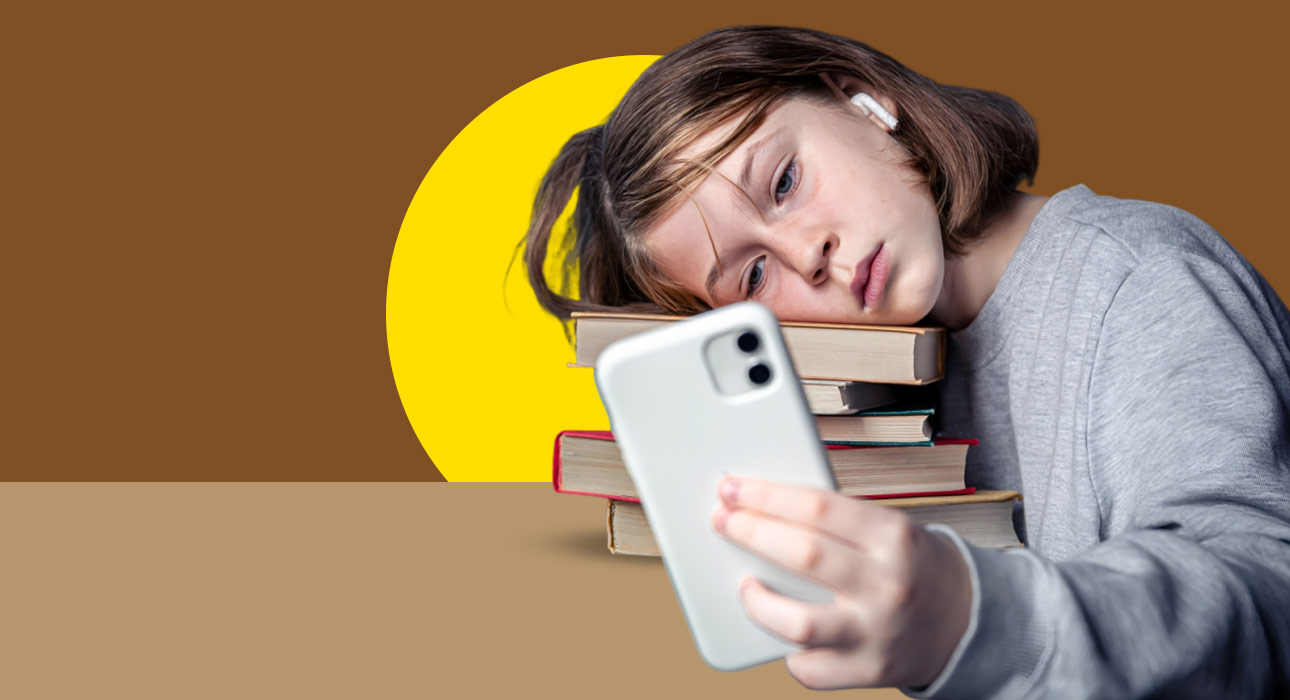
In today’s blended education system, students are facing academic responsibilities along with extended screen exposure. Online classes, digital assignments, and recorded classes have made screens an unavoidable part of learning. Technology has improved access to education to the last mile of the country, but on the rearer side, it has also introduced a growing challenge (i.e., screen fatigue. Addressing the challenge has become the need of the hour in order to protect the mental well-being of the students.
Read More: How do Responsibilities impact us?
Screen-Based Learning: Rising trend
Over ten years, the way we learn has changed a lot because of computers and the internet. We used to sit in a classroom with a teacher and use books manually. Now, we do a lot of our work on computers and phones. We take classes, do homework on the computer, and even have virtual classrooms. This change happened fast when the COVID-19 pandemic started, and schools had to close. Schools and universities around the world had to start teaching online out of no way (Hashish et al., 2022). As a result, computer screens, tablets, and smart phones has became mandatory for students to learn.
The virtual learning platforms are getting really big. This is helping a lot of students. Now, people who live away or do not have a lot of resources can take classes that they would not have been able to take before. These online tools are also very helpful because they have things like videos and games that make learning fun. On the other hand, virtual learning platforms mean that students have to spend a lot of time staring at the screen.
Virtual learning platforms have changed the way students learn. According to research on students’ views of online learning, students report that online education increases their screen time. Prolonged exposure to digital screens has been linked with visual discomfort, headaches, and reduced attentiveness among students engaged in extended periods of online learning (Hashish et al., 2022)
Read More: Do you know about Hybrid learning? And, its impact on children’s
Cognitive Overload and Reduced Attention Span
When we are learning from screens, our brain intakes more information. The brain can only handle one piece of information at a time. When students see a lot of information like videos and messages, it can be hard to focus. This is because our brain is trying to multitask. Screen-based learning can be hard when we have to look at a lot of things on the computer or phone. The brain gets tired when it has to take in much information from the screen.
Additionally, research scholars have noted a broader shift towards diminished sustained attention, where the brain becomes conditioned towards rapid task switching rather than deep, uninterrupted focus. This shift can decrease students’ ability to engage fully with longer academic materials or tasks requiring prolonged concentration.
Managing Academic Demands and mental well-Being: A challenge
Balancing studies and personal life is really tough for students these days. Students have a lot of things to do for school, such as assignments and projects. Some students also do part-time jobs and learn other skills. Managing all of these things can be really tough for students. When these demands cluster without adequate breaks, students experience stress, anxiety, and even burnout, all of which negatively affect their overall well-being (Benítez Agudelo et al., 2025; How Academic Workload Affects Student Well-Being, 2026).
When you start with a workload that seems okay. Then you have a lot of things due at the same time, and it becomes too much. Students often find themselves staying up late, not exercising, and not spending time with friends because they are trying to get all their schoolwork done. This happens when students have deadlines in the same week, and they feel like they have to do everything all at once to meet deadlines.
Deadlines can be really stressful for students. Research on student mental health says that, when students have to deal with school work all the time, they often have trouble sleeping, feel anxious and have a hard time coping with things(Benítez-Agudelo,2025). Addressing this challenge needs both individual and management support for developing time-management strategies, better academic policies that foster sustainable success without sacrificing health, and access to mental health resources.
Read More: Why Chasing Achievement Leads to Burnout and Disconnection
Role of Educators in Managing Screen Load
In the world we live in now, where computers and the internet are such a part of learning, teachers are really important too. Teachers do not just teach students things; they also show them how to use computers and other digital stuff because there are many screens in classrooms, like laptops and special boards on which you can write. Teachers have to make sure students are using technology and also doing the school work. Teachers have to find a balance between the two, so students can learn in the best way possible.
For example, we can do things like group discussions or experiments. They may help us to stay away from screen time and really think about what we’re learning. We need to make sure students understand how to use devices healthily. Digital devices like computers and phones are really helpful for learning, but how we use them plays a major role in blended education.
Read More: Emotional Wellbeing in Blended Education: A Psychological Perspective
Moving Towards Sustainable Digital Learning
Sustainable Digital learning is about using tools in a way that really works and also making sure students are doing well. Sustainable digital learning is what we need to focus on for blended education to work. Research shows that the rapid digitalisation of learning environments must be paired with digital literacy to truly support sustainable and inclusive education for all learners.
Sustainable digital learning is really important. The main thing is to make sure that technology helps make things fair for all students and good for their minds. This means we should try not to make students stare at screens much and help them really talk to each other. Sustainable digital learning is also about teaching students how to use technology in a way and giving them chances to use what they learn in the real world, not just on the computer.
Sustainable digital learning is about making sure technology really helps students and does not get in the way of their learning. Such approaches help reduce cognitive overload and build resilience, enabling learners not just to absorb information but to connect and apply what they learn.
Conclusion
“A mind that is rested learns deeply; a mind that is exhausted merely endures”. Balancing screen fatigue and academic demands has become a growing challenge. Hence, it is important to move towards developing a sustainable digital learning experience to manage. The sustainability of digital learning also involves policy and institutional support. Schools and universities must adopt frameworks that balance screen-based instruction with activities that support critical thinking and offline study habits. Proper planning in education, such as screen breaks, can lend a hand to improve the mental well-being of children.
References +
Latif, M., Ali, T., & Naseem, A. (2025). The impact of screen time on students learning in higher education. Dialogue Social Science Review (DSSR) https://www.thedssr.com/index.php/2/article/view/174
The Flex Edu. (n.d.). Understanding the effects of screen time on well-being in online learninghttps://theflexedu.com/effects-of-screen-time-on-wellbeing/
Muennig, P., et al. (2025). Digital device usage and childhood cognitive development: Exploring effects on cognitive abilities. https://www.mdpi.com/2227-9067/11/11/1299
The Flex Edu. (n.d.). Assessing the impact of online learning on attention span in students. https://theflexedu.com/impact-of-online-learning-on-attention-span/
Understanding the impact of screen time on student well-being in online learning. https://treklearn.com/impact-of-screen-time-on-student-well-being/
How Academic Workload Affects Student Well-Being (2026). https://en.mercopress.com/2026/01/12/how-academic-workload-affects-student-well being
National Centre on Curriculum and Classroom Context (NCCE). https://ncce.org/teacher tips-managing-screen-time-for-optimal-learning/
Teacher’s Guide. (n.d.). Screen time management for learning. https://teachersguide.net/screen-time-management-for-learning/
Edutopia. (n.d.). Students need to learn to manage their own screen time. https://www.edutopia.org/article/students-need-learn-manage-their-own-screen-time
Shadiev, R., Reynolds, B. L., & Li, R. (2024). The use of digital technology for sustainable teaching and learning. Sustainability, https://doi.org/10.3390/su16135353




Leave feedback about this