







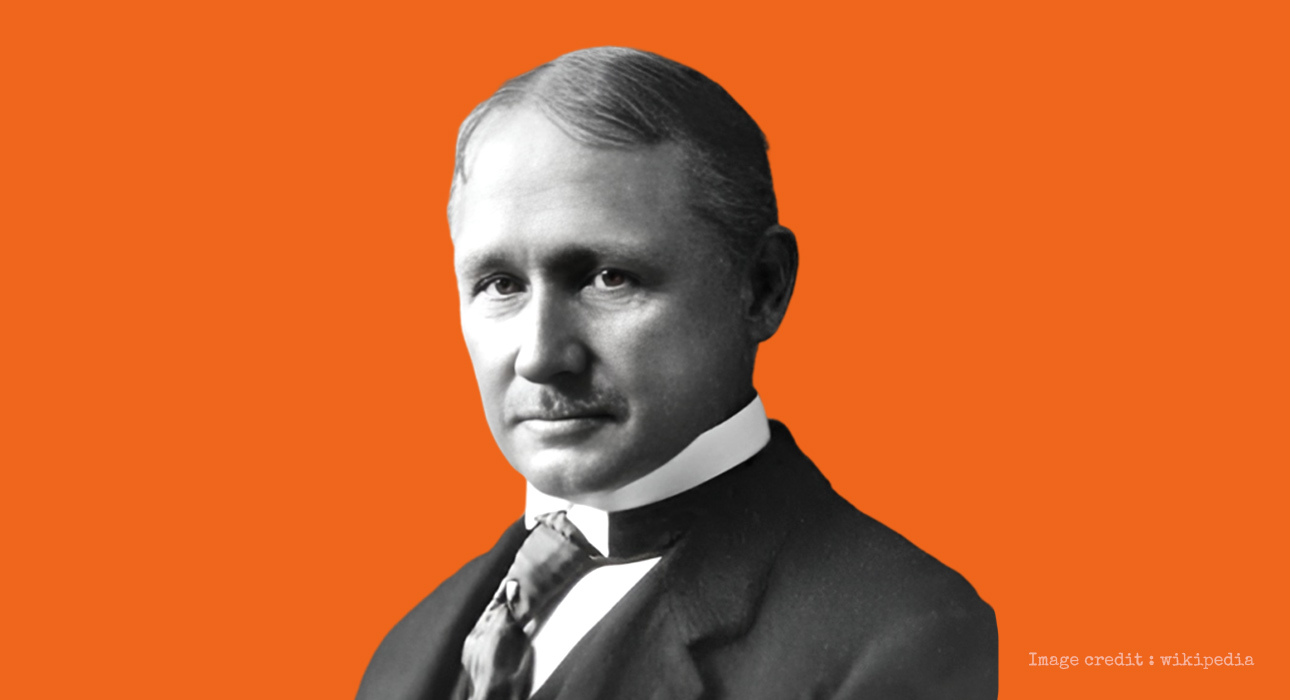
Can you imagine being told your entire work activities can be measured? How long you took to complete a task, how many units you could make and even how much time you took between tasks. Today one might think these are instructions used in the warehouse for employees, guiding workers via digital dashboards or software applications. The whole idea dates back almost a hundred years.
Frederick Winslow Taylor’s 1911 publication, The Principles of Scientific Management, proposed that organisations should not rely on “rules of thumb” or traditions but should standardise and systematise their processes while measuring performance (Taylor, 1911). With rising industrialisation, Frederick Taylor’s contribution to the field is an inseparable part because he puts productivity as part of management processes and performance at work as the centre of organisational procedures. But this actually led him to a dilemma of whether an increase in efficiency actually leads to an improvement in jobs, or it leads to controlling the workers.
Read More: It’s Okay to Rest: Rewriting the Inner Narrative Around Worth and Productivity
Scientific Management: The “Rules of Thumb” and the Rise to Science
Frederick Taylor’s core concern in industrial operations is that productivity is at stake due to a lack of uniform ways of performing any task. He suggests that the work process should be systematically measured by using a scientific experimental approach. Scientific management’s fundamental aspects consist of:
- Scientific Methods to Tasks: Rather than depending on traditional ways, scientific observation should be used to identify the efficient methods.
- Standardised Operations: The work procedures, tools and implementations need to be standardised.
- Selection and Training for work: Employees should be selected according to their capabilities and trained systematically.
- Division of Labour and Responsibility: The managerial role is to plan and design the tasks, while employees carry out tasks according to established methods.
- Performance Incentives: Pay and rewards could be connected to productivity and performance (Taylor, 1911).
Instead of assuming that productivity depended primarily on individual effort or managerial authority, Taylor argued that organisations could systematically design work. It’s significant to understand that Taylor considered that higher productivity would also provide equal benefits to the organisation and employees, including wage benefits and low-cost production of the products (Taylor, 1911). The main concern is therefore not in aiming at productivity itself, but in its measurement process, control structure, who manages it and who finally benefits from it.
What Makes Taylorism So Effective?
Taylor’s important contribution was to establish that workplace procedures should not rely on beliefs; instead, organisations should base them on facts and measurement. Modern organisations now measure performance, identify workflow issues, design training and enhance productivity using data-based analyses. Key Pillars of Its Effectiveness:
- Extreme Job Fragmentation: Complex jobs are broken down into tiny, simple steps. This minimises the learning curve for new hires and ensures rapid execution.
- Time and Motion Studies: Managers use stopwatches and precise analysis to eliminate unnecessary movements, finding the absolute “one best way” to perform a task.
- Absolute Standardisation: Every worker uses identical, optimal tools and procedures. This guarantees consistent quality and radically reduces errors.
- Separation of Planning and Doing: Workers focus exclusively on rapid physical execution. Meanwhile, specialised managers handle all scheduling, process design, and analysis.
- Piece-Rate Incentives: Financial rewards are directly tied to individual output. Workers are paid more only if they produce more, which aggressively combats slacking.
Taylorism maximises productivity by transforming human labour into a highly optimised, predictable machine. However, this intense focus on speed and standardisation often succeeds at the expense of worker autonomy and well-being.
Read More: The Psychology of Workplace Belonging: Driving Engagement & Productivity in Hybrid Workplaces
The Human Machine
When organisations use productivity as a standard for measuring success, Taylor’s model becomes controversial. “Scientific Management” could fragment work into small, repetitive activities and place considerable decision-making authority in the hands of management. This framework minimises workers’ “autonomy,” “work diversity,” and “personal judgement skills,” which modern Organisational Psychology can help evaluate. As modern organisations focus more on the psychosocial aspects of employees, workplace design significantly influences worker behaviour (Bright & Cortes, 2019).
The Hawthorne Studies (1924–1932) shifted attention towards employees’ attitudes, social relationships, supervision styles, and workplace behaviour. The study has contributed to perceiving workers from the perspective of human beings and as social beings rather than simply units of production (Sonnenfeld, 1985). Human Relations Theory argued that organisations cannot measure productivity solely through physical working conditions and task efficiency; employee motivation, meaningful work, workplace relationships, and leadership also play crucial roles in shaping workers’ behaviour (Bright & Cortes, 2019).
Read More: Humanistic Leadership in Competitive Workplace: How Empathy Drives Productivity
Motivation: Something More than Money in the Workplace
Frederick Taylor proposed that financial rewards were a key factor in motivating workers, but later research showed that employees are motivated by factors beyond income. For example, Deci and Ryan’s (2000) Self-Determination Theory emphasises:
- Autonomy (the ability to have control over their own decision),
- Relatedness (having a meaningful relationship with others),
- Competence (the ability to perform their jobs effectively).
Organisations that maximise output while minimising autonomy may therefore create a paradox: employees can experience high levels of control without necessarily feeling highly motivated (Deci & Ryan, 2000).
Similarly, the “Job Characteristics Model” (Hackman & Oldham, 1976) framework indicates that tasks which allow workers to develop skills, identity and significance as well as give them ‘autonomy’ and ‘feedback’ are highly motivational job roles for workers. Their model was tested on 658 employees across 62 different jobs, demonstrating the importance of job design in understanding internal motivation.
These approaches prove to be a great evolution from the Taylorist approach for measuring the efficiency of the task, whereas modern organisational psychology evaluates the task not just from an efficiency-based lens but also from its meaningfulness, motivation levels, sustainability and employees’ psychological well-being (Bright & Cortes, 2019).
Read More: What Successful People Always Do in Their Free Time, a Psychological take
Efficiency Leading to Exploitation
The strongest criticism of Taylorism concerns the possibility that measurement can become a mechanism of control. If organisations quantify every task, they may feel tempted to continually raise performance expectations without considering human limits.
Digital technologies can now track productivity at a scale Taylor could never have imagined. Algorithms may control the allocation of work, monitor workplace productivity, define roles, manage schedules and rate employees, known as algorithmic management (where computer-programmed systems coordinate and supervise work) [International Labour Organisation (ILO)].
Recent research in the logistics and health-care sectors, looking at algorithmic management, found that technology can indeed increase efficiency, while simultaneously raising concerns about job quality and invasive monitoring. The technological effects depend critically on the regulatory and institutional context. They are not inherent in producing either positive or negative impacts (Rani et al., 2024). The modern dilemma is therefore not about technology vs. workers. Technology’s impact depends on how organisations design and govern it.
Read More: Can Emotional Intelligence Protect You from Digital Burnout?
Taylor’s Legacy: Efficiency or Exploitation?
Taylor’s legacy cannot be simplistically viewed as either a contribution to efficiency or a form of exploitation. It contains elements of both possibilities. There were arguments about the limits of inefficient managerial practice and the importance of studying the tasks. As a result, researchers attempted to identify how organisations could better organise jobs through selection, training, standardisation, process improvement, and other methods.
But his model also leads to the over-simplification of jobs and restricted worker freedom. It prioritizes measurable outcomes over human experience, which could reduce satisfaction at work. Thus, scholars have analysed Taylorism as a form of controlling workers. They have also connected its historical logic to newer forms of technologically mediated work organisation (Konovalov, 2023). So, the lesson from Taylor’s model for organisations today is not to reject measuring completely. Measurements can help to improve the quality, fairness, safety and productivity. The important point is ‘measure responsibly’. A psychologically informed organisation should combine:
- Efficiency with well-being.
- Standardisation with flexibility.
- Performance measurement with human judgment.
- Technology with transparency.
- Organisational goals with employee voice.
- Productivity with sustainable workloads.
- Accountability with autonomy.
This approach recognises that people are not simply inputs in a production system. They are thinking, feeling, learning, and socially connected participants in the organisation.
Conclusion
Taylor himself brought about a shift, primarily by asking the managerial apparatus to stop guessing rather relying on scientific analysis of work. Over a hundred years later, his core obsession with efficiency is still very much present. Organisations can see this in performance dashboards, standardised tasks, productivity goals, and algorithmic work controls.
However, modern organisational psychology shows that we cannot understand work solely through the lens of efficiency. Rather, it is autonomy, competence, and relatedness that foster work motivation. Meaningfulness, task design, interpersonal interactions, and adequate resources also play an important role (Deci & Ryan, 2000; Hackman & Oldham, 1976; Parker et al., 2017).
A workplace that increases productivity at the expense of employee well-being, suppresses employees, or dehumanises them cannot remain truly efficient in the long run. The task of modern organisational psychology appears to be to keep the scientific temper. It also involves keeping the spirit of questioning that Taylor initiated. At the same time, we must reject the assumption that humans are merely units of production measured against their output. Thus, we should focus not on making humans more efficient, but on making efficiency work for humans.
References +
- Taylor, F. W. (1911). The principles of scientific management. Harper & Brothers.
- Hackman, J. R., & Oldham, G. R. (1976). Motivation through the design of work: Test of a theory. Organizational Behavior and Human Performance, 16(2), 250–279. https://doi.org/10.1016/0030-5073(76)90016-7
- Sonnenfeld, J. A. (1985). Shedding light on the Hawthorne studies. Journal of Organizational Behavior, 6(2), 111–130.
- Deci, E. L., & Ryan, R. M. (2000). The “what” and “why” of goal pursuits: Human needs and the self-determination of behaviour. Psychological Inquiry, 11(4), 227–268.
- Demerouti, E., Bakker, A. B., Nachreiner, F., & Schaufeli, W. B. (2001). The Job Demands–Resources model of burnout. Journal of Applied Psychology, 86(3), 499–512.
- Bakker, A. B., & Demerouti, E. (2007). The Job Demands–Resources model: State of the art. Journal of Managerial Psychology, 22(3), 309–328. https://doi.org/10.1108/02683940710733115
- Parker, S. K., Morgeson, F. P., & Johns, G. (2017). One hundred years of work design research: Looking back and looking forward. Journal of Applied Psychology, 102(3), 403–420. https://doi.org/10.1037/apl0000106
- Bright, D. S., & Cortes, A. H. (2019). Principles of management. OpenStax. ∙ Konovalov, I. (2023). Labour Process Theory: From Taylorism to algorithmic management. Journal of Economic Sociology, 24(1).
- Rani, U., Pesole, A., & González Vázquez, I. (2024). Algorithmic management practices in regular workplaces: Case studies in logistics and healthcare. International Labour Organisation.





Leave feedback about this