







Parkinson’s disease is a degenerative disorder of the nervous system, during which brain cells responsible for producing dopamine are gradually lost. As a result, patients experience tremors, muscle rigidity, and other motor problems. The most common way to alleviate these symptoms is to prescribe levodopa, also called “the gold standard medication,” which allows one to restore dopamine and relieve Parkinson’s symptoms within seconds. However, levodopa requires extremely accurate dosing since improper treatment may lead to severe side effects like dyskinesia, uncontrollable jerky movements. Indeed, if the dose is too low, patients may not be able to move due to extreme muscle rigidity, while too high a dose will cause dyskinesia.
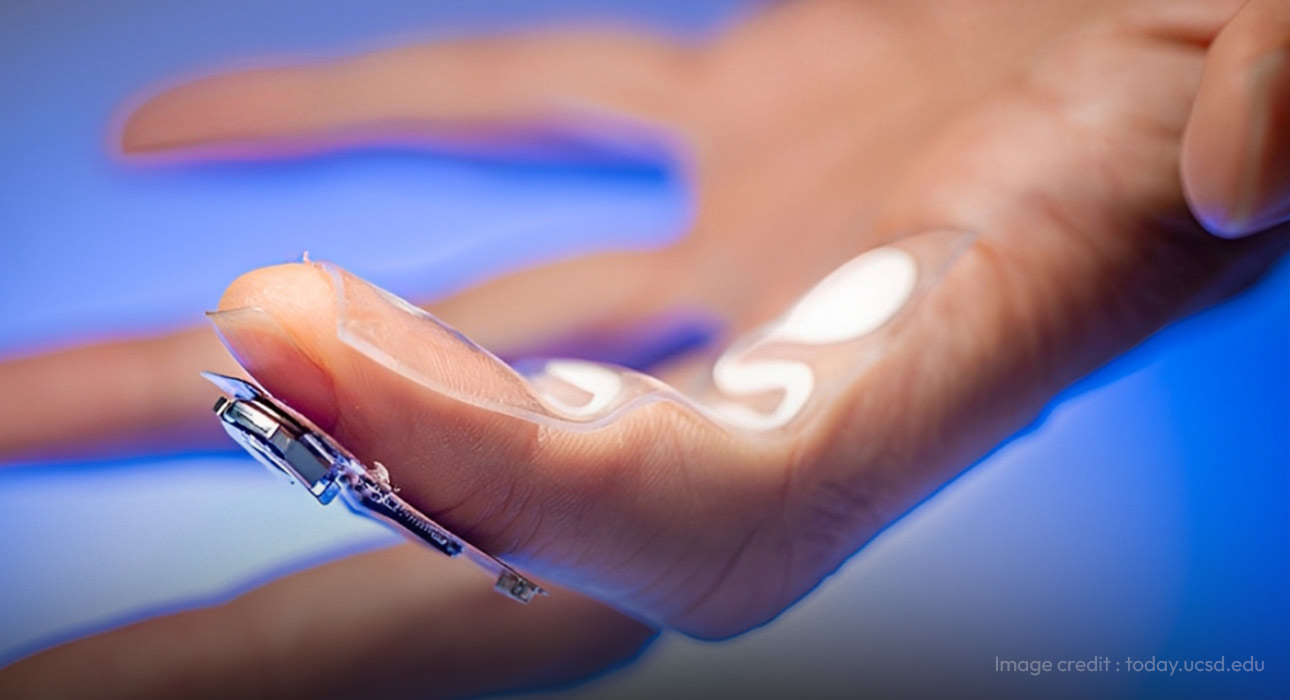
This research introduces a soft, wearable, battery-free patch that can be attached to the fingertip and constantly read the amount of levodopa in sweat, giving a simple, non-invasive way to track how much medication is in the bloodstream. This research is vital because it could provide a better alternative to the current system of patients keeping track of their own medication and having occasional blood tests, which can lead to dangerous spikes in symptoms due to the long time frame of medication changes. This technology could allow patients to better control their medication and create a more personalised treatment that could lead to an automated closed-loop system for treating Parkinson’s.
Read More: Parkinson’s Disease: Understanding Symptoms, Causes & Coping Strategies
Tracking how a drug acts inside the body
The main idea of the paper is pharmacodynamic monitoring, which means the study of the movement of drugs in the body over time and their effect on it, which makes it possible to control the further course of treatment individually for each patient. One of the examples is the constant increase in levodopa levels in patients with Parkinson’s disease after each dose, reaching a therapeutic maximum (most balanced motor function), after which they decrease to a new minimum; the duration of the “therapeutic window” is thereby reduced from several hours to one or two during the progression of the disease, which requires adjusting the dosing regimen.
Currently, clinicians are relying on subjective means such as the patient’s diary, “good hour/bad hour,” recall, or observation during the visit, all of which are limited in terms of capturing fine fluctuations of the state between “ON” and “OFF.” The main takeaway message from our study is that objective and continuous, yet non-invasive, assessment of levodopa levels could fundamentally change the paradigm of clinical Parkinson’s management by enabling timely intervention based on individual patients’ patterns rather than a one-size-fits-all approach, by providing information that is not available at the time of the office visit and by eliminating the need for invasive and inconvenient procedures.
From an everyday standpoint, the patch addresses a simple question: “How can we know, moment to moment, whether a person’s medication level is actually in the range where they can move well and avoid side effects?” This connects engineering, neuroscience, and clinical practice to make Parkinson’s treatment more responsive and personalised.
Experimental design
The study involved a team of engineers and neuroscientists from the University of California, San Diego, including Joseph Wang’s Centre for Engineered Nanomaterials and Environmental Research and his colleagues in the Department of Chemical and Nanoengineering, as well as Irene Litvan’s Parkinson’s Disease and Movement Disorders Centre and her neurology colleagues, a sign of collaboration between sensor developers and clinicians. Healthy volunteers and people with Parkinson’s disease received an immediate‑release levodopa/carbidopa oral dose as study medication.
The device itself takes the form of a small soft patch, which is placed on the tip of the finger known to have a high concentration of sweat glands. Of interest, the patch contains an engineered gel with an increased amount of salts and some inactive solvents, which absorbs sweat from the skin through capillary action and does not require any physical activity, heat application, or electric current to begin working.
The levodopa in sweat interacts with enzymes in the patch to produce a small electrical current. The current not only powers the device (so no external battery is needed) but also provides information about the drug concentration: the higher the current, the more levodopa in the sweat; the lower the current, the less levodopa. The team correlated their measurements of levodopa in sweat to standard blood tests using high-performance liquid chromatography to create a machine learning model that could track blood pressure changes during the day and estimate blood levodopa levels based on readings from the patch.
Relationship Between Levodopa Levels and Motor Functions
One of the most important results of the study was that the sensor’s continuous readouts compared to levodopa levels in blood taken by standard medical practice (HPLC) showed few differences. This is encouraging because it shows that non-invasive methods can provide results as accurate as traditional blood tests. They also offer greater comfort and convenience for patients.
The data also indicated that patients with Parkinson’s disease eliminate levodopa from the body much faster than healthy volunteers, although the bioavailability of the drug was comparable between the two groups. The researchers explained that this phenomenon could be the reason behind the abrupt “wearing-off” effects often reported by patients who have undergone lesioning surgery, resulting in sudden reappearance of tremors, motor problems, or slowed movements between injections.
Moreover, the study found an association between peaks in levodopa levels and low motor scores, indicating that the method tracks relevant biomarkers to manage motor symptoms. Episodes of hypotension occurred shortly after dosing in both groups, and the machine‑learning model found sweat biomarkers and blood pressure to be useful predictors of levodopa levels, yielding a mean absolute error of approximately 2 micromolar compared with HPLC measurements.
Read More: Ideomotor Apraxia: When the Brain Knows the Goal but Loses the Way to Move
Author’s interpretation
The researchers concluded that their experiments provided proof of concept for the passive, battery-free patches to enable continuous, pharmacodynamically relevant monitoring of levodopa in real-world settings. In their opinion, the possibility of assessing blood concentration of the drug based on sweat was critical, as was the correlation of these levels with motor score findings that could guide adjustment of the dosage, timing, or even formulation of levodopa therapy for Parkinson’s disease patients.
They point out that current approaches that ask patients to keep journals and make regular trips to the doctor’s office for blood tests are ill-adapted to the drug’s swift and shifting dynamics. The information from their patch could provide the kind of objective, high-resolution data necessary to individualise treatment schedules and ultimately to create closed-loop systems in which the patient’s sensor would automatically notify a drug-infusing pump when the level of medication in the system drops below the therapeutic threshold.
The authors also suggest that these technologies represent the next generation of wearable biosensors. These devices go beyond counting steps or measuring heart rates. They provide real-time biochemical analyses related to specific diseases and treatments. This development could help doctors assess patients based on how specific medications work inside their bodies rather than relying on more general health measures.
Conclusion
This study found that a stretchy, wireless fingertip patch can help track how much levodopa is in the sweat and estimate how much is in the blood for both healthy people and people with Parkinson’s disease. The study also found that people with Parkinson’s disease clear levodopa out of their system sooner than people who don’t have the condition, which may contribute to unpredictable changes in their symptoms and should be considered when determining optimal medication regimens.
By replacing subjective clinical impressions and intermittent blood tests with objective physiological measurements taken continuously, this technology has the potential to fundamentally change the management of Parkinson’s disease. It could lead to a significant improvement in both dosage and symptom control while reducing patients’ “off” time. The possibility of making such a patch part of a closed-loop system that includes an automated drug delivery system seems likely to have important clinical implications for patients with Parkinson’s disease.
References +
- Neuroscience News. (2026, July 27). Battery-free sweat patch to track Parkinson’s meds. Neuroscience News. https://neurosciencenews.com/neurotech-patch-parkinsons-medication-31138/
- Huang, Y., Gao, X., Yue, X., Yang, Q., Wang, R., Xu, Z., Sheng, Y., Niu, P., Qiu, J., & Sun, Y. (2026). A fully integrated wearable biosensing patch with mechanical robustness for Parkinson’s disease real-time therapeutic monitoring. Chemical Engineering Journal, 539, 177129. https://doi.org/10.1016/j.cej.2026.177129
- Liezel Labios, University of California San Diego. (2026, August 7). This fingertip patch tracks parkinson’s medication using sweat. Scitechdaily.Com. https://scitechdaily.com/this-fingertip-patch-tracks-parkinsons-medication-using-sweat/
- Li, T., Xiao, L., Chen, Z., He, Q., Zhang, R., Zou, H., Yang, B., Zhao, X., Lei, Q.-L., Gao, L., Ma, Y., Tao, Y., Weng, L., Liu, Z., Wang, T., & Wang, L. (2026). Intranasal conformal patch for sustained levodopa delivery and reactive oxygen species scavenging in parkinson’s disease. ACS Nano, 20(9), 7817–7830. https://doi.org/10.1021/acsnano.5c20622
- Frampton, J. E. (2019). Rotigotine transdermal patch: A review in Parkinson’s disease. CNS Drugs, 33(7), 707–718. https://doi.org/10.1007/s40263-019-00646-y
- Wang, Y., Yu, X., Zhang, P., Ma, Y., Wang, L., Xu, H., & Sui, D. (2018). Neuroprotective effects of pramipexole transdermal patch in the MPTP-induced mouse model of Parkinson’s disease. Journal of Pharmacological Sciences, 138(1), 31–37. https://doi.org/10.1016/j.jphs.2018.08.008
- Boroojerdi, B., Ghaffari, R., Mahadevan, N., Markowitz, M., Melton, K., Morey, B., Otoul, C., Patel, S., Phillips, J., Sen-Gupta, E., Stumpp, O., Tatla, D., Terricabras, D., Claes, K., Wright, J. A., & Sheth, N. (2019). Clinical feasibility of a wearable, conformable sensor patch to monitor motor symptoms in parkinson’s disease. Parkinsonism & Related Disorders, 61, 70–76. https://doi.org/10.1016/j.parkreldis.2018.11.024
- Yan, J., Ma, H., Liu, A., Huang, J., Wu, J., & Yang, J. (2021). Efficacy and safety of rotigotine transdermal patch on neuropsychiatric symptoms of Parkinson’s disease: An updated meta-analysis and systematic review. Frontiers in Neurology, 12. https://doi.org/10.3389/fneur.2021.722892




Leave feedback about this