






Personality is at the heart of understanding human behaviour, serving as a primary focus in psychological study for centuries. Personality refers to the unique combination of characteristics that defines an individual. It differs from person to person, yet they might be similar to people in certain aspects and levels. Personality assessment starts with humoral theory.
Now, in any modern workplace, people enter, and someone will eventually make a comment or have a conversation such as “That’s such a High D [Dominance] move,” or “She’s a total S [Steadiness], she hates confrontation.” These remarks aren’t fleeting small talk; they’re short forms drawn from one of the most widely used behavioural assessments in the corporate world: the DISC test. While personality frameworks attempt to map the depths of who a person is, DISC has a well – defined and more practical goal.
It questions how people tend to respond, particularly in communication, decision-making, and under pressure, rather than who they basically are. This unique scope is precisely why DISC has become a need in the hiring process, team integration, leadership development, and conflict resolution (Grizzell, 2022). This article explains the four DISC types, which go back to the model’s origins to William Moulton Marston’s 1928 theory, describes how the DISC works, reviews its practical occupational applications, and examines its key drawbacks.
Where Does DISC Come From?
The assessment goes back to 1928, when American psychologist William Moulton Marston published “Emotions of Normal People”. Marston was not primarily interested in clinical evaluation; he wanted to examine how normal, psychologically healthy people acted differently depending on how they interpreted their environment (as favourable or unfavourable) and how they perceived themselves in accordance with it (as more or less powerful).
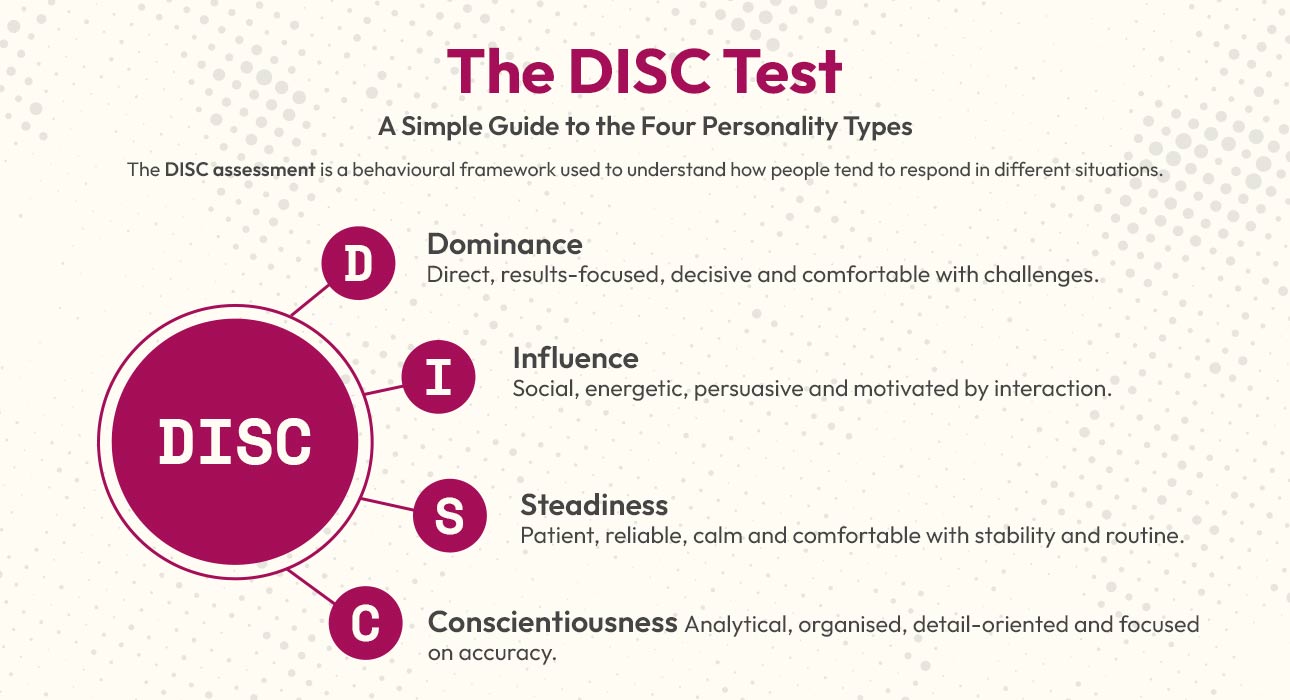
Outlining these two dimensions against each other, Marston proposed four primary behavioural patterns, later formalised as Dominance, Influence, Steadiness, and Conscientiousness (Aini et al., 2023; Grizzell, 2022). He himself did not draft the testing instrument; rather, it was developed over the years later through researchers who built practical assessment tools based on his theory (Grizzell, 2022). Today’s commercial DISC assessments are the progeny of that original 1928 model.
The Four Types are
- Dominance (D): People with D traits are focused on results, control and challenges. They are usually direct, strong and willing to take risks. They prefer exact communication. When people feel pressured, they can become more reactive than responsive, and while making decisions, they respond quickly without consulting others for their perspectives(Aini et al. 2023).
- Influence (I): I-type people are driven by social recognition, high energy and being a part of a group. They are often the ones who voice out their opinions and inputs in the meetings. They are encouraging and positive. Can make others feel good. They think out loud about thinking alone. When they are under pressure, they may get disorganised. Avoid difficult topics to keep things peaceful.
- Steadiness (S): People with high S traits care about working, being reliable and keeping things stable. They stay calm. Help keep projects moving. They like routines and listen more than they talk. Aini et al. (2023) found that in hospitals, the steady type was common, especially in areas where patients needed steady and focused care. When they are stressed, they may pull back from dealing with problems directly.
- Conscientiousness: People with C traits focus on being accurately organised and doing the best work. They ask questions like “why” and “how” before taking action. They like facts over guesses and hold themselves to high standards. When they are stressed, they can become very detail-focused. They solve problems on their own without asking for other opinions.
Many people don’t get categorised into one single type. A typical mix has one or two traits with lower levels, in the others (Grizzell, 2022).
How Does the Assessment Work?
The DISC assessment is pretty simple. It gives statements or groups of words, and you have to pick the ones that best and least describe oneself. People have to rate how much each one is like themselves on a scale. The thing is, there are no wrong answers. The assessment is just trying to figure out what one is like, not how good they are at something.
When people answer the questions, the testee gets responses. Used to make a profile. This profile talks about how people like to communicate, what motivates them, what stresses them out, and how they like to work. The DISC assessment is something they can do on their own, so the results are based on what they think about themselves. It is not like someone else is watching and saying what they are like. This is something to remember when people are looking at their results. The assessment is just showing them what they think about their behaviour. It is not always what someone else might think.
Applications
The DISC assessment translates behavioural insights into practical strategies that optimise day-to-day workplace operations. The following points illustrate how organisations apply these profiles to enhance communication, leadership, and overall team performance.
- Team-building: Knowing the team’s DISC composition, for example, a team that has a lot of D traits and a lot of C traits but not much Pervasiveness and not much Stability helps leaders know where blind spots might occur and allows leaders to precisely balance skill sets with behaviour styles. (Grizzell, 2022).
- Hiring and onboarding: Some organisations use DISC profiles not as a test that you pass or fail. As a way to start a conversation. This helps people who are applying for a job and the people who will manage them to understand how they work. It sets the expectations before the first day on the job.
- Leadership development: Grizzell (2022). The person in charge says that DiSC is really helpful when leaders use it to change the way they talk to people by just trying to figure out what kind of person their staff members are. For example, a manager who is naturally a D type of person may need to make an effort to slow down and give more details when they are giving feedback to an employee who is a High-C type of person and wants to know all the reasons why. They may also need to give support to an employee who is a High-S type of person and is dealing with a big change all of a sudden. This way, leaders can use DiSC to communicate with their staff in a way that really works for each DISC type of person.
- Conflict resolution and healthcare settings: Aini et al. (2023) demonstrated DISC profiling among nursing staff. Found a precise connection between behavioural style and roles. Patient personalities were found in inpatient wards where reliability and emotional regulation matter most. More dominant styles appeared often in recurring units. Broader research on nurses’ personality models describes how knowing behavioural styles can prevent counterproductive workplace behaviour before it becomes a problem (Aini, 2021). This kind of profiling gives managers a vocabulary for mentioning style differences. Reframing what looks like “behaviour, as simply a different, not wrong, approach can de-escalate everyday interpersonal friction.
Limitations
DISC’s popularity sometimes exceeds its empirical rigour, and several limitations matter for anyone applying it in practice.
- It measures behaviour, not ability: DISC says nothing about Thinking ability, skills, or mental well-being; it was exclusively designed for a “normal,” psychologically healthy population rather than as a clinical diagnosis (Rust et al., 2021).
- Self-report bias: People rate themselves on the outcomes, which can vary depending on their mood, the circumstances they’re in or how they want others to see them instead of how they actually act all the time. (Rust et al., 2021).
- Situational: Behaviour can vary meaningfully across many contexts such as personal versus professional, yet most assessments focus only on a single context at a time.
- Mixed scientific standing: Compared with standardised frameworks that examine broad traits like extraversion and conscientiousness and their links to job satisfaction (Kang & Malvaso, 2023), DISC has a likely limited base of peer-reviewed predictive-validity research, leading many practitioners to use it as a useful conversational tool rather than a strictly validated psychometric instrument (Rust et al., 2021).
Conclusion
The DISC framework is still in practice because it is easy to interpret and people can use it easily. It began with Marston’s notion from 1928 about how people respond in situations. After years, it has become a tool that people use in hospitals, schools and companies to communicate well, recruit the right people for jobs, make leadership decisions, and solve problems at work. Researchers like Aini and Grizzell have written about this in 2023 and 2022.
However, we should remember that the DISC model is not perfect because it is based on subjectivity, and it can be different in different situations. Also, it has not been proven to be true by scientists as much as some other models. So we should use it as a way to start talking about people, not as an answer. If we use it in a way, the DISC model can really help teams work together and deal with the everyday problems that come up when people work together.
References +
- Aini, Q. (2021). Detecting nurses’ personality models with DISC. *Bali Medical Journal, 10(3), 1038–1041. https://doi.org/10.15562/bmj.v10i3.2819
- Aini, Q., Dzakiyullah, N. R., & Abdulamir, M. (2023). The use of Dominance, Influence, Steadiness, and Compliance (DISC) personality test in the assessment of nurses’ personal characteristics. “Jurnal Keperawatan Soedirman, 18(2), 111–115.https://doi.org/10.20884/1.jks.2023.18.2.6592
- Grizzell, B. C. (2022). “Using the DiSC personality assessment to enhance organisational climate and culture at a Mississippi university” [Doctoral dissertation, University of Mississippi]. eGrove.https://egrove.olemiss.edu/etd/3014/
- Kang, W., & Malvaso, A. (2023). Associations between personality traits and areas of job satisfaction: Pay, work itself, security, and hours worked. *Behavioral Sciences, 13’(6), Article 445. https://doi.org/10.3390/bs13060445
- Marston, W. M. (1928). “Emotions of people”. Routledge.
- Rust, J., Kosinski, M., & Stillwell, D. (2021). “Modern psychometrics: The science of psychological assessment” (4th ed.). Routledge.
- Beedu, G. K. (2021). A study on the effectiveness of DISC personality test [Doctoral dissertation, Selinus University of Sciences and Literature]. https://uniselinus.education/sites/default/files/2021-07/Tesi%20Beedu.pdf
- Espinoza, J. A., O’Neill, T. A., & Donia, M. B. L. (2023). Big Five factor and facet personality determinants of conflict management styles. Personality and Individual Differences, 203, Article 112029. https://doi.org/10.1016/j.paid.2022.112029
- Nooead, S., & Sooraksa, N. (2025). A study of the relationship between personality (DISC model) and work values of human resources in a multinational company in Thailand. International Journal of Human Resource and Organisation Development, 2, 74–90. https://so13.tci-thaijo.org/index.php/IJHROD/article/view/2712
- Gianakos, D. (2023). Building emotional intelligence through the DiSC assessment. Physician Leadership Journal, 10(4), 52–54. https://doi.org/10.55834/plj.6311340293





Leave feedback about this