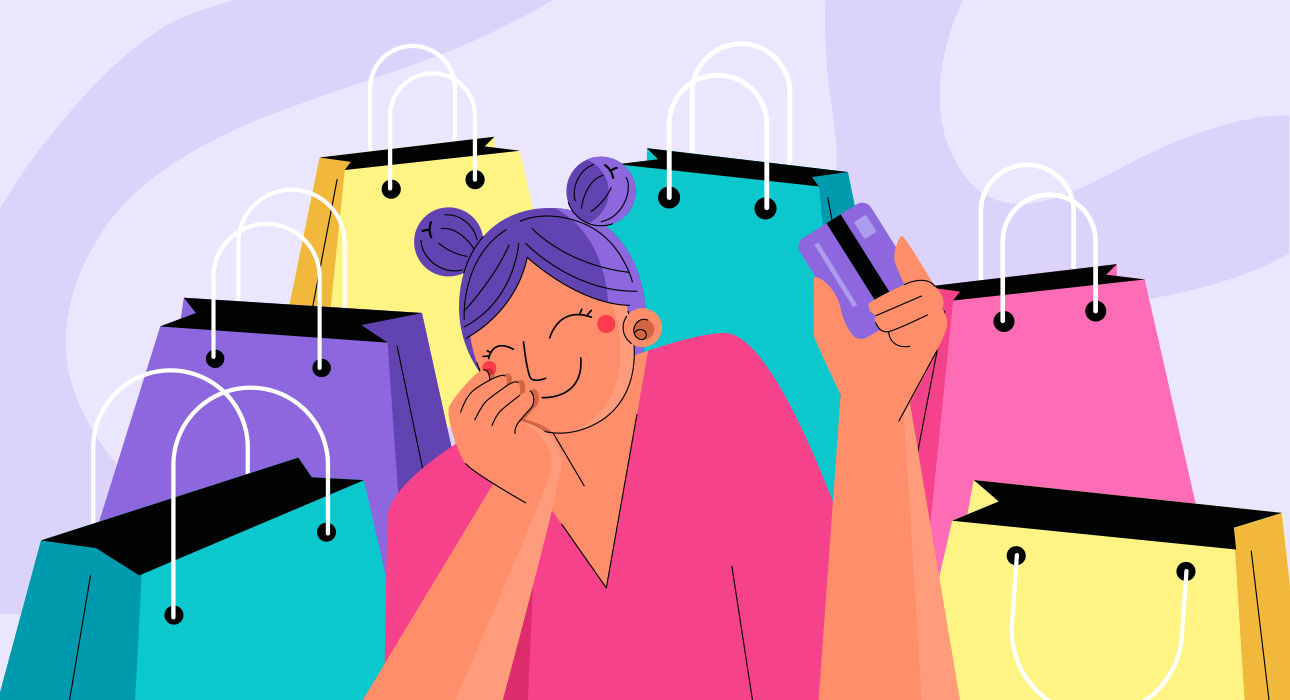
It has not been an easy week for you, and here you are at midnight, browsing through an online store and filling up your shopping cart with things that you don’t even need. Do these instances sound familiar to you? They have an official term associated with them: retail therapy. Almost everybody indulges in retail therapy at some point of time in their lives, irrespective of whether it involves purchasing a cup of coffee, a new pair of shoes, or spending a lot more after having a bad day.
Is it just recreational, or is there something more to it? Many psychologists have tried to explain the reasons behind people’s tendency to buy when they are stressed, depressed, or just plain bored. This article attempts to highlight the psychology of retail therapy and its significance.
Read More: Why do you feel good after shopping? Let’s understand the retail therapy
What Happens in Your Brain
It is not just about the possession of the thing. This entire process is very much connected with the reward process that takes place in our brain. When we buy anything, especially items that we have waited for a long time, a chemical compound is released by our brain called dopamine, making us happy and motivating us. Our brain responds in the same manner in which it does whenever we engage in any activity that brings happiness to us, such as music and other things.
The research proves this hypothesis to be true. As was found by Rick et al. (2014), the purchase of something a person likes alleviates negative emotions like sadness, even if the item purchased is not related at all to whatever is bothering a person. In fact, Rick et al. suggest that purchasing allows people to feel better because the decision-making involved in purchases gives people an opportunity to exert control over their surroundings and, therefore, overcome negative emotions like sadness. The importance of this notion of control cannot be overstated. It appears that when one feels life is out of control, shopping allows one to get a little bit of control back.
It is not only due to poor self-control or impulsiveness, but also a coping mechanism that exploits the workings of the brain’s need for release (Atalay & Meloy, 2011). The problem lies in the fact that such release is usually temporary.
Why Shopping Feels So Good
There is one explanation why retail therapy works, at least for some time. We are giving ourselves an escape from any worries. In just a couple of minutes of browsing or right after the purchase, our focus goes from stress and/or sadness to something else that grabs our attention in a pleasant way. It is all a matter of emotional regulation, or rather one way of doing it, meaning all the mechanisms we use to regulate or adjust our emotions (Gross, 1998).
Research has shown that many individuals purchase things not because of any need, but depending on how they feel at that particular point in time. According to Kacen and Lee (2002), impulsive buying behaviours are frequently induced due to certain moods rather than real needs, as individuals indulge in buying behaviours as a form of consolation or to improve their mood. The research has indicated that culture plays a major part in impulsive buying behaviours of consumers, alongside individual moods.
There is also what can be termed as “self-gifting,” which involves an individual purchasing gifts for him or herself as a form of rewarding him/herself and as self-comfort during difficult times (Mick & DeMoss, 1990). This is different from gift shopping, as gift shopping involves the purchasing of something for another person. Self-gifting is associated with self-significance where one feels that they should be rewarded for surviving difficult times. Here, shopping acquires a symbolic nature rather than the products acquired.
Read More: FOMO and Retail Therapy: The Drivers Behind Impulsive Buying Behavior
When Retail Therapy Turns Into a Problem
Going through retail therapy on a rare occasion is normal behaviour and is nothing to be concerned about. Not everyone who buys themselves a treat after having a bad day suffers from any condition. However, for some people, buying as a way of coping can develop into something harmful, which is called compulsive buying disorder (Black, 2007). The key feature of this disorder is the compulsion to purchase that a person finds difficult to resist.
The usual sequence of events in the life of a compulsive shopaholic includes increased anxiety, then going shopping in order to reduce the anxiety, followed by temporary excitement or relief, and, finally, remorse and regret, which can once again result in initial anxiety. Faber and O’Guinn have developed a scale to identify compulsive buying disorders, since although they seem like quite different activities from regular shopping at first glance, there is one specific set of emotions that accompany compulsive shopping. A compulsive shopaholic perceives shopping as an escape from unpleasant emotions.
The condition is one that can happen to anyone, although it seems to be more prevalent among individuals who already suffer from anxiety, depression, or low self-respect (Black, 2007). Shopping becomes not about the item but rather an effort at controlling emotions that have yet to be confronted directly. Consequences start to add up rapidly, and even faster because the temporary feeling of pleasure from shopping is very fleeting indeed.
Read More: Beyond Therapy: What Can You Do with a Psychology Degree in Today’s Job Market?
Ways to Manage Difficult Emotions
- Name the emotion: Gross (1998) points to labelling as one of the strongest regulation techniques. Just naming what you feel takes some of its power away.
- Move your body: A short walk changes your physiological stress response, which shifts your emotional state too.
- Talk to someone you trust: Connection makes an emotional burden lighter in a way no purchase ever could.
- Write it down: Journaling gives your emotions somewhere to go besides your shopping cart.
- Breathe deeply: A few slow breaths can calm the nervous system in real time.
- Sit with the feeling: Sometimes the most adaptive move is not trying to fix the emotion at all, just letting it be there (Gross, 1998)
As long as you enjoy shopping and it doesn’t create financial and psychological problems for you, you shouldn’t have any guilt associated with having a treat now and then. The aim here is not to ban yourself from doing that, but rather to see whether you tend to rely only on shopping to cope with difficult situations. A variety of methods, both active and passive, shows that you don’t depend on one thing alone.
Read More: Why Integrative Therapy Could Be a Game-Changer for Mental Health
Conclusion
Retail therapy is a grey area. It is not necessarily a negative experience, and for some people, it might be an effective and harmless way of coping with bad emotions during a period of stress (Black, 2007). The pleasure of buying something for oneself, the feeling of having control over something and the release of dopamine are all real psychological benefits of retail therapy; however, temporary they might be (Rick et al., 2014).
However, once the process of dealing with any kind of negative emotion via purchasing things turns into a routine, one might suffer from financial and emotional stress rather than relieve them (Black, 2007). People should balance occasional shopping with other healthy ways of managing their emotions. In case a person feels like having a shopping spree, they should take a minute and try to understand what exactly they need in that particular situation. Sometimes it is a pair of shoes, and sometimes it is not.
References +
- Atalay, A. S., & Meloy, M. G. (2011). Retail therapy: A strategic effort to improve mood. Psychology & Marketing, 28(6), 638–659.
- Black, D. W. (2007). A review of compulsive buying disorder. World Psychiatry, 6(1), 14–18.
- Faber, R. J., & O’Guinn, T. C. (1992). A clinical screener for compulsive buying. Journal of Consumer Research, 19(3), 459–469.
- Gross, J. J. (1998). The emerging field of emotion regulation: An integrative review. Review of General Psychology, 2(3), 271–299.
- Kacen, J. J., & Lee, J. A. (2002). The influence of culture on consumer impulsive buying behaviour. Journal of Consumer Psychology, 12(2), 163–176.
- Mick, D. G., & DeMoss, M. (1990). Self-gifts: Phenomenological insights from four contexts. Journal of Consumer Research, 17(3), 322–332.
- Rick, S. I., Pereira, B., & Burson, K. A. (2014). The benefits of retail therapy: Making purchase decisions reduces residual sadness. Journal of Consumer Psychology, 24(3), 373–380.
- American Psychological Association. (2022). Stress in America 2022: Concerned for the future, beset by inflation. https://www.apa.org/news/press/releases/stress