







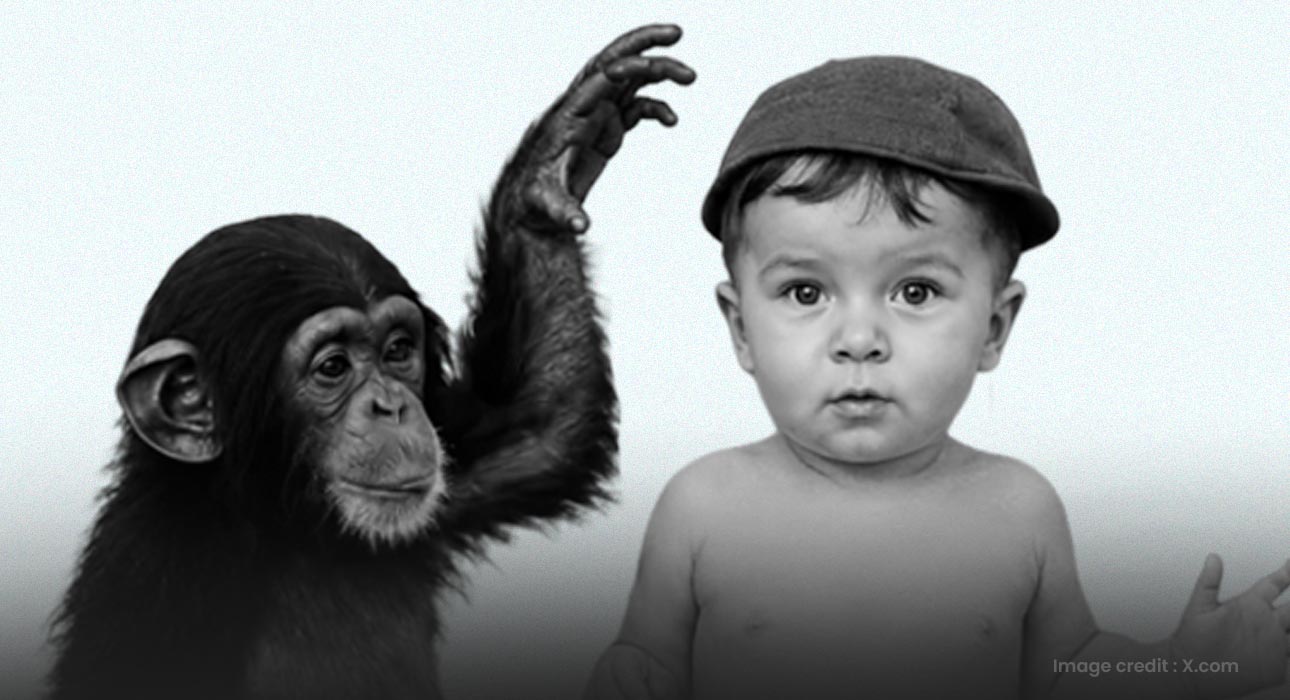
Mowgli and Tarzan are characters many people grew up watching. Both share a similar story: a boy separated from human society, raised among animals. Such stories have always fascinated people. And they are not just fiction. There have been real documented cases of children found living in isolation, cut off from human society, unable to speak or socialise like human beings, such as Victor of Aveyron (Lane, 1976) and Oxana Malaya (Grice, 2006). Cases like these have made people wonder: what really shapes us? Is it our biology, or is it the environment we grow up in?
This question is not new. It is one of the oldest debates in psychology: nature versus nurture. In 1931, two psychologists tried to answer this very question. Winthrop and Luella Kellogg brought a seven-month-old female chimpanzee named Gua into their home and raised her alongside their own infant son, Donald. This article explores the controversial experiment conducted by psychologists to understand the impact of environment on development, the ethical concerns it raises, and the outcomes of this bizarre experiment.
The Question Behind the Experiment
In 1931, a psychologist named Winthrop Niles Kellogg came up with a curious idea. What would happen if you took a chimpanzee and raised it exactly like a human child? Not in a lab. Not as a circus animal. But as a real member of a family eating at the same table, sleeping in the same home, and being given the same care and attention as a human baby. It was an odd idea. But it came from a genuine place of scientific curiosity (Kellogg, 1931).
Kellogg had read a lot about feral children. These were children who had grown up without human contact and struggled to learn language or fit into society when they were found. He noticed something in those cases. Environment seemed to play a crucial role. But he could not take a child and remove them from society just to test that idea. So he did the opposite. He brought an animal into human society instead (Kellogg, 1931).
At the time, a school of thought called behaviourism was very popular in psychology. Its main argument was simple: the environment shapes behaviour. Give any organism the right conditions, and you can mould it into almost anything. Kellogg wanted to test just how far that was true. And he chose the closest biological relative to humans to do it with (Kellogg & Kellogg, 1933).
How the Experiment Was Set Up
In June 1931, the Kellogg family moved to Florida. Winthrop, his wife Luella, and their ten-month-old son Donald. Shortly after arriving, a seven-and-a-half-month-old female chimpanzee named Gua joined them. Gua had been born in Cuba and was brought to the Kellogg home through the Yerkes Laboratories of Primate Biology (Murgatroyd & Nephew, 2022). The age gap between her and Donald was small on purpose. The Kelloggs wanted both infants to be at a similar developmental stage.
For nine months, from June 1931 to March 1932, Gua and Donald were raised as if they were siblings. Gua was dressed in clothes, pushed in a pram, given meals in a high chair, and put to bed each night the same way Donald was. The Kelloggs did not teach Gua tricks or treat her like a pet. The Kelloggs simply parented her as one would their own child. Every single day, for twelve hours a day, seven days a week, both children were tested, observed, filmed, and recorded (Kellogg & Kellogg, 1933). Their reflexes, motor skills, memory, emotions, and language were all tracked.
The daily routine was rigorous. The Kelloggs used cameras and standardised physical tests to document every reaction and milestone. Think about what that means for Donald. He was at the age when most children are playing freely, learning to talk, and spending their days surrounded by family. That window, roughly the first three years of life, is when the brain develops fastest. It is when children are most ready to absorb language, form emotional bonds, and learn social behaviour. The Kelloggs spent that critical developmental window measuring and observing Donald alongside a chimpanzee every single day. It was one of the most hands-on and demanding experiments in the history of psychology.
What Gua Could Do and Where She Stopped
In the early months, Gua was ahead of Donald in almost everything. She responded to simple commands before he did and learned to drink from a cup, use a spoon, and open doors by the handle. She walked upright earlier and sat in her high chair without support sooner, and also showed strong emotional responses, seeking comfort from the Kelloggs when she was upset, and showing what looked like concern when Donald cried (Kellogg & Kellogg, 1933).
Research in interspecies communication has since confirmed that chimpanzees are capable of understanding human gestures and responding to spoken words. They are capable learners. But they cannot produce human speech. Not because they have not been taught, but because their vocal anatomy simply does not allow it (Hasanova et al., 2025).
That is exactly where Gua hit her limit. The Kelloggs surrounded Gua with language every single day. She heard speech constantly. But she could not form words. Her sounds stayed chimp sounds, food calls, contact calls, alarm signals. No amount of exposure could change the structure of her larynx (voice box) or rewire her brain for human speech. The Kelloggs’ own conclusion put it simply: environment can do a lot, but it cannot override biology (Kellogg & Kellogg, 1933).
The Problem Nobody Expected: Donald
The Kelloggs’ experiment was focused on Gua. They treated Gua as the independent subject and Donald as the control. They wanted to see how human she could become. What they did not plan for was what would happen to Donald.
As the months went on, Donald started copying Gua. He began making her food bark. He dropped to his hands and knees and moved the way she moved. His speech was falling behind other children his age. He was picking up chimp behaviour faster than he was picking up human language. The child meant to be the control in the experiment was becoming the subject (Murgatroyd & Nephew, 2022).
The experiment was ended on March 28, 1932. The Kelloggs had seen enough. Winthrop Kellogg later wrote: ‘Gua, treated as a human child, behaved like a human child except when the structure of her body and brain prevented her. This being shown, the experiment was discontinued’ (as cited in Murgatroyd & Nephew, 2022). They had their answer. But it came with a cost they had not expected.
Read More: Social Curiosity: The Evolutionary Bond Between Humans and Chimpanzees
What This Tells Us About Language and Development
The Gua experiment taught psychologists something important about language. It is not enough to just be around it. A child needs exposure, yes. But they also need the right biological setup, the right brain structures, the right vocal anatomy, and an instinct to seek out and imitate human communication from a very early age.
Gua had the environment. She did not have the biology. That gap could not be closed. This idea later connected to Chomsky’s theory of a language acquisition device, the argument that humans are born with a built-in capacity for language that other species do not have (Chomsky, 1965).
Donald’s story added another layer. Developmental psychologists now understand that there is a critical period for language, a window in early childhood when the brain is most ready to acquire it. Disrupting that window or exposing a child to inappropriate language input can have lasting effects. Donald’s primary companion during that window was not speaking to him in words. It showed that language development depends not just on exposure, but on who you are learning from. The right social model matters just as much as the environment itself.
The Ethical Problems
Looking back, the experiment raises serious ethical questions. Gua was taken from her species, placed in a completely foreign environment, and then returned nine months later. She died of pneumonia on December 21, 1933, aged just three, less than two years after leaving the Kellogg home (Murgatroyd & Nephew, 2022). Whether the disruption of her early development played any role in her death is impossible to say. But it is a question worth asking.
Donald’s story is harder to read. He was at the most impressionable stage of his life, the years that shape a person the most. And he had no say in any of it. He could not understand what was happening around him. He simply absorbed everything: Gua’s sounds, her movements, her way of communicating. His brain, at its most active and most open, was taking in a model that was never meant for a human child. He grew up never speaking publicly about the experiment. He died by suicide in 1973 at the age of forty-three (Science and Culture Today, 2024). No one can say whether his earliest years played a role in that. But the fact remains that a child who deserved a normal childhood was used as an unknowing subject in someone else’s experiment.
The Kelloggs were not cruel people. By the standards of their time, they were careful and thorough. But they did not stop to ask whether the question was worth the cost. Modern psychology has ethics committees and review boards precisely because of studies like this one. What is morally acceptable in research has changed significantly since 1931, and cases like Gua and Donald are part of the reason why.
What the Experiment Left Behind
Researchers regard the Gua experiment as both a landmark and a warning. It produced real findings. It showed that the environment has genuine power over development, but that biology sets the boundaries. Researchers still cite these findings in studies on interspecies communication today (Hasanova et al., 2025).
It also made people think about a bigger question. How different are we from chimpanzees, animals that share around 98 per cent of our DNA? Gua showed that the gap is real. It shows up in language, in abstract thinking, and in the depth of human social learning. But she also showed the gap is not as wide as many assumed. The empathy, the attachment, the ability to learn from human models- all of it was there.
Today, the study sits at a crossroads in psychology. It is part of the foundation of comparative psychology and developmental theory. But it is also a reminder that science without ethical guardrails can cause real harm to a chimpanzee who never made it past the age of three, and to a little boy who never got to just be a child.
References +
- Chomsky, N. (1965). Aspects of the theory of syntax. MIT Press.
- Grice, E. (2006). Cry of the wild. The Guardian.https://www.theguardian.com/society/2006/jul/11/childrensservices.ukraine
- Hasanova, G., Garbuz, M., Guziy, O., Zhebka, V., Yatsenko, O., Karpova, I., & Baidiuk, N. (2025). Animals as communication partners: Ethics and challenges in interspecies language research. Animals, 15(8), 1097. https://doi.org/10.3390/ani15081097
- Kellogg, W. N. (1931). Humanizing the ape. Psychological Review, 38(2), 160–176. https://doi.org/10.1037/h0070063
- Kellogg, W. N., & Kellogg, L. A. (1933). The ape and the child: A study of environmental influence upon early behaviour. Whittlesey House (McGraw-Hill).
- Lane, H. (1976). The wild boy of Aveyron. Harvard University Press.
- Murgatroyd, C., & Nephew, B. C. (2022). Adult health and early life adversity: Behind the curtains of maternal care research. Frontiers in Neuroscience, 16, 826421. https://doi.org/10.3389/fnins.2022.826421
- Science and Culture Today. (2024). Donald Kellogg: The human child in the Gua experiment. Science and Culture Today.


Leave feedback about this