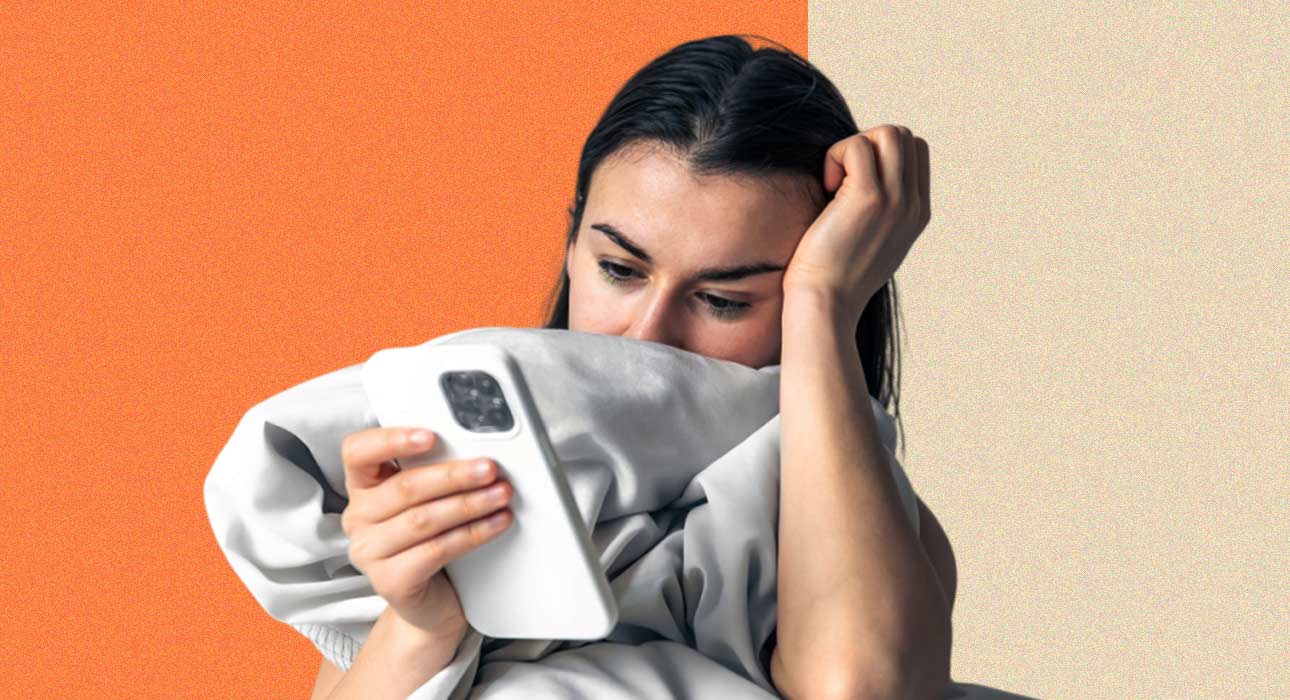
In 2019, researchers discovered that 72% of individuals use their cellphones in their rooms. Furthermore, 56% of those surveyed admitted to checking their phones within half an hour of their intended sleep time (American Psychological Association, 2020). The consequence is not merely delayed sleep. It is a clinically recognised phenomenon: digital insomnia. The brain cannot transition from wakefulness to rest. Not because of stress. Not because of caffeine. Because of the screen itself.
This article examines neuroscience. Melatonin suppression. Circadian rhythm disruption. The dopamine reward system. Maladaptive behaviour conditioning. Hyperarousal theory. Each mechanism contributes. Together, they explain why the brain refuses to shut down.
Read More: How Emotional Stress Affects Sleep: Insights from Neuroscience Research
Melatonin Suppression: How Bright Screens Delay Sleep Onset
Melatonin is secreted by the pineal gland. Its secretion increases in the dark. Its secretion decreases in light (National Institute of Neurological Disorders and Stroke, 2023).
This is the whole system. Simple. Vulnerable. The screens of smartphones produce blue light, which has wavelengths of 450 to 495 nanometers. The wavelength of 450 to 495 nanometers is highly efficient in inhibiting melatonin (Harvard Medical School, 2015). It is not that all light inhibits melatonin. Blue light does. A controlled study was conducted by Chang et al. (2015).A separate group read from printed books. The results were clear. The screen group took approximately 10 minutes longer to fall asleep. Their REM sleep was reduced. Their evening melatonin levels were significantly lower. The brain received one message: It is still daytime. Sleep onset delayed. Deep sleep quality has reduced. In the case of kids and teens whose brains are not fully developed, the consequences become magnified (Sigman, 2017).
Read More: The Psychology and Neuroscience of Sleep Deprivation in Modern Society
Disruption of Circadian Rhythms: Misalignment of the Body’s Clock
The circadian rhythm is based on about 24 hours. It controls sleep, hormone secretion, and body temperature (Santrock, 2021).Light resets it. Morning light advances the clock. Evening darkness prepares the body for rest. Nighttime phone use sends conflicting signals. Light screens emulate daylight. The body clock moves backward (Rossen & Cowan, 2012). This results in circadian misalignment
The person struggles to go to bed early. And wakes up late in the mornings. This leads to a delayed sleep-wake phase disorder (Chopra & Khanna, 2019). Teenagers are particularly prone to this. Their natural body clock adjusts backward during puberty. The result is chronic sleep restriction. Not a choice. Biology (Rana et al., 2018).
Read More: Non-24-Hour Sleep Wake Disorder
The Dopamine Reward System: Why the Brain Prefers Scrolling
Light is only half the problem. The other half is content. Social media platforms, video games, and streaming services are designed around intermittent variable rewards (Limber, 2011). A notification. A like. A new episode recommendation. Each trigger causes a small dopamine release. Dopamine is the reward neurotransmitter. It creates pleasure and motivation. It also promotes wakefulness (Sigman, 2017). Directly opposing the brain’s sleep pathways. Consider the conflict. The individual feels tired. Genuinely tired. But each scroll provides a small dopamine hit. The brain stays engaged. Not because of weak willpower. Because the reward system is doing exactly what it evolved to do, seeking novelty. This is not addiction in the clinical sense. But it is a powerful competing drive. The brain has to choose between sleep (low immediate reward) and scrolling (variable immediate reward). Sleep loses.
Read More: The Role of Dopamine in the Mind
Behavior Conditioning
Classical conditioning explains what happens next. The bed should be associated with sleep. That is the original learning (Rossen & Cowan, 2012). But when individuals regularly use phones in bed checking emails, watching videos, scrolling social media, the brain learns a different association. Bed equals wakefulness, equals alertness and reward-seeking. This is stimulus control failure. The bed has become a conditioned cue for arousal. Individuals with digital insomnia often report feeling “wired” the moment they lie down. Even when exhausted. Even when they desperately want to sleep. Breaking this requires strict sleep hygiene. Remove screens from the bedroom entirely. Use the bed only for sleep (Kamath, 2015). For those with established conditioning, stimulus control therapy is often necessary.
Read More: The Neuroscience Behind Doomscrolling: Why Can’t We Stop Scrolling?
Hyperarousal Theory
Hyperarousal theory proposes a central finding. Some individuals maintain excessive alertness during the pre-sleep period. The central nervous system simply will not transition (Srisiva et al., 2013). Digital technology worsens hyperarousal through three pathways:
- Cognitive arousal: Engaging content keeps the mind actively processing. A social media argument. An exciting video game. Work emails.
- Emotional arousal: Negative online interactions trigger cortisol release. The stress hormone. Directly opposing sleep.
- Physiological arousal: Blue light suppresses melatonin. Screen attention maintains thalamic activation. The brain stays on. Rana et al. (2018) measured heart rate and cortisol at midnight. Adolescents who used screens within one hour of bedtime had significantly higher levels than those who did not. Physiological hyperarousal. Measurable. Treatable.
Sleep Hygiene: Evidence-Based Interventions
Sleep hygiene refers to behavioral practices that promote consistent, high-quality sleep. Several interventions have empirical support (Rossen & Cowan, 2012).
- Stop screens 60–90 minutes before bed. This allows natural melatonin secretion. Non-negotiable.
- Make the bedroom a screen-free zone. Phones charge outside the room. Tablets stay in the living area.
- Use night mode settings if screens cannot be avoided. Blue-light filters reduce suppression. They do not eliminate it (Harvard Medical School, 2015).
- Practice stimulus control. If unable to fall asleep within 20 minutes, leave the bedroom. Read a paper book. Return only when sleepy.
- Address pre-sleep anxiety about sleep loss. Worrying about insomnia makes insomnia worse. Cognitive restructuring helps (Chopra & Khanna, 2019).
For children and adolescents, parental modeling is critical. Adults who maintain digital boundaries create household norms. Children follow observed behavior, not instructed behavior.
Conclusion
Digital insomnia is not a character flaw. It is an expected neurological outcome of utilizing light-producing devices that give out rewards in a time frame when the brain should be winding down. Melatonin inhibition postpones falling asleep. Circadian disruption advances the biological clock. The dopamine system keeps the brain stimulated. Classical conditioning creates an association between the bed and alertness.
Hyperarousal prevents the transition to rest. Each mechanism is understandable. Each is reversible. Evidence-based sleep hygiene works but only when individuals understand why it works. The goal is not to demonize technology. The goal is to respect how the human brain evolved to rest. In darkness. Without notifications. Without reward loops. That is the standard. Anything less is a fight the brain will lose.
References +
- American Psychological Association. (2020). Sleep in the digital age: Technology use and adolescent sleep patterns. APA Publishing.
- Chang, A. M., Aeschbach, D., Duffy, J. F., & Czeisler, C. A. (2015). Evening use of light-emitting eReaders negatively affects sleep, circadian timing, and next-morning alertness. Proceedings of the National Academy of Sciences, 112(4), 1232–1237.
- Chopra, N., & Khanna, I. (2019). Play as a mechanism of promoting emergent literacy among young children: The Indian context. IntechOpen. https://doi.org/10.5772/intechopen.82363
- Harvard Medical School. (2015). Blue light has a dark side. Harvard Health Publishing.
- Kamath, S. (2015). Childhood disability our responsibility. Indian Pediatrics.
- Limber, S. P. (2011). The Olweus Bullying Prevention Program. American Psychologist, 66(2), 114–126.
- National Institute of Neurological Disorders and Stroke. (2023). Brain basics: Understanding sleep. NIH Publication.
- Rana, M., Gupta, M., Malhi, P., Grover, S., & Kaur, M. (2018). Effectiveness of a multicomponent school-based intervention to reduce bullying among adolescents. Journal of Public Health Research, 7(1).
- Rossen, E., & Cowan, K. C. (2012). A framework for schoolwide bullying prevention and safety. National Association of School Psychologists.
- Santrock, J. W. (2021). Life-span development (18th ed.). McGraw-Hill.
- Sigman, A. (2017). Screen dependency disorders: A new challenge for child neurology. Journal of the International Child Neurology Association.
- Srisiva, R., Thirumoorthi, R., & Sujatha, P. (2013). Prevalence and prevention of school bullying. International Journal of Humanities and Social Science Invention, 2(5), 36–45.