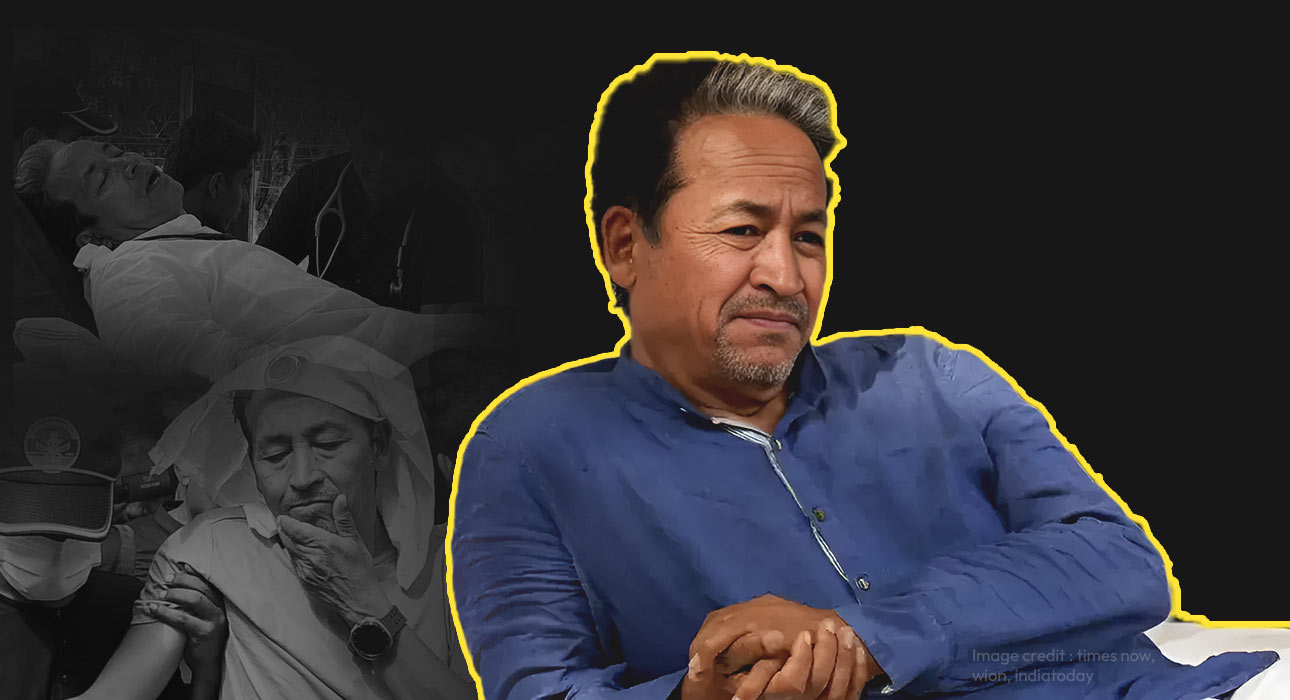
Think of an educational system that fosters a culture of asking “why” rather than expecting the students to memorise “what”. The time is spent making machines, solving local problems, understanding nature, and learning through experience, rather than in preparing themselves solely for examination purposes. This unique way of teaching has been advocated by an Indian educational reformer named Sonam Wangchuk, who has changed the education system in Ladakh.
The education philosophy of Wangchuk opposes the idea that education can be judged on the basis of marks alone. Rather, it emphasises curiosity, creativity, critical thinking, and practical learning. Interestingly, modern educational psychology also supports such a philosophy of education, which shows that students learn effectively when they participate actively and relate their learning to life situations. This article aims to discuss how Wangchuk’s philosophy of education fosters individual development and makes a person a lifelong learner.
Learning by Doing: Why Experience Matters
Conventional education frequently demands that students memorise facts for exams. Although knowledge is very important, mere rote memorisation of information does not always enable students to understand its practical application in the real world. Sonam Wangchuk asserts that education must equip children to address practical issues as opposed to preparing them for tests.
This principle is manifested in SECMOL (Students’ Educational and Cultural Movement of Ladakh). The entire campus acts as a learning environment. Students are actively involved in the administration of the campus, energy conservation, cultivation of crops, construction of eco-friendly buildings, and decision-making processes. Every activity serves as an avenue for learning.
The psychology of education offers an explanation for the success of this approach. As per Experiential Learning Theory by David Kolb, learning gains significance as people acquire knowledge through firsthand experience, reflect upon the same, and use it in different situations (Kolb, 1984). Learners are not passive recipients of information. For instance, when a student learns about solar energy from a book, he will know various definitions that can be tested during an exam. But a student who constructs and installs a solar heating system acquires hands-on knowledge and becomes confident. He will not forget the lesson since he has experienced it himself. Practical learning minimises the fear of failure. Students learn how to view failures as learning experiences rather than as setbacks.
Curiosity Creates Better Learners
Children have natural curiosity. They ask endless questions as they are curious to learn about their surroundings. However, education tends to reward right answers rather than questions. Sonam Wangchuk says that curiosity must stay at the heart of education. Learning becomes fun if children are allowed to inquire on their own. It is referred to as intrinsic motivation when an individual does a task for personal satisfaction, not for external factors like grades and compliments (Ryan & Deci, 2020). Intrinsic motivation has been found to lead to higher creativity, persistence, and deeper comprehension.
Critical thinking is another vital psychological aspect. Critical thinking involves the proper analysis of information before taking it for granted. Instead of cramming information, students learn how to analyse evidence and come up with reasonable decisions. It is essential nowadays when there is plenty of misleading information that easily spreads on the Internet. In such cases, students with critical thinking skills will be good citizens and effective thinkers. Students’ creativity develops in an atmosphere of safety of expression of bizarre ideas. They stop being afraid of making mistakes and start exploring the unknown.
Schools That Prepare Students for Life
The philosophy of education of Wangchuk is not limited to classroom teaching. The aim of his philosophy is to educate children to face the problems of day-to-day life. This philosophy can be seen in the SECMOL project as well as in the Himalayan Institute of Alternatives, Ladakh (HIAL). The students are encouraged by the HIAL to find solutions to their local environmental and social problems. This makes education related to sustainability, engineering, entrepreneurship, and community development.
The theory of self-efficacy was developed by Albert Bandura, which is the belief of an individual in their capability of success (Bandura, 1997). Students who complete the meaningful projects successfully gain confidence in themselves as they have achieved something. In the same way, the theory of growth mindset was proposed by Carol Dweck, which is defined as the belief of an individual that intelligence and abilities are improved through practice and learning (Dweck, 2006). An education that is based on Wangchuk’s principles would automatically instil this attitude in its learners. The learners will learn that failure is an essential aspect of the learning experience. The learners won’t keep asking themselves, “Am I failing?” but will start asking, “What can I do better next time?”
In addition to the above, such an education will improve one’s teamwork, communication skills, empathy, and leadership skills. The learner will understand the importance of listening to other people’s views and working with others. These are skills that cannot be evaluated in exams but are important for life.
Education for an Uncertain Future
The world is evolving at an alarming rate due to technological development, global warming, artificial intelligence, and other problems that did not exist even a generation ago. Future job opportunities will need capabilities that are not currently taught at school. International organisations like UNESCO and OECD stress the importance of creativity, adaptability, teamwork, and lifelong learning in the context of future education rather than memorisation alone.
The philosophy of Sonam Wangchuk coincides perfectly with those recommendations. The educational concept of Sonam Wangchuk promotes active involvement of the student in the process of becoming part of society. Learning also benefits psychologically by ensuring happiness. When children are given the chance to make choices, form connections and deal with actual challenges, they tend to enjoy their learning process and feel more confident in themselves.
The most important aspect is that Wangchuk shows teachers how every child is different in terms of the way they comprehend things. While some children learn things during discussions, others do so while observing, and others get information during practice.
Conclusion
Sonam Wangchuk’s philosophy of education reminds society that the purpose of education is to prepare children not just for exams but also for life itself. His vision questions conventional notions of success through emphasising the significance of curiosity, creativity, experience and independent thinking in education. There is significant psychological evidence confirming most of his beliefs.
People learn much better when they actively participate, explore ideas independently, collaborate with others, and practice their skills in real-life situations. Learning strategies like experiential learning, intrinsic motivation, growth mindset and self-efficacy illustrate how effective learning occurs when people become an active part of the process and do not simply listen. The examples of SECMOL and HIAL prove that education can be meaningful and socially relevant at the same time.
It shows that schools can foster innovation in students as well as help them gain self-confidence, resilience, empathy and a sense of responsibility. Maybe the biggest message from Sonam Wangchuk’s philosophy is that classrooms have to encourage children to ask questions, think and find solutions to important problems.
References +
- Bandura, A. (1997). Self-efficacy: The exercise of control. W. H. Freeman. ◻ Bransford, J. D., Brown, A. L., & Cocking, R. R. (Eds.). (2000). How people learn: Brain, mind, experience, and school (Expanded ed.). National Academy Press. https://doi.org/10.17226/9853
- Deci, E. L., & Ryan, R. M. (1985). Intrinsic motivation and self-determination in human behaviour. Plenum Press.
- Dweck, C. S. (2006). Mindset: The new psychology of success. Random House.
- Kolb, D. A. (1984). Experiential learning: Experience as the source of learning and development. Prentice Hall.
- Ryan, R. M., & Deci, E. L. (2020). Intrinsic and extrinsic motivation from a self-determination theory perspective: Definitions, theory, practices, and future directions. Contemporary Educational Psychology, 61, 101860. https://doi.org/10.1016/j.cedpsych.2020.101860
- UNESCO. (2021). Reimagining our futures together: A new social contract for education. UNESCO. https://unesdoc.unesco.org/ark:/48223/pf0000379707
- Vygotsky, L. S. (1978). Mind in society: The development of higher psychological processes. Harvard University Press.
- SECMOL. (n.d.). Students’ Educational and Cultural Movement of Ladakh. https://www.secmol.org
- Himalayan Institute of Alternatives, Ladakh. (n.d.). HIAL. https://hial.edu.in