







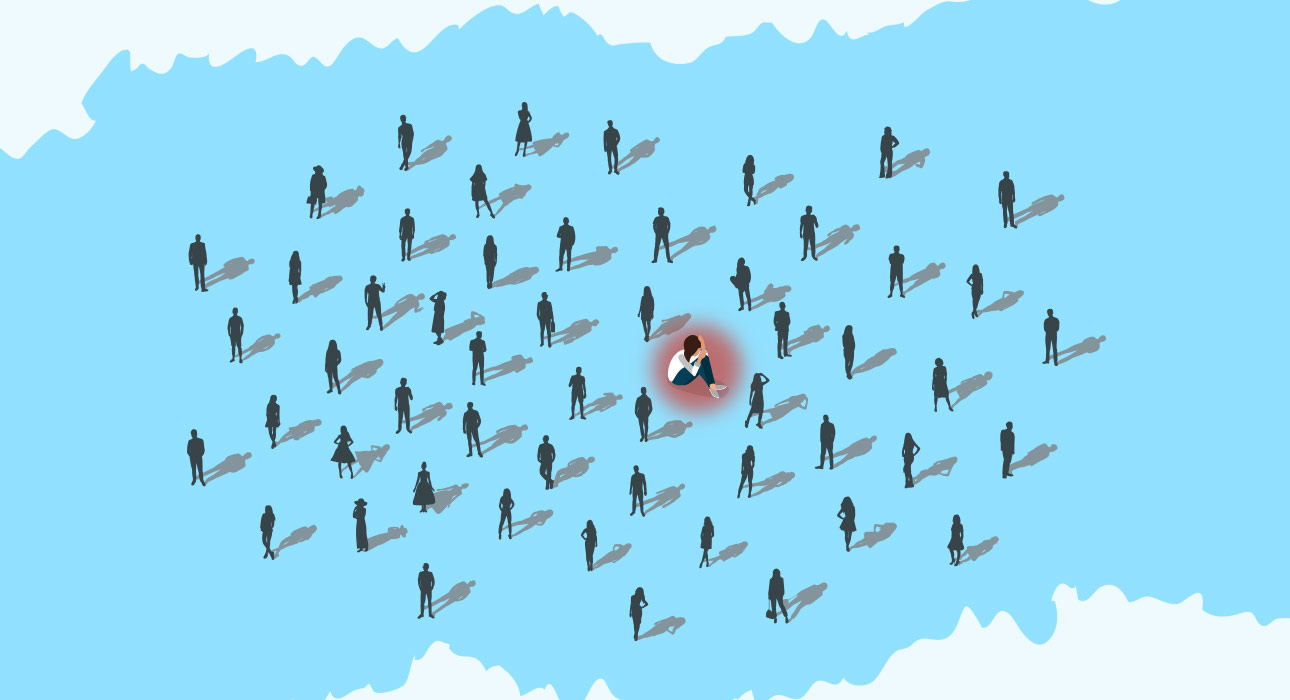
People like to think of themselves as kind, caring and ready to help someone in trouble. Most would say they would step in to help if they saw someone in trouble. Yet both history and psychological research tell a different story. When an emergency happens in front of a group, help is often delayed, or sometimes it never comes at all. This contradiction is at the core of one of social psychology’s most well-known ideas: the bystander effect.
The article explores what the bystander effect really means. It walks through Darley and Latané’s five-step model of helping behaviour to explain how people decide whether to act. It also looks at real-life incidents and research findings to understand why someone who genuinely cares can still end up doing nothing when another person needs help the most.
The Origins of the Bystander Effect
The scientific study of bystander behaviour began with a real tragedy. In 1964, a young woman named Kitty Genovese was murdered outside her apartment building in Queens, New York. Early newspaper reports claimed that dozens of neighbours heard or saw parts of the attack, but did nothing to step in or call for help. Later investigations questioned those reports. Journalists and, later, psychologists re-examining the original case files found that the number of witnesses, and how much they actually saw, had likely been exaggerated (Manning, Levine, & Collins, 2007). Even so, the story stuck. It became a powerful example in public discussion and pushed psychologists to ask a difficult question: why would so many people fail to help someone whose life was in danger?
This question led two psychologists, John Darley and Bibb Latané, to run a series of important experiments. Their work gave us the idea now called the bystander effect. The bystander effect means that a person is less likely to help someone in trouble when others are around. And the more people who are present, the less likely any one person is to step in (Darley & Latané, 1968). It’s surprising. Most people assume that with more people around, someone is bound to help. But Darley and Latané’s research showed that the opposite often happens.
Read More: The Bystander Effect in the Digital Age: Why We Scroll Instead of Help
Darley and Latané’s Five-Step Model
To understand why bystanders often do not act, Darley and Latané (1970) proposed a model that explains the steps people go through before deciding to help. According to this model, a person has to move through five stages. Help may not happen if the process gets stuck at any one of them.
Step One: Noticing the Event
Before anyone can help, they first have to notice that something is wrong. In busy places, a crowded street, a noisy subway, or a loud public space, people are often focused on their own thoughts, their phones, or their conversations. Because of that, they can miss signs that an emergency is happening right in front of them.
Step Two: Interpreting the Situation as an Emergency
Once someone notices something unusual, they still have to decide if it is actually an emergency. Many situations are not clear. A person lying on the pavement might be hurt, or they might just be drunk. A couple arguing loudly might be in a serious fight, or they might just be having a private argument. Because it is often hard to tell, people tend to look at others around them to figure out what is happening.
Step Three: Assuming Responsibility
Even after deciding it is an emergency, a person still has to feel that it is their job to help. This is where the presence of other people matters most. When there are many bystanders, each person feels less personal responsibility. Psychologists call this diffusion of responsibility, and it will be explained in more detail below (Latané & Nida, 1981).
Step Four: Knowing How to Help
A person also has to believe they can actually help. If someone does not know first aid, they might worry about doing the wrong thing or making things worse. That doubt can stop them from stepping in, even if they want to help.
Step Five: Deciding to Act
Finally, after getting through the other steps, a person still has to act. Even then, fear can get in the way. Fear of looking foolish, fear of legal trouble, or fear for their own safety can keep someone from doing anything. Darley and Latané argued that unless a bystander successfully passes through all five steps, they will not help, and any one of these steps can be interrupted by the presence of other people.
Why the Presence of Others Inhibits Helping
Several psychological reasons help explain why groups of onlookers are less likely to help than someone who is alone.
Diffusion of Responsibility
This is the most well-known explanation. When many people witness an emergency, each person feels less personal pressure to act. They assume that someone else will help, or that someone already has (Darley & Latané, 1968). The responsibility to help gets spread across the group. But that spreading has a strange effect: it lowers the chance that anyone will actually step in, because everyone is quietly waiting for someone else to go first (Latané & Nida, 1981).
Read More: Take responsibility over your life
Pluralistic Ignorance
This happens when people look to others to decide how to react, especially when a situation is unclear. Latané and Darley (1968) showed this in a classic experiment. Participants sat in a room that slowly filled with smoke. People who were alone reported the smoke right away. But people sitting with others who were told to stay calm were much less likely to report it. Because no one else looked worried, participants convinced themselves the smoke was not dangerous. Even though many felt uneasy inside, they took everyone else’s calm faces as proof that nothing was wrong.
Evaluation Apprehension
This is the fear of being judged. A bystander might worry about looking silly for rushing to help someone who is not actually hurt. Or they might worry about being blamed if their attempt to help makes things worse. That fear of what others will think can be enough to keep a person from acting, especially in a group. Several interlinked psychological mechanisms explain why groups of onlookers are less likely to help than a lone witness.
Evidence from Research and Real Life
The Seizure Experiment
One of the clearest examples of the bystander effect comes from Darley and Latané’s (1968) seizure experiment. Participants thought they were talking over an intercom with either one, two, or five other people. In reality, they were hearing pre-recorded voices. During the discussion, one “participant” suddenly sounded like they were having a seizure and called for help. The results were striking.
When participants believed they were the only one listening, 85 per cent went to get help within the first minute. But when they believed four other people were also listening, only 31 per cent helped at the same time, and some never got help at all. Importantly, the people who did not help were not indifferent. Many showed clear signs of stress and anxiety. This suggests they felt torn between genuine concern and the pressure of being in a group.
A later meta-analysis pooling more than a hundred studies and over 7,700 participants confirmed that this pattern holds up across decades of research, though the effect can shrink in situations that are physically dangerous or where bystanders are able to support one another rather than acting alone (Fischer et al., 2011).
Real-Life Examples
The bystander effect shows up outside the lab too. In 2011, a two-year-old girl named Wang Yue was hit by a car in Foshan, China, and left lying in the street. Security footage showed at least eighteen people walking past her without stopping. Finally, one passerby stopped to help. The video sparked a national debate in China about apathy and people’s sense of responsibility. But psychologists argued it was not simply about people being cold. It was the same processes Darley and Latané described: diffusion of responsibility and uncertainty about what to do (Latané & Nida, 1981). Those mechanisms explain the delay better than just calling it a moral failure.
The same pattern appears in other situations too. Public assaults, medical emergencies on trains or buses, and even cyberbullying with hundreds of viewers online often follow it. People may care and want to help, but when many others are watching, each person feels less personal responsibility to act.
Read More: The Bystander Effect: Past, Present, and the Digital Age
Why Caring Is Not Enough: The Role of Situation
One of the most uncomfortable findings from this research is that having good values and empathy does not automatically mean a person will help. The situation itself can matter more than a person’s character. Darley and Batson’s (1973) “Good Samaritan” study showed this clearly. Seminary students were asked to walk across campus to give a talk. These were students who were expected to value compassion.
On the way, each student passed a person lying in an alley who seemed to need help. The biggest factor in whether a student stopped was not their faith or personality. It was how much of a hurry they were in. Students who were told they had plenty of time were much more likely to stop. Students who were told they were late were far less likely to help. Some even stepped over the person because they were rushing.
This shows that helping is shaped just as much by outside pressures as by a person’s values. Things like time pressure, uncertainty, and the presence of others can all make a difference. It does not mean people do not care. It means that ordinary social and mental processes can quietly get in the way of helping, especially when other people are around.
Conclusion
The bystander effect reveals a difficult truth about how humans act in social situations. When other people are present, it does not make help more likely. Instead, it often makes it less likely that anyone will act at all. Darley and Latané’s five-step model explains why. Helping depends on moving through a series of decisions. At each step, things like diffusion of responsibility, uncertainty, or fear of being judged can cause a person to stop.
Real events and lab studies point to the same result. The case of Kitty Genovese (Manning, Levine, & Collins, 2007), the case of Wang Yue, the seizure experiment, and the Good Samaritan study all show this pattern. People often do not ignore emergencies because they do not care. They hesitate because group situations quietly make it harder for any one person to step forward. Understanding these processes matters beyond research. Studies show that when people learn about the bystander effect, they become more likely to help (Beaman, Barnes, Klentz, & McQuirk, 1978). Awareness breaks the automatic assumptions that usually keep people from getting involved when others are watching.
References +
- Beaman, A. L., Barnes, P. J., Klentz, B., & McQuirk, B. (1978). Increasing helping rates through information dissemination: Teaching pays. Personality and Social Psychology Bulletin, 4(3), 406–411.
- Darley, J. M., & Batson, C. D. (1973). From Jerusalem to Jericho: A study of situational and dispositional variables in helping behaviour. Journal of Personality and Social Psychology, 27(1), 100–108.
- Darley, J. M., & Latané, B. (1968). Bystander intervention in emergencies: Diffusion of responsibility. Journal of Personality and Social Psychology, 8(4), 377–383.
- Fischer, P., Krueger, J. I., Greitemeyer, T., Vogrincic, C., Kastenmüller, A., Frey, D., Heene, M., Wicher, M., & Kainbacher, M. (2011). The bystander-effect: A meta-analytic review on bystander intervention in dangerous and non-dangerous emergencies. Psychological Bulletin, 137(4), 517–537.
- Latané, B., & Darley, J. M. (1968). Group inhibition of bystander intervention in emergencies. Journal of Personality and Social Psychology, 10(3), 215–221.
- Latané, B., & Darley, J. M. (1970). The unresponsive bystander: Why doesn’t he help? Appleton-Century-Crofts.
- Latané, B., & Nida, S. (1981). Ten years of research on group size and helping. Psychological Bulletin, 89(2), 308–324.
- Manning, R., Levine, M., & Collins, A. (2007). The Kitty Genovese murder and the social psychology of helping: The parable of the 38 witnesses. American Psychologist, 62(6), 555–562.


Leave feedback about this