Before directing Big World (小小的我, 2024), director Yang Lina had a disturbing question to ask herself: “Where does a person with a disability go? The film aimed to break the reality that, despite the 85 million disabled residents in China, they are seldom seen in public life or in theatres (RADII, 2025). The narrative follows 20-year-old Liu Chunhe, a boy with cerebral palsy (C.P.), a condition that affects movement, balance and coordination caused by brain damage occurring before or shortly after birth, as he battles to attend college, fall in love, write poetry and put himself in a place where he can live his life.
Possibly the most unique thing about Big World is that it doesn’t make Chunhe into that. This article looks at the film from a psychiatric perspective, focusing on the themes of stigma, family bonds, identity, and the human need to be understood beyond the diagnosis.
Read More: Family Dynamics and Disability: Understanding Love, Guilt, and Overprotection
Stigma and Society
One of the most forthright moments in the film comes when Chunhe comments on the looks people give him in public: “Gazes of pity, gazes of fear and even gazes of disgust. But I have never seen a gaze that dared to stare at me and tell me that I am one of them.” This speaks silently of social stigma, a term coined by the sociologist Erving Goffman (1963), which refers to the way in which the world reduces a person to a mere aspect and treats him as an isolated unit. Chunhe’s sellout is something he has on his head: cerebral palsy. There is a lack of stability in movement, slurred speech, and they cease to look for the person behind it.

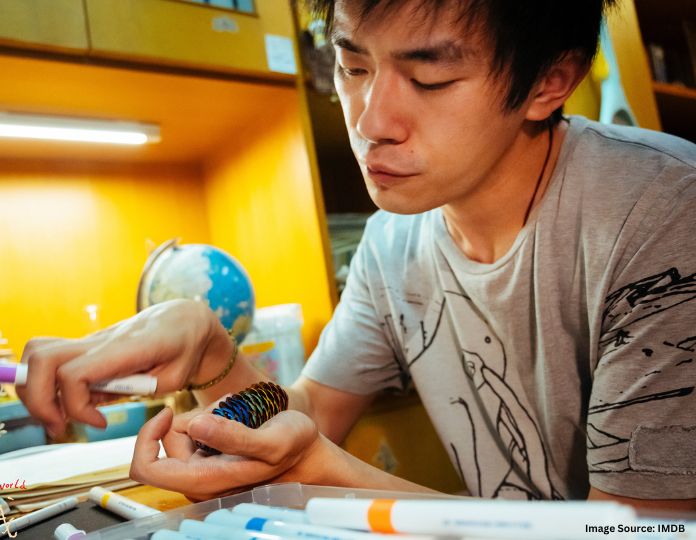
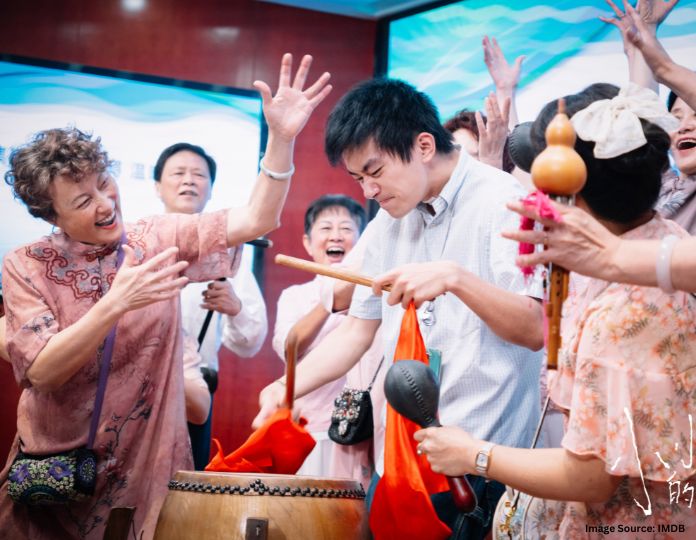
Goffman said stigma was a process that involved oversimplified stereotypes, fixed ideas about a group, that help society categorise and dismiss the group. This is manifested in the movie when Chunhe loses a drumming competition and a fellow student calls him a “retard”, assuming that since he moves differently, he thinks differently.
The scene does not seem to be a dramatic villain moment, but rather a casual cruelty that is maybe more realistic and more painful. Real stigma isn’t a straightforward bully; it’s in the assumptions we make, the lowered voice and the awkward look of the stranger.
The stigma also can lead to pressure on stigmatised people to control how they are perceived, Goffman said. The entire film is a portrait of Chunhe’s life in the midst of this tension. His goal to become a teacher is not only about education, but it’s also about gaining what he calls “genuine respect”, or respect for who he is, not sympathy for what he has been through. Empirical evidence consistently demonstrates that this form of identification-based stigma has a real effect on mental health, such as increased depression and anxiety, decreased self-worth, and other mental health outcomes for individuals who have a visible disability (Corrigan & Watson, 2002).
What the film does do, and does well, is to depict the world of the worst kind, one that is dismissive, uncomfortable, that pities Chunhe, without reducing Chunhe to a victim of the world. He defends, fights, writes, falls in love with and debates. His humanity is not something that the story needs to justify. It’s just on screen.
Read More: Why Representation of Disability Matters: The Psychology of Visibility
Family Dynamics
Among Chunhe’s family members are the most psychologically rich relationships, and they are as different as can be within the same family. His grandmother, Chen Suqun, considers him a normal kid in the truest sense. She pushes him to study, work and experience life even if it hurts him. His mother, Chen Lu, loves him just as much but in a controlling manner. She wants him in her own house and away from the world she thinks will reject or harm him.
Family Systems Theory can be used to explain this separation, proposed by psychologist Murray Bowen. Bowen (1978) says that families are emotional units; each person’s behaviour influences and is influenced by the other members. Chen Lu’s overprotectiveness is not only about overprotectiveness towards Chunhe’s disability. It’s entangled in her own complicated relationship with her mother, Chen Suqun, as well as the guilt and grief she has been feeling since Chunhe was born. She’s not only keeping Chunhe safe; she’s keeping herself safe. Her power over Chunhe’s world, in part, is how she attempts to control her own unprocessed feelings.
Bowen added the idea of the capacity or ability of an individual to keep a separate identity from the family rather than merging with the family’s needs and expectations. In the film, Chunhe’s journey is a journey towards differentiation. He has a deep affection for his mother, but he doesn’t want her fear to be the limit of his life. His decision to apply for a teachers’ college far away from home is not defying authority; it is moving forward.
Self-Concept
Big World is a movie about a young man asking himself one question: “Who am I, if not just my disability?” It’s the land of self-concept. It is the total of beliefs that a person develops about himself, as a result of experience, relationships and reflection (Rogers, 1959). Self-concept is not permanent. It changes with growth and is strongly influenced by people’s behaviour towards us.
One of the founders of humanistic psychology, Carl Rogers, a psychology movement that emphasises human potential, personal growth, and the need to be accepted for who they are, believed that a healthy self-concept comes when a person is treated with what he called unconditional positive regard: being accepted as they are, regardless of what they do or how they look (1961).
This unconditional regard is given to Chunhe by Chen Suqun in the film. She has the poet in him, the thinker, the dreamer, before he really sees these things in himself. This is later confirmed by his friendship with Yaya.
Here, too, Erik Erikson’s psychosocial stages of development come in handy. Erikson (1963) suggested that the most important developmental task of the young adult years is to be able to establish identity; what he called “identity versus role confusion. During this phase, a person needs to discover who they are, what they value and what type of life they would like to construct. This is challenging enough for most youths. For Chunhe, it is complicated because of a society that has already decided what sort of life can be lived by someone who looks like him.
This process of identity-construction includes Chunhe’s fascination with poetry, a wish to teach, and even his romantic affection for Yaya. Studies have demonstrated that when society consistently shapes the self-concept of a person with a disability based on his or her limitations, the person is actively undermined in their ability to develop a positive self-concept, and thus, engage in successful life activities (Livneh & Antonak, 1997).
Authenticity in Portrayal
The most common issue that was addressed with the show, both domestically and abroad, was the casting of an able-bodied actor (Jackson Yee) as a character who suffered from cerebral palsy. In the context of disability representation, it is a fair and important debate. However, many people with cerebral palsy and their families who have seen the film reported that it was not ‘over-dramatised’. It did not include inspiration-porn (a term used to describe content that portrays disabled people primarily to make non-disabled people feel moved but not to show the full complexity of life) (Grue, 2015).
This means that it is a systemic social issue that director Yang Lina has expressed in his own question, “Where have all the disabled people gone?” If they are not seen in public spaces, in the media, or in society, then people with disabilities are not seen as normal. This invisibility is not only experienced by people with disabilities. It affects everyone’s conception of what a human life can look like.
Big World is successful and original in maintaining Chunhe’s internal world as the focus of the film. It differs from the more sentimentally oriented films about disability. Chunhe feels frustrated, funny, embarrassed, ambitious, and lovesick. He is not special because he’s a person with cerebral palsy. He’s a remarkable guy because he’s a human being. That is the psychological reality the movie equates with. It is the very one disability studies research has long advocated: that quality of life and selfhood are not a function of having a disability. But a function of having opportunities, connections, and respect. (Schalock et al., 2002).
Conclusion
Big World isn’t a movie about cerebral palsy. It’s about a young man who happens to have cerebral palsy. Chunhe’s story makes us question our beliefs about ambitions, relationships, and our place in the world. It also makes us reflect on the stigmas we hold and how we sometimes limit people’s lives by the way we see and love them. Stigma is a social construct, says Goffman. Man makes it, and man can take it down. As Rogers reminds us, everyone has to see themselves if they are to grow. Erikson reminds us that forming an identity is difficult for everyone. The world makes it even more challenging when it has already decided who you are supposed to be.
References +
- Bowen, M. (1978). Family therapy in clinical practice. Jason Aronson. https://murraybowenarchives.org/books/family-therapy-in-clinical-practice/
- Corrigan, P. W., & Watson, A. C. (2002). Understanding the impact of stigma on people with mental illness. PubMed. https://pmc.ncbi.nlm.nih.gov/articles/PMC1489832
- Erikson, E. H. (1963). Childhood and society (2nd ed.). W. W. Norton & Company.
- Goffman, E. (1963). Stigma: Notes on the management of spoiled identity. Prentice-Hall.
- Grue, J. (2015). Disability and discourse analysis. Research Gate. https://www.researchgate.net/publication/216754698_Disability_and_discourse_a nalysis_Some_topics_and_issues
- Livneh, H., & Antonak, R. F. (1997). Psychosocial adaptation to chronic illness and disability. Research Gate. https://www.researchgate.net/publication/232567490_Psychosocial_Adaptation_t o_Chronic_Illness_and_Disability
- RADII. (2025, January 24). Chinese film Big World explores cerebral palsy and adolescence. https://radii.co/article/chinese-film-big-world-explores-cerebral palsy-and-adolescence
- Rogers, C. R. (1959). A theory of therapy, personality, and interpersonal relationships as developed in the client-centred framework. In S. Koch (Ed.), Psychology: A study of a science (Vol. 3, pp. 184–256). McGraw-Hill.
- Rogers, C. R. (1961). On becoming a person: A therapist’s view of psychotherapy. Houghton Mifflin.
- Schalock, R. L., Brown, I., Brown, R., Cummins, R. A., Felce, D., Matikka, L., Keith, K. D., & Parmenter, T. (2002). Conceptualisation, measurement, and application of quality of life for persons with intellectual disabilities. Mental Retardation, 40(6), 457–470. https://doi.org/10.1352/0047-6765(2002)040<0457:CMAAOQ>2.0.CO;2