







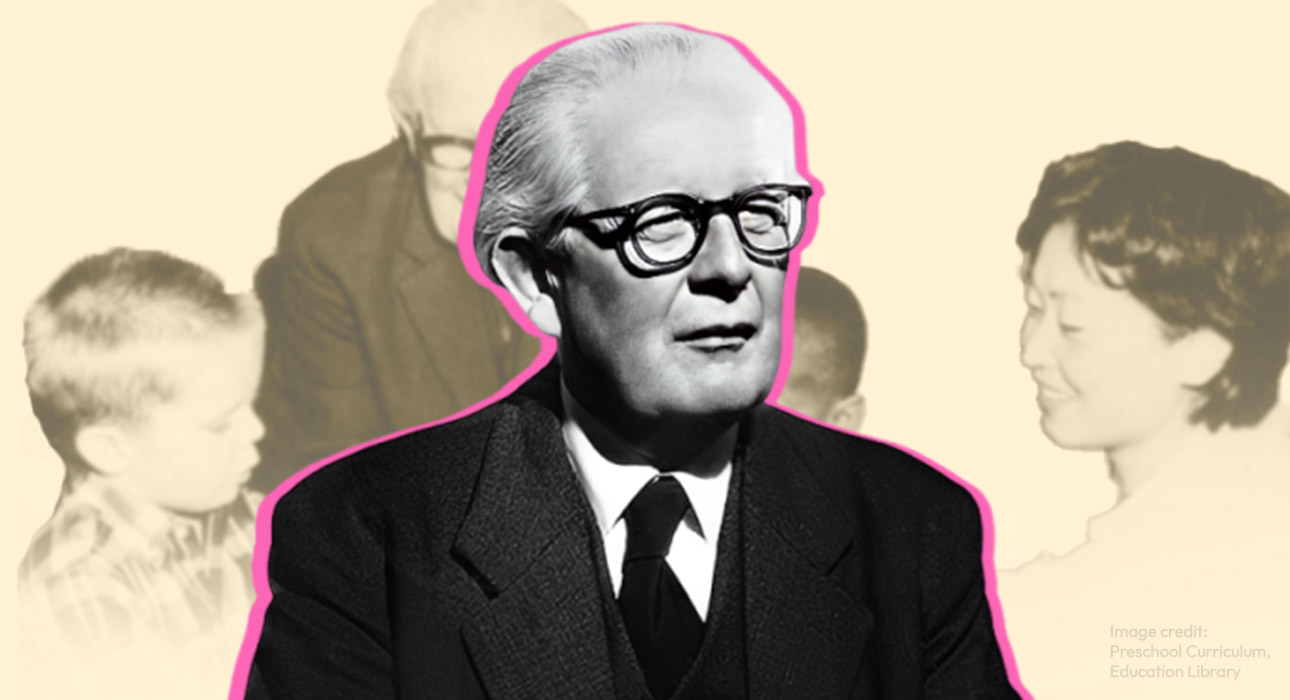
It was in the winter of 1925 when a Swiss scientist by the name of Jean Piaget embarked on an experiment that would forever revolutionise human psychology. His laboratory was not the sterile room with the equipment, but the nursery with the sun, and his test subjects were not the anonymous volunteers, but his own newborn children: Jacqueline, Lucienne and Laurent (Cherry, 2025). Jean Piaget arrived with nothing but a notebook and a motivating curiosity, spending years on the floor, observing his babies drop spoons, cuddle beneath blankets, and struggle with the magic of a disappearing toy (Piaget, 1936).
It was a process that was borderline domestic, but it gave birth to a revolution. Jean Piaget invalidated the belief that children were just miniature adults having empty heads by using his own kids as a biological experiment within their natural environment (Cherry, 2025). He instead opened up a world in which the mind of a child is driven by a logic of its own- qualitatively distinct, brilliantly organised, and creatively endowed.
But this close point of observation worked both ways. Although it gave a richness of detail, which no laboratory could have matched, it tied one of the best known theories of the world to a sample of three, an unwonty question, indeed, to ask: Can the universal laws of human intelligence really be found in the playpens of a Swiss family of three (Baillargeon et al., 1985; Rose & Blank, 1974)?
The Biologist in the Playpen
The reason behind the odd moves of Jean Piaget can be attributed to his shift from zoology to psychology. He was a naturalist at heart, and he was trained to observe molluscs in the Swiss lakes and thought that the only way one can really know a living system is by observing it to operate freely in its natural habitat (Cherry, 2025). He carried this lens along when he shifted his attention to the growth of the mind.
His children gave him a scientific indulgence, unlimited, longitudinal access. He not only got a glimpse of a child, but also the movie of the development of their reason through time. This enabled him to introduce the clinical approach – a form of open-ended questioning that pursues the wrong responses of the child to view the scaffolding of their thinking. This type of observation, a diary-like observation, in the early 20th century, before the existence of strict ethics boards and standardised testing, was the gold standard of developmental research.
Read More: Why Piaget’s Stages Still Matter: A Modern Reassessment
The “Aha!” Moments: Defining the Stages
From his observations, Piaget proposed that children don’t just know less than adults; they think in entirely different ways across four universal stages:
- Sensorimotor (0–2 years): Learning through touch and taste.
- Preoperational (2–7 years): The birth of symbols and “make-believe,” though logic is still egocentric.
- Concrete Operational (7–11 years): The beginning of logical rules, but only for physical things.
- Formal Operational (12+ years): The leap into the abstract and the “what if.”
A cornerstone of his early work was object permanence, the realisation that a ball still exists even when it’s under a couch. By watching Laurent stop searching for a toy the moment it was covered, Piaget concluded that for an infant, “out of sight” literally meant “out of existence” (Piaget, 1954). These nursery observations gave us the vocabulary we still use today: schemas (mental folders), assimilation (fitting new info into folders), and accommodation (creating new folders).
Read More: Theories Of Child Development: Know About the Whole Stages
The Strengths: Ecological Validity
The brilliance of the methodology of Jean Piaget was its ecological validity. The behaviour of the children was sincere since they were at their respective places of residence. A laboratory could turn a child shy or performative; the nursery had captured the spontaneous spark of human thought. Following the lives of the same three children throughout ten years, Jean Piaget was able to observe the process of stage change, the chaotic and fascinating glitches in logic, which happen just prior to a child making the transition to a new stage of thought.
The Fatal Flaws: The Bubble of Three
But the same intimacy that provided Piaget with his data has corrupted it with bias.
- The Representation Issue: Jacqueline, Lucienne and Laurent were children of a genius, white, middle-class Swiss scholar. To propose that they were the cognitive prototype of all the children on the planet- of the London streets and the Andes villages- was a giant methodological leap.
- The Father-Scientist Bias: Piaget was attempting to validate his theories when he served as the main data collector. Unless there were independent observers or a blind test, he was likely a victim of confirmation bias and noted the moments that would fit his theory and disregarded those that did not.
- The Language Trap: One of his theories in clinical work was based on the possibility of a child describing their thought. We have learned that children are usually aware of something well before they can tell the words of the concept.
The Modern Verdict: When the Evidence Pushed Back
Decades later, experiments that were more rigorous demonstrated that Jean Piaget and his children had misled him and undervalued what babies could actually do.
- The Drawbridge Study: In 1985, Renée Baillière employed eye-tracking (the “violation-of-expectation” paradigm) to demonstrate that at the age of 5 months, babies are shocked when a screen slides over an object that they cannot see. They had heard it was there all along. The kids of Piaget had not been deficient in the idea of the object; they just had not been able to move enough to grasp it (Baillaire et al., 1985).
- The Conservation Glitch: Rose and Blank (1974) discovered that Jean Piaget, who habitually repeated a question (e.g. “Is there more water now?”), caused children to believe that the initial response was incorrect. Only being asked once, younger children showed they were actually much more rational than Piaget ever considered them to be.
Conclusion
Jean Piaget observed his own children since they were the most living, available window to the human soul. His work is a legacy to the strength of the curious eye. Although he might have miscalculated some of the milestones, the clockwork he had right was that of children not being passive buckets to be filled with facts, but little scientists constructing their own reality.
Piaget’s nursery story reminds us that though science started with one close observation that is very personal, it does not turn out to be true until it is tested by the world. He provided the map; it is only modern psychology that is filling in the terrain.
References +
Baillargeon, R., Spelke, E. S., & Wasserman, S. (1985). Object permanence in five-month-old infants. Cognition, 20(3), 191–208.
https://doi.org/10.1016/0010-0277(85)90008-3
Cherry, K. (2025). Jean Piaget biography (1896–1980). Verywell Mind. https://www.verywellmind.com/jean-piaget-biography-1896-1980-2795549
Johnson, F. L. (1977). Role-taking and referential communication abilities in first- and third-grade children. Human Communication Research, 3(2), 135–145. https://doi.org/10.1111/j.1468-2958.1977.tb00512.x
Piaget, J. (1936). The origins of intelligence in children. International Universities Press.
Piaget, J. (1954). The construction of reality in the child. Basic Books.
Rose, S. A., & Blank, M. (1974). The potency of context in children’s cognition: An illustration through conservation. Child Development, 45(2), 499–502. https://doi.org/10.2307/1127977
Yasnitsky, A. (2014). Vygotsky, Lev. In D. C. Phillips (Ed.), Encyclopedia of educational theory and philosophy. Sage Publications.




Leave feedback about this