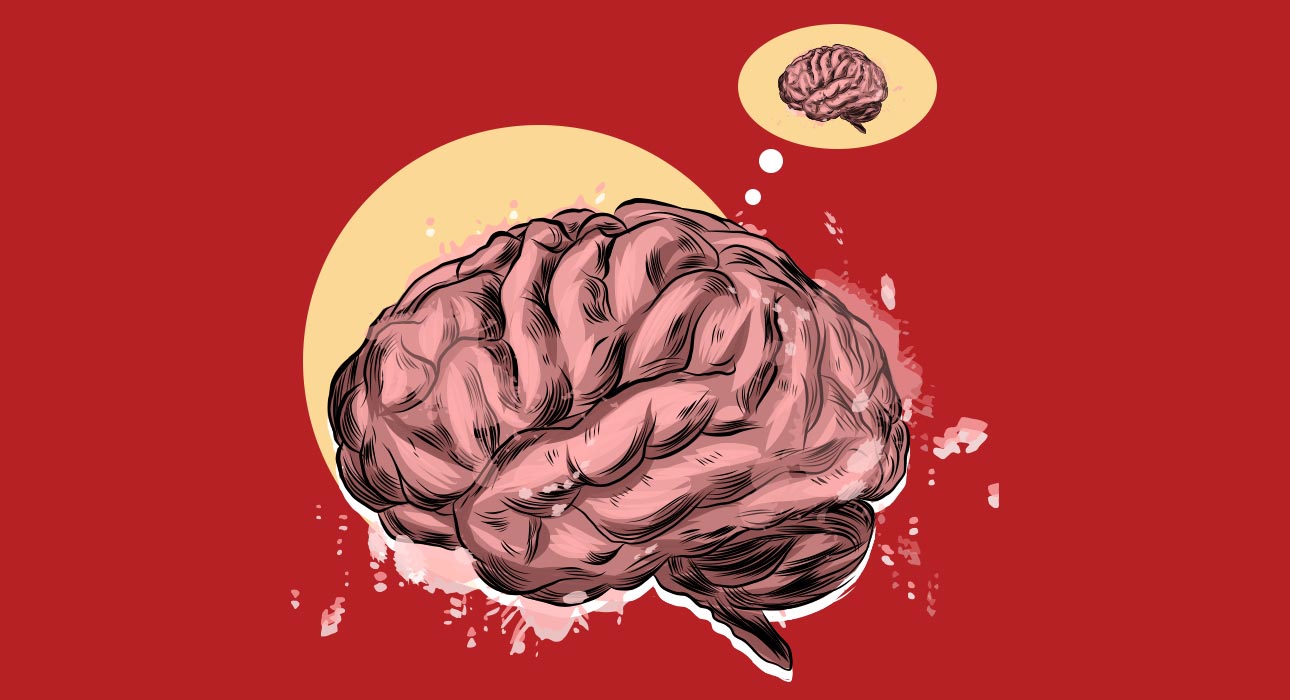
Have you ever paused your thoughts and thought of how we think?
Our thoughts are zooming out and learning how to engage with our thoughts more intentionally. Often it is called “thinking about thinking”. Metacognition is the awareness and regulation of one’s own thought process. Metacognitive skills involve observing mental patterns, monitoring, planning, and evaluating one’s emotional response. These skills are the core of self-regulation, coping mechanisms, and mental well-being. As it is the core foundation of self-awareness (Fleur, Johnson, & Patel, 2023). It is also interdisciplinary in educational psychology, neuroscience, clinical psychology, and positive psychology.
Metacognition
The term “Metacognition” comes from the root word “meta,” which means “beyond,” and “cognition” means “mental action or process of acquiring knowledge and understanding through thoughts”. Metacognition is thinking beyond our thoughts. It means one who can reflect and control one’s cognitive processes rather than react immediately (Chou, Lin, & Wang, 2023).
Read More: Psychological Insights into Metacognition and Learning
Core components of metacognition
Metacognition has a combination of metacognitive knowledge and metacognitive regulation. Metacognitive knowledge is awareness of one’s abilities, strengths, and weaknesses, understanding the strategies and how to apply them. It is also knowing when and why to use these particular strategies. Metacognitive regulation is the process of planning, monitoring, and valuing cognitive processes (Fleur et al., 2023). Research shows that metacognitive training for undergraduate students’ exam performance and ability to transfer knowledge to new contexts (Stanto, Ramirez, & Chen, 2021)
Think Out of the “Box”
We often hear the saying, “Think out of the box.” It means solving problems or unconventionally making decisions. Designing your thoughts to create awareness, notice mental patterns, and choose clear responses. The transformative aspect of metacognition is the distinction between “being caught inside our thoughts” and “our observing our thoughts from outside.” For example, if a student thinks, “I am not good at math,” he believes it. He caught inside his thought, avoiding studying and reinforcing his thought. Which means he identified with his thought. He reacts and behaves according to his thoughts.
If the same student steps back and addresses his patterns of mind, and he reflects, “I am not good at math, alright, it just seems too difficult, better I choose an easy strategy to cope with this,” This recognition and awareness create space to choose a clear response rather than reacting instantly( Chou et al., 2023). So, our mind, as a tool, not itself, observes our thoughts from outside. We should think outside the box, not within the box.
How neuroscience involves metacognition
Neuroscience shows how the brain region regulates the function of meta-cognition. The neural processes contribute to self-awareness and manipulate self-awareness. By combining both internal and external stimuli to create a unified sense of self. In the brain region, internal stimuli regulate self-awareness (Hulbig, 2026).
Architecture of Self-Awareness
We are architects of our own thoughts. Our brain, neural, and cognitive processes design our thoughts of self-awareness. Self-awareness is also a basic skill to develop metacognition. Self-awareness is a multi-level construction process ranging from basic interoceptive awareness to complex, recursive metacognitive representations. This process is synthesising bottom-up sensory data, top-down expectations, and beliefs (Fleur et sl, 2023).
Computational Hierarchies
Metacognition is modelled as a hierarchy, with higher-order process monitoring and controlling lower-order cognition. This architecture supports recursive self-reflection and adaptive regulation (Chou et al., 2023).
Neural hierarchies
According to an fMRI study, metacognitive ability linked to the region of the prefrontal cortex and anterior cortex helps in monitoring and error detection. The prefrontal cortex regulates the central node of the metacognitive process, comprising information from sensory, memory, and affective systems. The cingulo-opercular components support generic monitoring across tasks, while the prefrontal cortex is specialised for particular domains of perception and memory. (Hulbig, 2026)
Architect of Learning Cognition
In education, metacognition helps conceptualise the awareness and regulation of learning strategies, self-monitoring, and evaluation. It is the architecture of self-regulated learning and academic success. The practical technique, such as think-aloud protocols, Graphic organizers, regulatory checklists, reflective journals, and self-questions, helps students shift from identifying with thoughts to observing them (Chou et al., 2023). The metacognitive skills are assessed through performance-based tasks, inventories, and learning behaviour observation. It helps students to growth mindset and resilience. Metacognition helps the learning process, the ability to think proactively, and enhances motivation (Stanto et al., 2021).
For example, if the student works through the difficult math problem, the prefrontal cortex regulates the information in memory (formula) and applies strategies to solve the math problem. The Cingular-opercular regulates quality control monitoring, like concentration, noticing errors, recheck and critical thinking. Here, the student applies knowledge and monitoring, and accessing the process helps learning cognition.
Read More: A Guide to Using Cognition for Effective Learning
Practices that help with metacognition
Rushing into hurried life, our thoughts are even rushing fast without recognising the patterns. Pause in your thought, step back, and design it like a building using metacognition. Project clearly through ways of journaling, self-talk, and feedback
- Journaling: Journaling is also an efficient way to build self-awareness. While writing your thoughts, emotions, and feelings. It helps to analyse the pattern, the way of reconstructing the ideas, and to make a clear decision.
- Slow down thoughts and meditation: Meditation is a good way to slow down the thoughts, practice patience, and organise the cognitive process.
- Self-talk: Self-talk is also an effective way to construct our ideas emotionally. Self-talk is talking with yourself and questioning yourself. Self-talk recognises and questions our thoughts. For example, before doing something, ask yourself questions: “Am I good enough to handle?” “Is it the right way to approach? “How do I face this consequence?” Self-talk helps to clear decision-making and process self-awareness.
- Feedback: Feedback from internal and external source help to decision making and problem-solving.
Once, decided and constructed thoughts, share your thoughts with a trusted person, asking for opinions and suggestions improves Metacognition (Fleur et al., 2023).
Read More: Mindfulness Meditation has a Positive Effect on Mental Health
Conclusion
Metacognition is the transformative process. The brain changes the place of static into thinking beyond the cognition process. It is a higher-order metacognitive process involving self-awareness, self-regulation, and transformation. It is both the self-awareness and regulation of thought processes. Its neuroscience and education, psychology, and metacognition are recognised as critical abilities for adaptive functioning, learning, and well-being.
The metacognition is hierarchical and integrative, monitoring and controlling across cognitive domains and neural systems. Instead of cultivating observing thought through explicit instruction, reflective practice, and therapeutic intervention empowers individuals to detach from programmed patterns, regulate their behaviour and emotion on their own, and realise their potential for growth and transformation. This self-awareness helps one to construct the development process of cognition and self -aware leaners and resilient and adaptive individuals. Metacognition is all about the architecture of “thinking about thinking”.
References +
American Psychological Association. (2018). Metacognition. In the APA Dictionary of Psychology.
Dimmitt, C., & McCormick, C.B (2012). Metacognition in education. In K. R. Harris, S. Graham, T. Urdan, C. B. McCormick, G. M. Sinatra, & J. Sweller (Eds.), APA educational psychology handbook, Vol. 1: Theories, constructs, and critical issues (pp. 157–187).
American Psychological Association.
Fleming, S. M., & Frith, C. D. (2014). Metacognitive neuroscience: An introduction. In S. M. Fleming & C. D. Frith (Eds.), The cognitive neuroscience of metacognition (pp. 1–6). Springer
Fleur, M., Johnson, R., & Patel, S. (2023). Metacognition and self-awareness: Foundations for adaptive learning. Cognitive Psychology Review, 38(4), 512–530. (doi.org in Bing)
Stanto, L., Ramirez, P., & Chen, K. (2021). Training metacognitive skills to enhance exam performance and knowledge transfer. Learning and Instruction, 72, 101–118. (doi.org in Bing)
Hulbig, A. (2026). Neural processes of self-awareness: Integrating internal and external stimuli. Neuroscience & Consciousness, 12(1), 33–49. (doi.org in Bing)
Fleur, D. S., & Bredeweg, B. (2021). Metacognition: Ideas and insights from neuro- and educational sciences. NPJ Science of Learning, 6(13), 1–10. (doi.org in Bing)
Proust, J. (2025). Metacognition. Open the Encyclopedia of Cognitive Science. (doi.org in Bing)