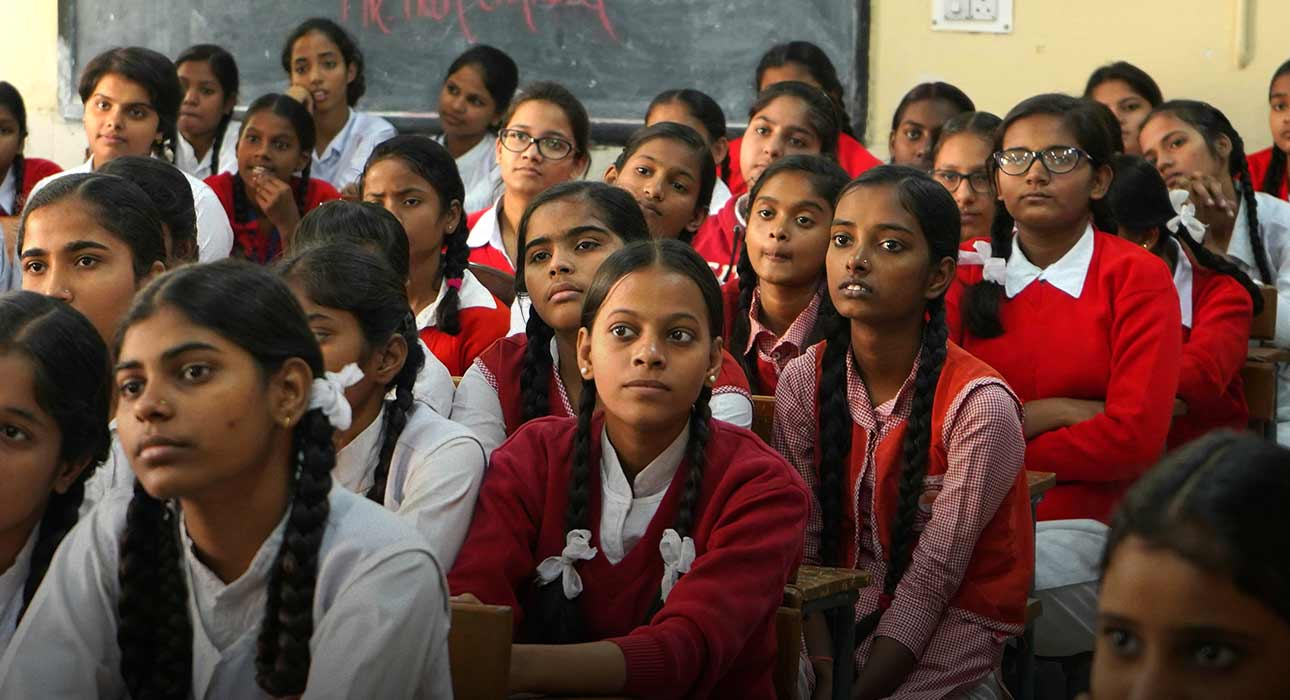
There has long been an unwritten, excruciating ritual among school-going girls across India: hours of lessons endured alongside agonising cramps, frantic slips of sanitary pads up their sleeves during breaks, and the hope that they won’t leak until the last bell. Now the newly installed United Democratic Front (UDF) government in Kerala, under Chief Minister V.D. Satheesan, is attempting to break that ritual. A day before making a major policy speech to the State Assembly, Governor Rajendra Vishwanath Arlekar unveiled a proposal to grant schoolgirls up to three days’ paid Menstrual Leave per month.
Called “Project Menstrual Dignity,” the program is aimed at developing the state into a women-friendly zone. To ensure that young women do not lose out on academics, the state proposes to conduct supplementary classes for them on weekends.
Though the conversation surrounding menstruation leave usually revolves around physical discomfort, educational psychologists and mental health experts point out that the true breakthrough is emotional and psychological. The policy is aimed at alleviating the enormous psychological pressure a young woman faces in dealing with menstruation in a system designed to neglect it.
The Invisible Strain in the Classroom
The unseen pressure in the classroom: We usually focus on periods as just a physical problem with cramps, backaches and exhaustion. But when the teenage brain and body are already going through overwhelming growth, the issue becomes much larger than that. Periods often accompany overwhelming emotional states and symptoms, fatigue and mind fog.
As demonstrated in a study published in the Italian Journal of Paediatrics, “the symptoms experienced directly interfere with concentration, daily functioning, and emotional regulation” of an adolescent (Rigon et al., 2012). However, our schools require students to attend school and perform with a flawless facade, regardless of how much they are suffering. A student must go through high-pressure tests or long school days, hiding severe discomfort, causing pressure to accumulate and contributing to a significant degree of emotional burnout and academic anxiety.
Read More: How Does Menopause Affect Mental Health: Psychologist Speaks
Breaking the Psychological Burden of Shame
While physical pain takes its toll, it’s often the shame attached that causes far greater suffering. In a UNICEF report, it states how “the pervading shame of periods destroys a girl’s self-esteem, silences her in class and negatively impacts her emotional health (UNICEF, 2021). Since infancy, girls have been taught that periods are a private, dirty matter that should be concealed, whispered about and managed alone.
This cultural secrecy is, in turn, sustained by constant low-grade anxiety; a fear of ridicule by other students or judgment from male teachers/school staff. “Psychologists say that bearing pain alone while you’re trying to conform to expectations places a massive mental strain on you when your confidence is at its lowest point, especially as a child going through the most sensitive period of growth: adolescence”.
Why Validation is the Best Medicine
Educational psychologists have long understood that the school environment deeply influences a student’s well-being. A groundbreaking study by Eccles and Roeser (2011) revealed that in supportive environments that validate students’ lives, their resilience grows, their self-worth increases, and they become motivated to succeed.
When a government or school board enacts a menstrual leave policy, they are offering a profound gift: validation to the student. It is a validation to young girls that their suffering is seen, their bodies are valued, and that their biology is not an indication of deficiency. Removing the requirement to hide their suffering, or devise a cover story to explain their absence from school, a menstrual leave policy can undo the deeply embedded institutional shame attached to menstruation and affirm a girl’s sense of safety, belonging and respect.
Education with a Human Face
The policy is not some impulsive experiment, but the continuation of the journey that began when Kerala passed its period leave for students in the state universities (The News Minute, 2026). Extending the policy to the school level is an intervention into the early days of girls coming into adulthood, safeguarding their mental health before they can learn the very templates of shame. Most importantly, the policy does not frame periods as a ‘disability’ or an opportunity to bunk education. With the provision of catch-up classes on weekends, Kerala has smartly struck a balance between empathy and education. It has unequivocally questioned the age-old dogma that no-stopping, constant productivity is the only key to development, at the cost of a child’s well-being.
A New Path Forward
The national conversation ignited by Kerala’s suggestion reflects a simple, yet profound, truth: menstrual health and mental health cannot be decoupled. If a natural biological function consumes a student’s energy, makes it difficult to focus, and leads her to withdraw, that is a psychological problem, not just a physical one.
Through Project Menstrual Dignity, Kerala is taking a small, yet important, step towards building a more humane model of education in India. This proposal is a soft but necessary reminder that education can function optimally not when students are seen as automatons but when the student as a whole, mind, body and soul is taken into consideration.
References +
- Kerala Proposes Three-Day Menstrual Leave for Schoolgirls – GKToday https://www.gktoday.in/kerala-proposes-three-day-menstrual-leave-for-schoolgirls/
- Kerala moots three-day menstrual leave for schoolgirls https://www.thehindu.com/news/national/kerala/kerala-moots-three-day-menstrual-leave for-schoolgirls/article71036352.ece