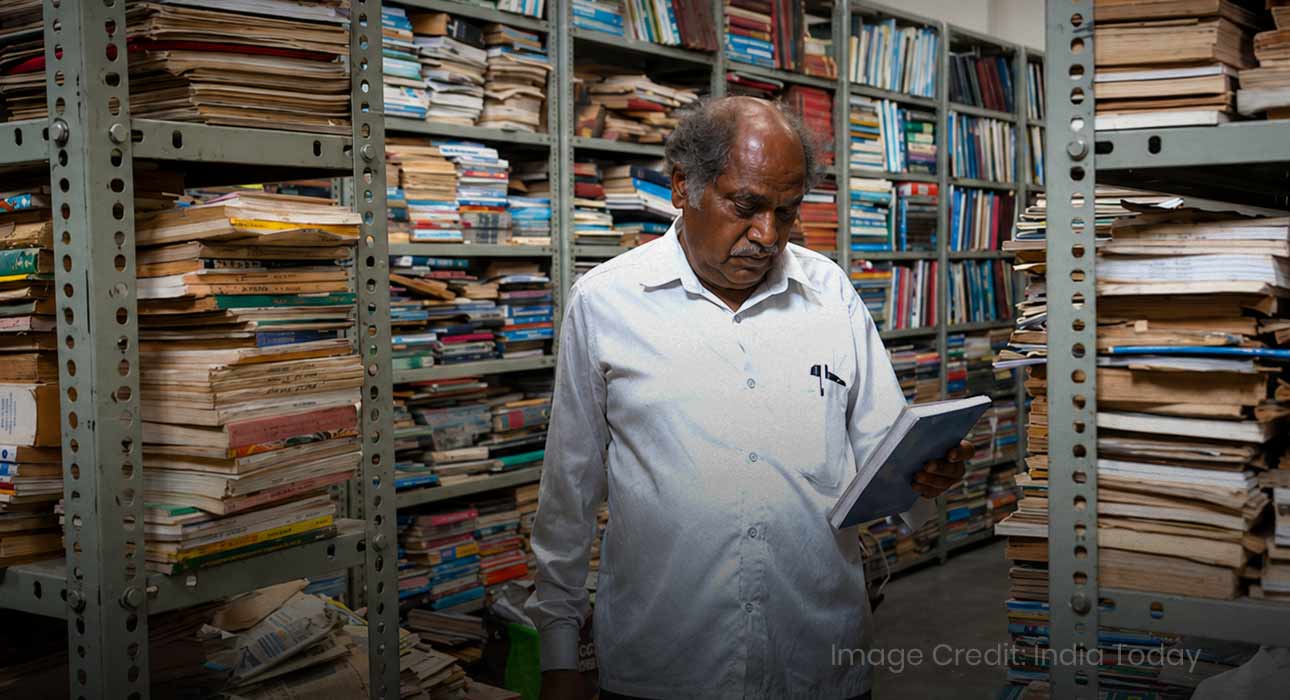
After spending more than five decades collecting over 20 lakh books with his personal savings, Karnataka’s Anke Gowda has been recognised with the Padma Shri, highlighting the transformative power of individual commitment to public education and knowledge accessibility.
In an era dominated by digital screens and shrinking reading habits, the remarkable story of Anke Gowda, a retired bus conductor from Karnataka, stands as a powerful reminder that one individual’s lifelong commitment can transform access to knowledge. Honoured with the Padma Shri 2026, Gowda has built one of India’s- and arguably the world’s- largest free-access private libraries, housing more than 20 lakh books collected over five decades entirely through personal sacrifice and unwavering dedication (Hindustan Times, 2026).
Known as ‘Pustaka Mane’ (House of Books), the library in Haralahalli village of Mandya district has become a sanctuary for students, researchers, teachers, and bibliophiles from across the country. Unlike conventional institutions supported by governments or philanthropic organisations, Gowda’s library grew solely through his determination to ensure that books remained accessible to everyone, irrespective of social or economic background (The Better India, 2026).
A Childhood Without Books Sparked a Lifetime Mission
Born into a farming family, Gowda experienced firsthand the scarcity of books in rural India. As a young student, he often walked long distances simply to borrow reading material. That early struggle shaped a lifelong conviction that access to books should never be determined by geography or financial status.
While working first as a bus conductor and later as an employee at the Pandavapura Sugar Factory, Gowda devoted nearly 80 per cent of his salary to purchasing books. Rather than accumulating wealth, he invested his earnings in building an ever-expanding collection that would eventually become a public resource spanning over 20 Indian and international languages (Hindustan Times, 2026).
A Library Built Through Personal Sacrifice
What began with a handful of books gradually evolved into an extraordinary literary archive covering literature, history, philosophy, religion, science, medicine, law, agriculture, and countless other disciplines. Today, the collection reportedly includes:
- More than 20 lakh books and magazines
- Around 5 lakh rare international publications
- Thousands of dictionaries
- Extensive collections on Mahatma Gandhi, the Bhagavad Gita, the Ramayana, the Bible, and numerous religious and cultural texts
- Rare journals, research papers, newspapers, and manuscripts spanning decades (Times of India, 2026).
Unlike many private collections that remain inaccessible, Gowda opened his doors to the public free of cost, allowing visitors to read, borrow, and conduct research without membership fees or institutional restrictions.
Recognition After Decades of Quiet Service
For over fifty years, Gowda continued his work without seeking awards or public recognition. His efforts finally received national acknowledgement when the Government of India conferred upon him the Padma Shri 2026 under the category recognising grassroots contributions to education and literacy.
The honour celebrates not merely an individual achievement but also the broader importance of preserving knowledge and promoting lifelong learning. Education experts have described Gowda’s work as a rare example of citizen-led educational infrastructure that complements formal academic institutions (India Today, 2026).
Preserving a National Treasure
Despite the prestigious recognition, Gowda now faces one of the greatest challenges in his mission- space. As the collection continues to grow, a significant number of books remain stored outside the main building due to insufficient infrastructure, exposing valuable publications to weather-related deterioration. Gowda has appealed for government assistance, requesting land and financial support to establish a modern archival facility capable of preserving this irreplaceable collection for future generations (Times of India, 2026).
Following his Padma Shri recognition, the Karnataka government has initiated steps to support the preservation and expansion of Pustaka Mane, including proposals for improved infrastructure and long-term conservation measures.
A Powerful Lesson in the Value of Public Knowledge
At a time when conversations around education increasingly focus on technology, infrastructure, and policy reforms, Anke Gowda’s story underscores another essential pillar of the learning community: access to knowledge. His journey demonstrates that libraries remain more than repositories of books; they are spaces that foster critical thinking, curiosity, and equal opportunity. By dedicating his life and livelihood to creating a freely accessible knowledge ecosystem, Gowda has shown how personal conviction can leave a lasting educational legacy.
The Padma Shri honours his extraordinary contribution, but perhaps more importantly, it brings national attention to the enduring relevance of libraries in strengthening literacy, preserving cultural heritage, and nurturing informed citizenship in contemporary India.
References +
- The Better India – From Bus Conductor to Padma Shri: Anke Gowda’s Free Public Library
- Hindustan Times – Bus Conductor Who Built 20-Lakh-Book Library Among Karnataka’s Padma Shri Awardees
- The Times of India – Mandya’s Anke Gowda Awarded Padma Shri for Building One of India’s Largest Private Libraries
- India Today – Meet Padma Shri Anke Gowda, the Bus Conductor Behind India’s Largest Free Library
- The Times of India – State Government Extends Support to Anke Gowda’s Pustaka Mane
- The Times of India – Padma Awardee Anke Gowda’s Library with Over 25 Lakh Books Needs Space