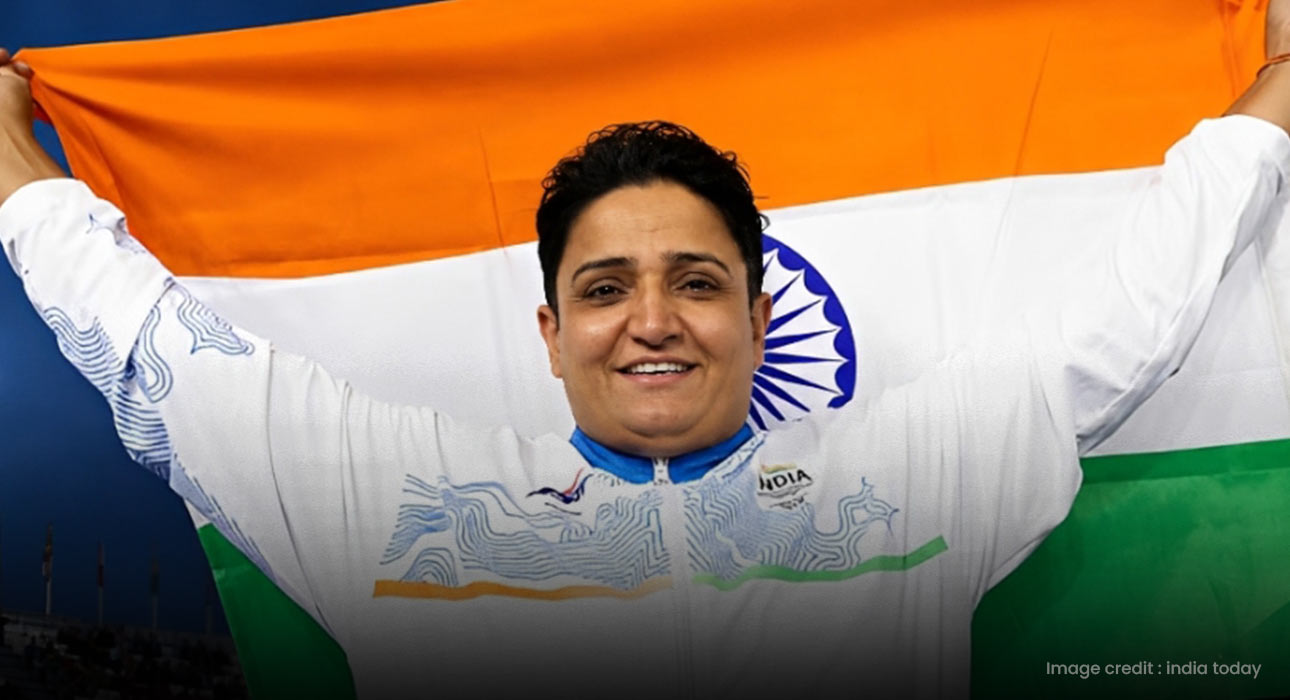
The Indian contingent witnessed an incredible feat at the Commonwealth Games held in Glasgow in 2026, with para-athlete Sharmila Dhankar winning the first-ever Commonwealth Games gold medal for India in the field of para-athletics in the Women’s Shot Put F57 category. Although the medal in itself is a commendable feat, the backstory behind the medal makes it even more special. The success of Dhankar has been against all odds, including domestic abuse, disability in childhood due to polio, poverty, and discrimination from society. This feat has made her one of the most inspiring athletes of the games (India Today, 2026).
A Historic Gold for Indian Para Athletics
In the event of Women’s Shot Put F57, Sharmila Dhankar threw a best throw of 9.81 meters and became the first para-athlete in India to win the Commonwealth Games gold medal in para athletics. This victory not only gave India a Commonwealth Games gold after almost two decades but also put her among India’s most famous para-athletes (The Indian Express, 2026). This victory was an important milestone in increasing India’s medal tally, reflecting the increased involvement of the country in para-sports. The officials from the sports community stated that this victory was a milestone in Indian athletics.
Read More: The Impact of Domestic Violence on Women’s Mental Health
From Domestic Abuse to the World Stage
This gold medal is a result of exceptional resilience on her part. As explained by Dhankar, she suffered domestic violence for many years at the hands of her spouse in her previous marriage. It is believed that she faced physical assault and emotional abuse as well as discrimination because she had two daughters. Finally, after being thrown out of the marital residence just after the birth of her second daughter, she went back to her parental home and started everything from scratch (India Today, 2026). Much later in her life, her second marriage turned out to be a milestone in her life, since, encouraged by her family emotionally and by her spouse, Dhankar took up competitive sports.
Read More: The Controversy of Domestic Violence in Intimate Relationships
Overcoming Disability and Financial Hardship
Dhankar’s difficulties started way before marriage. As a child, she contracted polio, which left her physically disabled in her right leg. In a family that was not economically well-off, she had fewer opportunities for education and sports. Though she always excelled in academics, economic reasons forced her into marriage rather than pursuing studies further (India Today, 2026). After her divorce, when she went back to her family house, she took time to rebuild her self-confidence until the day when she got into para-athletics. Her coach, Tek Chand, realised her potential, and with her family’s, including her mother’s, consistent encouragement and sacrifices, she pursued a career in sport.
Read More: How Paralympic Athletes Build Identity and Self-Concept Beyond Disability
Sport as a Pathway to Healing and Empowerment
Dhankar’s journey illustrates the possibility that sport not only can be an avenue for competition but also one of healing, identity, and personal recovery. Research consistently indicates that involvement in sporting activities increases resilience, self-esteem, emotional well-being, and social support among people who are recovering from tough circumstances (Fletcher & Sarkar, 2012). In the case of Dhankar, sports were a means for her to restore her confidence, reconstruct her life and channel her personal suffering into success. Dhankar’s story further draws attention to the issues surrounding women’s empowerment, disability, and the need for survivors of abuse to have access to supportive avenues through which they can reconstruct their lives.
Read More: Women’s Won Gold at Asian Games: Empowerment from a Psychological Perspective
A Victory Beyond the Podium
The Commonwealth Gold Medal means far more to Dhankar than mere sporting triumph. This is because she frequently talks about her daughters, who, like her, are also participating in athletics, and hopes that one day all of them will compete for India at the international level. It, therefore, serves as a message that violence can be overcome by resilience and aspirations. Her story has touched millions of people across India: women, para-athletes, domestic violence victims, and others who have faced adversities in their lives. The truth is that resilience is not just about enduring tough times, but about creating a completely different future despite them.
Why This Story Matters
Win for Sharmila Dhankar at the Commonwealth Games goes way beyond winning any athletic medal. Her success helps us to understand problems that we usually tend to ignore: domestic violence, disability stigma, gender bias, and poverty – while showing how amazing the impact of opportunities, family and determination can be. As India continues to develop its para-sporting system, the story of Sharmila Dhankar serves as a constant reminder that not only talent but also hard work and persistence can make an athlete a champion. Thus, the first-ever gold medal of an Indian woman athlete at the CWG becomes a tribute to the power of the human spirit.
References +
- Fletcher, D., & Sarkar, M. (2012). A grounded theory of psychological resilience in Olympic champions. Psychology of Sport and Exercise, 13(5), 669–678. https://doi.org/10.1016/j.psychsport.2012.04.007
- India Today. (2026, July 28). Sharmila Dhankar, once victim of domestic abuse, now has a CWG gold. https://www.indiatoday.in/sports/commonwealth-games/story/sharmila dhankar-cwg-bronze-domestic-abuse-womens-shot-put-glasgow-2957972-2026-07-28
- The Indian Express. (2026, July 28). Sharmila Dhankar wins gold, Shilpa Shyla bronze in para shot put at CWG 2026. https://indianexpress.com/article/sports/sharmila-dhankar gold-shilpa-shyla-bronze-cwg-shotput-10806411/
- The New Indian Express. (2026, July 27). Difficult childhood, abusive marriage to CWG gold: Para athlete Sharmila’s tale. https://www.newindianexpress.com/sport/other/2026/Jul/27/difficult-childhood-abusive marriage-to-cwg-gold-para-athlete-sharmilas-tale
- The Economic Times. (2026, July 29). Beaten, abandoned but spirit unbroken: The making of Sharmila Dhankar’s Commonwealth gold.
- https://economictimes.indiatimes.com/news/sports/other-sports/beaten-abandoned-but spirit-unbroken-the-making-of-sharmila-dhankars-commonwealthgold/articleshow/132693932.cms