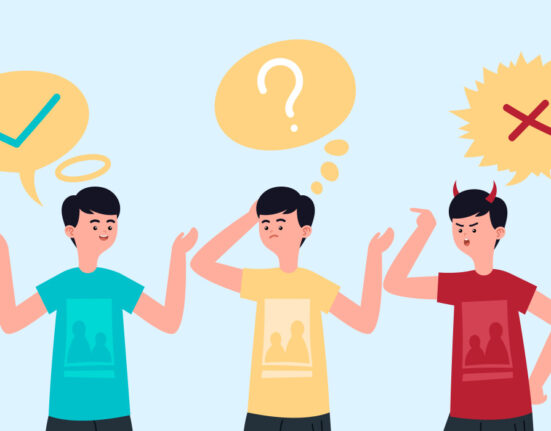
Late one evening, Mira sat at her desk, facing two job offers. One was stable but unexciting, the other was riskier but more aligned with her passions. She mulled it over repeatedly. What if she chose wrong? What if she failed? Hours turned into days, sleep became restless, and what should have been a straightforward decision turned into an endless loop of checking pros and cons, monitoring her heart racing, and replying to feedback from friends. Anxiety had crept in, and with it, her self-monitoring system kicked into overdrive. Instead of clarity, she felt trapped in fog.
This scenario is familiar to many of us. Anxiety often doesn’t just stir worry, but it changes how we monitor ourselves, process information and make decisions. In the “fog” of worry, self-awareness becomes hyper alert yet fragmented, decision awareness becomes muddled, and what should be deliberate choice becomes reactive scanning. This article digs into the psychological mechanisms by which anxiety affects self-monitoring and decision making, explores the implications for everyday life and suggests strategies to navigate the fog.
Understanding Anxiety, Self-Monitoring and Decision Awareness
- Anxiety: is more than momentary unease. Anxiety often triggers heightened vigilance, a tendency to anticipate potential danger and a skewed focus on negative possibilities ( American Psychological Association, 2020 ). This state activates the Behavioural Inhibition System (BIS), promoting individuals to become overly attuned to risks, warning signals and uncertainties (Corr & McNaughton, 2012)
- Self-monitoring: means how we detect mistakes, regulate performance and adjust our choices. Under anxiety, self-monitoring tends toward hyper vigilance, rumination and error checking.
- Decision awareness: means being conscious of the decision process, how we gather information, weigh alternatives, evaluate risks, reflect on outcomes and commit. Anxiety influences this by narrowing attention, amplifying threat signals and reducing cognitive bandwidth ( Miller & Freed, 2023)
Together, these processes form a chain:
Anxiety—-> altered self-monitoring—-> changes in decision awareness—-> decision outcomes.
Anxiety’s Impact on Various Aspects of Life
1. Bodily and Chemical Changes
People with high anxiety often monitor bodily symptoms like heart rate, sweating, trembling and cognitive signals like intrusive thoughts, what-if loops. For example, research shows that high trait anxiety individuals, especially those with low heart rate variability(HRV), display worse attentional Control and greater risk aversion (Ishii et al., 2015). In such cases, self-monitoring isn’t simply reflective; rather, it becomes exhausting surveillance.
2. Anxiety’s Effects on Decision Awareness
Narrowed focus, and when anxious, people tend to gather less information, skip alternatives and make faster heuristic decisions. Research indicates that individuals with high employment anxiety gather less comprehensive information before deciding, rely on intuitive processing and avoid deeper reasoning ( Wang et al., 2023). In decision awareness terms, the player becomes reactive rather than reflective.
3. Social & Professional Effects
Anxiety impacts decision awareness in social contexts, too. In an ultimatum game paradigm, highly anxious individuals accepted more unfair offers from humans but rejected more from computers, indicating altered social decision patterns tied to trait anxiety (Finger et al., 2012). Monitoring of internal states distracts from readiness to act, altering interactions and opportunities.
4. Error Monitoring and Over-Checking
Anxiety amplifies error detection and monitoring. In social anxiety, for instance, individuals focus intensively on perceived mistakes, negative evaluations and performance vigilance (Clark & Wells, 1995). In practical tasks, anxious individuals second-guess themselves, revisit decisions and struggle to shift focus away from internal signals to external task demands.
Risk Perception & Choice Patterns
Anxiety alters perceived risk. Individuals often view the environment as more unpredictable, engage in more option scanning and show reduced exploratory behaviours ( Smith et al.)
The Feedback Trap: Worry, Self-Evaluation and Loops
Constant self-monitoring can trigger a feedback loop: noticing a worry—> checking for signals —>Interpreting them negatively, —> more worry.
Over time, what might start as a healthy reflection becomes pathological rumination. Worry functions as a self-monitoring bias rather than a helpful signal for adjustment.
Heightened Subjective Estimation Anecdotal Bias
An experimental study found that situationally activated anxiety increases the tendency to rely on vivid anecdotal evidence, instead of statistical data; what the researchers described as “anecdotal bias” ( Chu & Spikes, 2015). Thus, decision-making under anxiety can tilt toward affective impressions over analytical reasoning. High Anxiety individuals may over-explore (seeking control) or freeze into minimal exploration (avoiding risk). Their decision awareness is skewed by heightened threat perception, not objective evaluation.
Read More: How Does Overthinking Impact Our Decision-Making Power?
How Self-Monitoring and decision Awareness Interact under anxiety
Self-monitoring and decision awareness are both processes that are interlinked. When self-monitoring is high and worry-driven, cognitive resources are diverted from decision task processing to internal scanning. This reduces capacity for reasoning, evaluation and awareness of alternatives. Studies show that impaired attention control ( as seen in anxious individuals with low HRV) is directly related to risk-averse decision-making (Ishii et al. 2015). In turn, poor decision awareness (fast, heuristic decisions) can trigger doubts: Did I make the right choice? Should I monitor again? This leads to more anxiety, more self-monitoring and more fog.
Read More: Cognitive Biases That Secretly Control Your Decisions – And How to Outsmart Them
Real Life Implications: From Minor Choices to Life Paths
Every day,” fog” in small decisions when everyday choices like- what to eat, wear, say and get trapped in cycles of worry and second-guessing, as decision fatigue takes hold, mental clarity diminishes( Newcomb & Bentler,1988). For individuals living with anxiety, even seemingly trivial choices can feel loaded with risk, eroding spontaneity and chipping away self-confidence.
Life-significant decisions in major decisions like career moves, relationships, health choices, anxiety-induced deficits in self-monitoring and decision awareness can have long-term consequences. A meta-analysis found that nurses with higher anxiety were more prone to indecision and independent decision-making ( Yilmaz et al., 2018). In everyday life, this may manifest as delayed action, fear-driven avoidance or overly safe choices.
Strategies to clear the Fog
Improving Self Monitoring and Decision Monitoring, and decision awareness, increasing Self Monitoring Awareness
- Mindfulness and interceptive practice: Improving body awareness while reducing reactive monitoring helps create space between signal and response ( Farb et al., 2015).
- Heart rate variability (HRV) training: Because HRV moderates the anxiety attention link, breathing exercises may boost decision awareness in anxious individuals. (Ishii et al., 2015)
Read More: Breathing Techniques for Stress Relief and Emotional Balance
Improving Decision Awareness
- Structured decision frameworks: Algorithm or decision checklists force slower reflective processing rather than reactive jumping.
- Information gathering protocols: Encouraging broader data gathering but limiting time helps mitigate the anecdotal bias observed under anxiety ( Chu & Spikes, 2015)
- External feedback and peer review: Having another person review a decision can break loops of self-monitoring and bring a fresh perspective.
Cultivating an Adaptive Monitoring Awareness Balance
The goal isn’t to “turn off” self-monitoring but to optimise it, allowing monitoring signals ( bodily, emotional) to inform rather than hijack decision awareness. Training across both domains ( monitoring+awareness) can reduce the fog and restore clarity.
Coclusion
Anxiety doesn’t merely reflect worry, but it transforms how we monitor ourselves and how we understand decisions. Heightened monitoring, internal scanning, biased attention and impaired decision frameworks together create a fog that distorts clarity. Recognising this dynamic is the first step because awareness is the opposite of fog.
By learning to moderate self-monitoring, structure decision awareness, and differentiate between signals and noise, we can navigate choices with more confidence and less metabolic cost. In short, when worry has fogged the road, better tools help us see the turns again.
References +
American Psychological Association. (2020). Diagnostic and statistical manual of mental disorders (5th ed., text rev.). Author.
Chu, A. M., & Spikes, M. (2015). How anxiety leads to suboptimal decisions under risky choice situations. Risk Analysis, 35(11), 1967‑1979. https://doi.org/10.1111/risa.12418
Corr, P. J., & McNaughton, N. (2012). Approach and avoidance: A commentary on Grey and McNaughton’s ‘Reinforcement Sensitivity Theory’. Psychology & Neuroscience, 5(1), 101‑113.
Farb, N. A., Daubenmier, J., Price, C. J., Gard, T., Kerr, C., Dunn, B. D., … & Mehling, W. E. (2015). Interoception, contemplative practice, and health. Frontiers in Psychology, 6, 763. https://doi.org/10.3389/fpsyg.2015.00763
Figner, B., Murphy, R. O., & Sanfey, A. G. (2012). The impact of anxiety on social decision-making: behavioural and electrodermal findings. Psychophysiology, 49(3), 203‑212. https://doi.org/10.1111/j.1469‑8986.2011.01280.x
Ishii, A., Tanaka, H., Bücher, C., Capusan, A., Naito, E., Shigeto, M., & Yamanaka, G. (2015). Anxiety, attention, and decision making: The moderating role of heart rate variability. Biological Psychology, 110, 113‑121. https://doi.org/10.1016/j.biopsycho.2015.05.001
Miller, S., & Freed, A. (2023). New University of Minnesota research shows the impact of anxiety and apathy on decision‑making. University of Minnesota Medical School News. Retrieved from https://med.umn.edu/news/new‑university‑minnesota‑research‑shows‑impact‑anxiety‑and‑apathy‑decision‑making
Newcomb, M. D., & Bentler, P. M. (1988). Impact of adolescent drug use and social support on problems of young adults: A longitudinal study. Journal of Abnormal Psychology, 97(1), 64‑75.
Tversky, A., & Kahneman, D. (1974). Judgment under uncertainty: Heuristics and biases. Science, 185(4157), 1124‑1131.
Wray‑Lake, L., & Stone, E. R. (2005). The role of self‑esteem and anxiety in decision making for self versus others in relationships. Journal of Behavioural Decision Making, 18(2), 125‑144. https://doi.org/10.1002/bdm.490