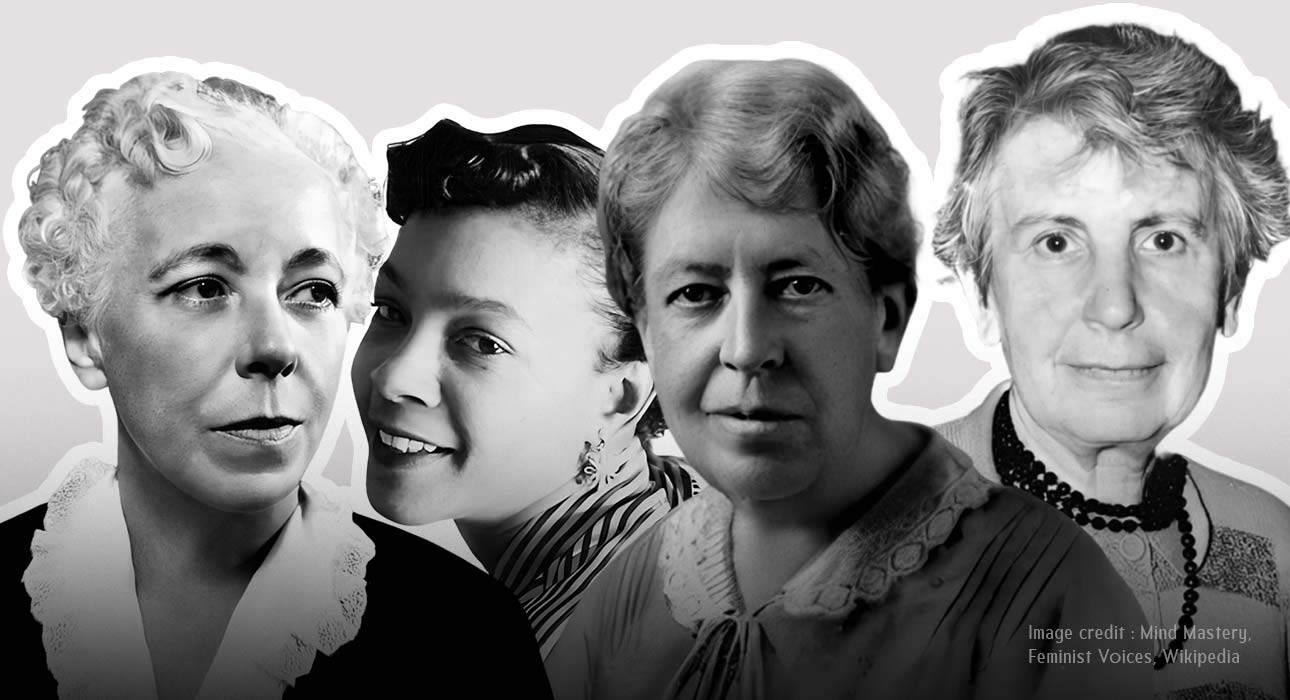
They made important discoveries, pushed past limits, and changed the world, but do we remember their names? This is a hidden pattern where women’s achievements are often ignored, undervalued, or taken by men. This is the Matilda effect, showing us that gender bias can affect who contributes to the knowledge and recognition of information.
The Matilda effect is that women’s work is unacknowledged or misacknowledged, especially in science. Women’s contributions and discoveries have sometimes been given less credit or given to their male colleagues.The term was created by historian Margaret Rossiter in honour of Matilda JoslynGagee, a women’s rights activist whose work was overlooked. Women’s efforts were less visible and left out of the scientific stories because of the barriers that prevented them from joining professional groups, scientific organisations, and educational systems.
The Matilda effect is that women’s work is unacknowledged or misacknowledged, especially in science. Women’s contributions and discoveries have sometimes been given less credit or given to their male colleagues. The term was created by historian Margaret Rossiter in honour of Matilda JoslynGagee, a women’s rights activist whose work was overlooked. Women’s efforts were less visible and left out of the scientific stories because of the barriers that prevented them from joining professional groups, scientific organisations, and educational systems.
What Is the Matilda Effect?
The Matilda effect is when women’s achievements are not acknowledged and often credited to a male colleague. For example, nuclear fission was discovered by Lise Meitner, but the Nobel Prize in Physics went to Otto Hahn and not her. Another example is Jocelyn Bell Burnell, who discovered pulsars, but the discovery was given to her supervisor and colleague. The Matilda effect shows us that there is not only bias when women are not directly credited for their work, but also how gender bias is displayed in what is seen as more important and less important achievements.
The Psychology Behind Recognition and Bias
Our ideas about skills, abilities, and how people can fit into society might help explain the psychology behind the Matilda Effect. Usually, skills and being in charge are thought of as more masculine, and women are seen to be caring, nurturing and warm. These ideas can change how certain achievements are seen and what is seen as more important (Moscatelli, 2023). Role congruity theory states that bias can occur when characteristics associated with women do not align with roles that are expected to require high levels of skill, power, or leadership (Eagly & Karau, 2002).
This can affect how people recognise achievements, with women’s work being evaluated against preconceived gender norms rather than the merit of the work itself. Communication research has highlighted this issue in contemporary academia, where Rajkó et al. (2023) conducted a study of 5,500 scholars from 11 countries, finding that women’s work was read more but cited less than men’s (Rajkó et al.,2023). These trends show that the Matilda Effect is not only an issue of the past but also of the present day in terms of how people are viewed, assessed, and recognised.
Instead of examining women’s achievements in isolation, we should consider them in relation to current gender norms. Evidence from communication research highlights the problem in today’s academia: Rajkó et al.(2023) have studied 5,500 scholars from 11 countries and found that women’s publications were viewed more but cited much less than men’s (Rajkó et al.,2023). These trends suggest that modern processes of visibility, assessment, and academic recognition can influence the Matilda Effect, making it both a historical and a contemporary issue. How Bias Becomes Reinforced by Society
The Psychological Impact on Women
When people give women less recognition or credit, it can affect how women view their abilities and their place in their work or studies. If this happens often, they may start to doubt their skills, especially when they lack opportunities to lead, win awards, work in teams, or receive public recognition. This can also make imposter syndrome worse, which is when smart people question if they really deserve their success. Women might also feel stressed if they worry their actions could support harmful beliefs about women being less capable or less suited for leadership.
Over time, these feelings can reduce their motivation, confidence, and sense of belonging, especially in places where few successful women serve as role models or where others take credit for their work. But this doesn’t have to happen. Having supportive mentors, fair ways of assessing work, seeing strong female examples, and clearly giving credit for women’s efforts can help build confidence and a sense of belonging. To fix the Matilda Effect, it’s important to look at both the unfair recognition and the mental effects it has.
From One Generation to the Next: How People Learn Stereotypes
According to social learning theory, children learn about gender roles slowly by watching and copying the actions, behaviours, and successes of people around them. By observing others, parents, teachers, books, media, and other role models send messages to kids. These messages can shape people’s expectations about who can become a scientist, leader, inventor, or expert. Gender schema theory says these messages help shape mental ideas about what is normal or suitable for human beings.
Repeatedly linking scientific success to men can strengthen stereotypes. People may overlook women’s work, credit others for their contributions, or leave them out of scientific stories. The stories of scientists like Alice Ball, Rosalind Franklin, and Lise Meitner show how missing their contributions can hide their achievements. So, recognising and including more women scientists can provide a wider range of examples. This can help challenge the idea that only certain people belong in science.
The Matilda Effect and the Upcoming Generation
The lack of acknowledgement for women’s achievements may shape the views of younger generations. It may also affect how they see their own educational and career prospects. People often attribute scientific discoveries to men. Girls may not see as many examples of women achieving success in the fields of science, technology, engineering, and maths. This may affect career goals and ideas of potential selves. Therefore, lack of representation can reinforce the notion that some professions or types of success are more suited to men. However, prominent female scientists might have the reverse role-model effect. Learning about people such as Rosalind Franklin, Alice Ball, Chien-Shiung Wu, and others
Breaking the Cycle
To address the Matilda effect, both individuals and organisations need to make changes. Everyone, including students, teachers, researchers, and employers, can benefit from being aware of biases. They can also understand how unconscious assumptions can influence the way people judge skills and achievements (Webster et al., 2022). Schools and institutions should also strive to reduce stereotypes. They can do this by having a wide range of scientific role models. They should also properly recognise women’s work when others have overlooked or wrongly credited their contributions (Haynes, 2017)
Clear and open standards for authorship, awards, promotions, hiring, and research funding can help ensure fair and equal evaluation in educational and professional fields (Haynes, 2017). Giving proper credit is very important because it connects achievements to the right people. Organisations can help ensure fairness by having leaders from different backgrounds. They can regularly check how people give recognition. They can also make sure people take responsibility for any unfair actions (Webster et al., 2022). When people take these steps together, they create work and learning environments where everyone treats success equally, regardless of gender.
Conclusion
The Matilda Effect shows how people often fail to acknowledge women’s achievements properly. This is not only a series of old problems. It is also an ongoing issue due to various types of gender bias. For example, people express these ideas through their thoughts and behaviours, while institutions reinforce them through their rules. Preconceived ideas about who is smart or powerful can cause people to overlook women’s work or credit others for it.
These ideas can pass through generations and affect how children see who belongs in fields such as science. This cycle does not need to continue if we give proper credit and treat people fairly. We can educate inclusively and have diverse role models. We can also understand our own biases and preconceived ideas. This can help change these unfair beliefs and create a more equal system. To deal with the Matilda effect, we must not only fix the past. We must also change the systems and expectations that continue to affect whom people notice, respect, and remember.
References +
- Eagly, A. H., & Karau, S. J. (2002). Role congruity theory of prejudice toward female leaders. Psychological Review, 109(3), 573–598. https://doi.org/10.1037/0033-295X.109.3.573
- Haynes, C. (2017, March 8). What is the “Matilda Effect,” and how can we improve recognition of women scientists? Sustainable Nano. University of Wisconsin–Madison.
- Mathison, N. (2021, November 25). The Matilda Effect. Lost Women of Science.
- Moscatelli, S. (2023). A multidimensional implicit approach to gender stereotypes. Frontiers in Psychology, 14.
- Rajkó, A., Herendy, C., Goyanes, M., & Demeter, M. (2023). The Matilda Effect in communication research: The effects of gender and geography on usage and citations across 11 countries. Communication Research, 52(2), 209–232. https://doi.org/10.1177/00936502221124389
- VanDrunen, B. (2025, November 25). The Matilda Effect: The erasure of women in science. Medium.
- Webster, C. S., Taylor, S., Thomas, E., & Weller, J. M. (2022). Social bias, discrimination and inequity in healthcare: Mechanisms, implications and recommendations. BJA Education, 22(4), 131–137. https://doi.org/10.1016/j.bjae.2021.11.011