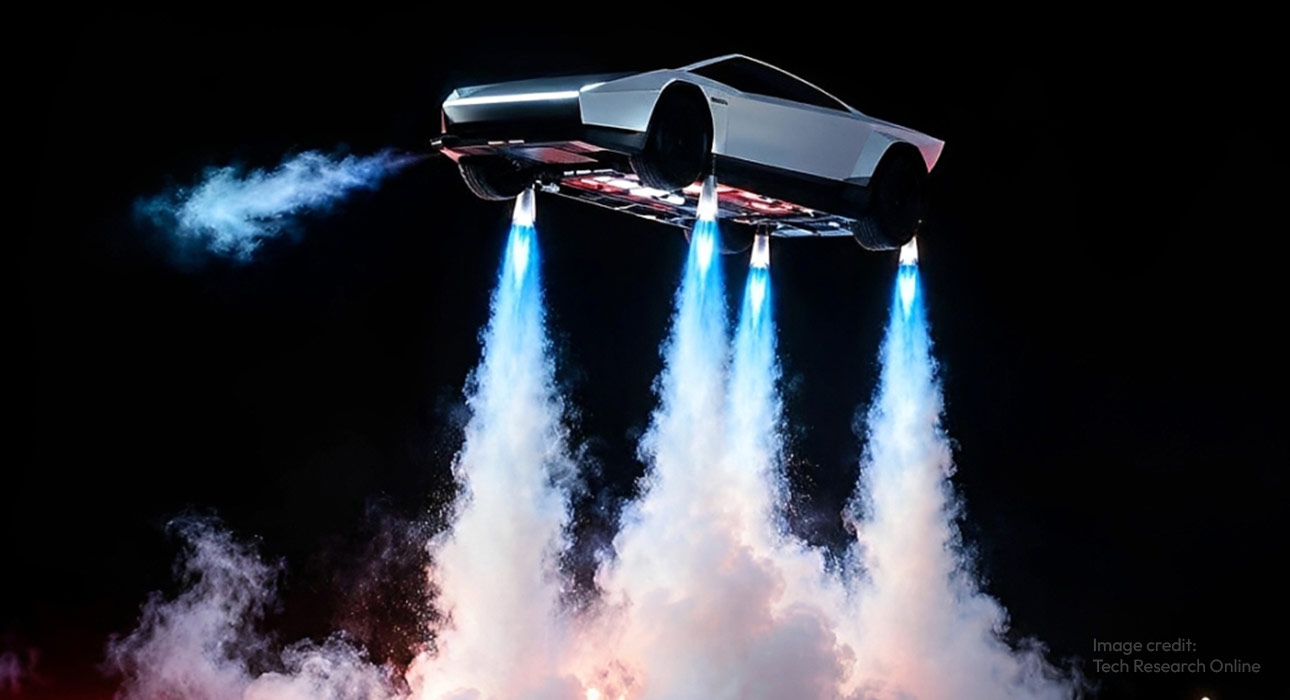
Imagine travelling to work in a car that does not need to follow roads, avoids traffic by taking to the air and allows you to reach your destination in a fraction of the usual time. For generations, the idea of flying cars has captured the human imagination. It represents more than a different form of transportation: it reflects our fascination with possibilities that appear to challenge the limits of everyday life.
Recent discussions surrounding Tesla’s Roadster have brought this futuristic idea back into public attention. Tesla’s current Roadster webpage describes optional cold-gas thrusters and a proposed “Rocket” configuration that the company presents as capable of flight. However, the company also states that this configuration is not approved for public-road use and is not available in all regions (Tesla, Inc., n.d.). It is important to distinguish this proposed rocket-assisted Roadster concept from a conventional flying car or a commercially available air vehicle. A vehicle equipped with thrusters is not automatically a practical or independently verified flying transportation system.
Nevertheless, the idea raises an interesting psychological question: why are people so fascinated by technology they may never have experienced? The answer involves curiosity, imagination, emotional responses to risk and the way people develop trust in unfamiliar innovations. Understanding these psychological processes can help explain not only why we dream about futuristic technologies but also what determines whether we are eventually willing to use them.
Read More: How Is Technology Redefining Human Memory?
The Psychology of Curiosity and Imagination
Curiosity is one of the psychological forces that encourages people to explore the unknown, ask questions and seek new experiences. According to Loewenstein’s (1994) information-gap theory, curiosity emerges when individuals recognise a gap between what they already know and what they would like to understand. For example, someone who has always travelled by road may wonder how a flying car would operate, how it would remain stable in the air and whether it could make everyday journeys safer or faster. The questions themselves create an interest in discovering more.
Imagination allows people to go beyond their existing experiences by mentally constructing situations that have not yet occurred. Schacter et al. (2007) explain that remembering past events and imagining possible future experiences involve overlapping brain processes. People use elements of previous experiences and stored knowledge to construct possible future scenarios.
Consider someone watching a film in which a car takes off vertically and travels above a crowded city. Although the viewer has never travelled in such a vehicle, they may imagine sitting inside it, looking down at traffic and reaching their destination without encountering a traffic jam. This imagined experience can create expectations about how convenient, exciting or comfortable flying cars might be. At the same time, the person may also imagine possible dangers, such as mechanical failure or difficulty landing safely.
This example demonstrates that imagination does not simply create excitement. It can also shape expectations and concerns about unfamiliar technologies. People may develop positive or negative attitudes towards an innovation before they have any direct experience of it. Curiosity encourages them to explore the possibility, while imagination helps them construct a picture of what using it might actually feel like.
Read More: Can Human Cognition Adapt to an AI-Assisted Future?
From Science Fiction to Technological Expectations
Science fiction has played an important role in shaping how people imagine the future. Films, novels and television programmes introduce audiences to technologies such as flying cars, intelligent robots, space travel and virtual reality long before these technologies become widely available. These fictional representations give people a visual and emotional picture of possible future experiences.
For example, the communication devices shown in Star Trek offered audiences an imaginative representation of portable communication technology. Similarly, films such as The Matrix introduced viewers to fictional worlds in which virtual environments could become almost indistinguishable from physical reality. Such stories can influence the questions people ask about technology and the possibilities they expect researchers and engineers to explore.
Research by Osawa et al. (2022) examined representations of artificial intelligence and robots in science fiction. The researchers analysed 115 fictional AI systems and identified different categories of imagined technology, including human-like characters, intelligent machines, robotic helpers and technological infrastructure. Their findings illustrate how science fiction provides a shared collection of images through which people discuss and interpret emerging technologies.
However, the influence of science fiction should not be confused with technological prediction. Fictional stories may inspire public interest and help people imagine new possibilities, but they do not establish that a particular invention is technically achievable or commercially viable. The development of real technologies depends on scientific research, engineering, funding, safety requirements and social needs.
Flying cars provide a useful example. Their repeated appearance in films and popular culture has made them familiar as an idea, even though their practical development involves substantial challenges relating to propulsion, energy use, airspace management, passenger safety and regulation. Science fiction helps people imagine what the future might look like, while research and engineering determine which possibilities can become reality.
Excitement vs. Fear: Understanding Risk Perception
New technologies often produce mixed emotional responses. On one hand, innovations such as autonomous vehicles, intelligent robots and advanced aircraft promise convenience, efficiency and new experiences. On the other hand, they can create uncertainty about safety, reliability and the possibility of losing control.
Psychological research suggests that emotions can influence how people evaluate risks. Lee and Andrade (2015), for example, investigated how fear and excitement influenced financial risk-taking. Their experiments showed that the effect of fear depended partly on how a situation was framed. Fear encouraged more cautious decisions when participants considered a stock investment, but it could encourage risk-taking when the same decision was presented as an exciting casino game.
Although this research focused on financial decisions rather than technology adoption, it illustrates an important psychological point: emotional responses do not operate independently of context. The same feeling can influence decisions differently depending on how individuals interpret the situation.
A similar process may occur when people consider autonomous vehicles. Someone may feel excited about the possibility of travelling without having to drive. However, the same person may become anxious when thinking about whether the vehicle can recognise pedestrians, respond to unexpected obstacles or make safe decisions during bad weather.
The emotional response to a technology is therefore not necessarily the same as a willingness to use it. A person can find an innovation fascinating while remaining concerned about its safety. Excitement may encourage exploration, whereas fear and uncertainty may make individuals more cautious. Understanding these emotional responses helps explain why futuristic technologies can attract public attention without immediately gaining public acceptance.
Read More: Why We Talk to Objects: The Psychology of Human Connection with the Inanimate
Why Are Some Innovations Accepted While Others Are Rejected?
Emotional reactions help explain how people feel about new technologies, but actual adoption involves additional considerations. People are more likely to use an innovation when they believe it offers practical benefits, is easy to operate and can be trusted in everyday situations.
The Technology Acceptance Model (TAM), developed by Davis (1989), explains technology adoption through two central factors: perceived usefulness and perceived ease of use. Perceived usefulness refers to the belief that a technology will improve performance or make a task easier. Perceived ease of use refers to the belief that using the technology will not require excessive effort.
Consider someone deciding whether to use a navigation application. If the application provides accurate directions, saves travel time and is easy to understand, the person may be willing to use it regularly. However, if it frequently gives incorrect directions or has a confusing interface, the user may return to a familiar alternative, even if the application offers advanced features.
The same principles can apply to a flying vehicle or an autonomous car. People may be interested in the idea, but they will also want to know whether it is safe, reliable, convenient and affordable. A technology that looks impressive in a demonstration may still struggle to gain acceptance if people cannot understand how it works or do not believe it will perform reliably.
Venkatesh et al. (2003), through the Unified Theory of Acceptance and Use of Technology, further explain that adoption is influenced by performance expectations, effort expectations, social influence and facilitating conditions. In everyday terms, people may be more willing to use a new technology if they believe it will help them, if others they trust recommend it and if the necessary infrastructure and support are available.
This distinction is important. Curiosity and excitement may encourage people to explore a new invention, but adoption requires more than fascination. Individuals need to see how the technology fits into their lives and whether they can depend on it.
Read More: Will AI Change the World for Everybody? An Inclusive Perspective
Psychologists and the Design of Future Technology
As technology becomes increasingly automated, psychologists have an important role in understanding how people interact with machines. Their knowledge of attention, perception, decision-making, emotions and behaviour can help engineers develop systems that are understandable, usable and responsive to human needs.
Autonomous vehicles provide a particularly relevant example. Although these vehicles are designed to perform driving tasks with reduced human involvement, passengers still need to understand what the system can do, when it may encounter limitations and how they should respond if something goes wrong.
One important factor is trust. Walker et al. (2023) explain that trust in automated vehicles is not simply a fixed attitude. It develops and changes through people’s experiences with the system. Their review highlights the importance of exposure to different driving situations, including system malfunctions and the way the vehicle responds to them. Appropriate trust is essential because people should neither rely on automation blindly nor reject systems that can be used safely.
Research by Lee et al. (2021) illustrates how this trust can change. In a driving-simulator study involving 56 drivers, the researchers examined how prior information and different types of automation failure influenced trust in partially automated vehicles. They found that trust generally increased with experience, but failures produced a temporary decline. Trust could subsequently recover when participants experienced reliable system performance again. The findings also suggested that the reliability of the system was a particularly important factor in how drivers evaluated it.
These findings have practical implications. If a vehicle is capable of operating autonomously only under certain conditions, users need clear information about those limitations. A system that communicates its capabilities accurately can help people form realistic expectations. In contrast, a system that appears more capable than it actually is may encourage inappropriate reliance.
Usability is equally important. Liu et al. (2021) conducted a field experiment involving 261 participants who experienced an automated vehicle in a low-speed environment. Some participants experienced a normal journey, while others were exposed to an automated driving system failure. The researchers found that system failure reduced positive experiences and perceived usability while increasing negative experiences. Positive experience and perceived usability were associated with participants’ willingness to ride in the vehicle again.
This demonstrates that technical performance alone does not determine whether people accept a technology. The experience of using it matters as well. Passengers need to feel that the vehicle is understandable, comfortable and reliable. If an unexpected failure occurs, the system should communicate the problem clearly, explain what is happening and provide appropriate instructions.
The relationship between human imagination and technology design is particularly important here. People often imagine futuristic vehicles as effortless and completely reliable. Real-world technology, however, must operate in uncertain conditions and respond to unexpected situations. Psychologists can help bridge the gap between imagined expectations and actual capabilities by studying how people interpret information, respond to errors and develop trust.
By incorporating psychological research into the design process, engineers can create technologies that are not only technically advanced but also understandable and appropriate for the people who use them.
Read More: Creating Workplaces Where Everyone Can Breathe: AI, Assistive Technology, and Inclusive Design
Conclusion
Innovation is more than technological advancement. It also involves understanding human curiosity, imagination, emotions and expectations. Flying cars and autonomous vehicles capture public attention because they represent possibilities beyond familiar experiences. People imagine how these technologies might transform everyday life, but their willingness to use them depends on much more than excitement.
Psychological research helps explain this relationship. Curiosity encourages exploration, imagination allows people to mentally experience possible futures, and emotional responses influence how they evaluate unfamiliar risks. Technology acceptance research further demonstrates that usefulness, ease of use, trust and practical support are important when people decide whether to adopt an innovation.
The development of future technologies should therefore consider both engineering possibilities and human needs. A vehicle may appear revolutionary, but it must also be safe, reliable, accessible and understandable. By combining technological innovation with psychological and ethical knowledge, researchers and designers can create systems that people can use with confidence.
Perhaps the most interesting question is not simply whether flying cars will become a reality, but whether the technologies we create will genuinely improve human life. The future should not only be impressive to imagine; it should also be safe, meaningful and practical to experience.
References +
- Davis, F. D. (1989). Perceived usefulness, perceived ease of use, and user acceptance of information technology. MIS Quarterly, 13(3), 319–340. https://doi.org/10.2307/249008
- Federal Aviation Administration. (n.d.). Advanced air mobility. https://www.faa.gov/air-taxis
- Lee, C. J., & Andrade, E. B. (2015). Fear, excitement, and financial risk-taking. Cognition and Emotion, 29(1), 178–187. https://doi.org/10.1080/02699931.2014.898611
- Lee, J., Abe, G., Sato, K., & Itoh, M. (2021). Developing human-machine trust: Impacts of prior instruction and automation failure on driver trust in partially automated vehicles. Transportation Research Part F: Traffic Psychology and Behaviour, 79, 161–175. https://doi.org/10.1016/j.trf.2021.06.013
- Liu, P., Jiang, Z., Li, T., Wang, G., Wang, R., & Xu, Z. (2021). User experience and usability when the automated driving system fails: Findings from a field experiment. Accident Analysis & Prevention, 161, Article 106383. https://doi.org/10.1016/j.aap.2021.106383
- Loewenstein, G. (1994). The psychology of curiosity: A review and reinterpretation. Psychological Bulletin, 116(1), 75–98. https://doi.org/10.1037/0033-2909.116.1.75
- National Aeronautics and Space Administration. (n.d.). Advanced air mobility. https://www.nasa.gov/mission/advanced-air-mobility/
- Osawa, H., Miyamoto, D., Hase, S., Saijo, R., Fukuchi, K., & Miyake, Y. (2022). Visions of artificial intelligence and robots in science fiction: A computational analysis. International Journal of Social Robotics, 14, 2123–2133. https://doi.org/10.1007/s12369-022-00876-z
- Schacter, D. L., Addis, D. R., & Buckner, R. L. (2007). Remembering the past to imagine the future: The prospective brain. Nature Reviews Neuroscience, 8(9), 657–661. https://doi.org/10.1038/nrn2213
- Tesla, Inc. (n.d.). Roadster. https://www.tesla.com/roadster
- Venkatesh, V., Morris, M. G., Davis, G. B., & Davis, F. D. (2003). User acceptance of information technology: Toward a unified view. MIS Quarterly, 27(3), 425–478. https://doi.org/10.2307/30036540
- Walker, F., Forster, Y., Hergeth, S., Kraus, J., Payre, W., Wintersberger, P., & Martens, M. (2023). Trust in automated vehicles: Constructs, psychological processes, and assessment. Frontiers in Psychology, 14, Article 1279271. https://doi.org/10.3389/fpsyg.2023.1279271