Assume you wake up without a phone call or an alarm, no sunshine filtering through the curtains and telling you that it’s morning. There is no clock to let you know whether it’s day or night. Soon, you find it difficult to track the time or even sense how many days, weeks, or months pass by. In today’s world, where people often like to detach from their day-to-day routines during lockdowns, remote work, or prolonged isolation, this scenario feels strangely familiar.
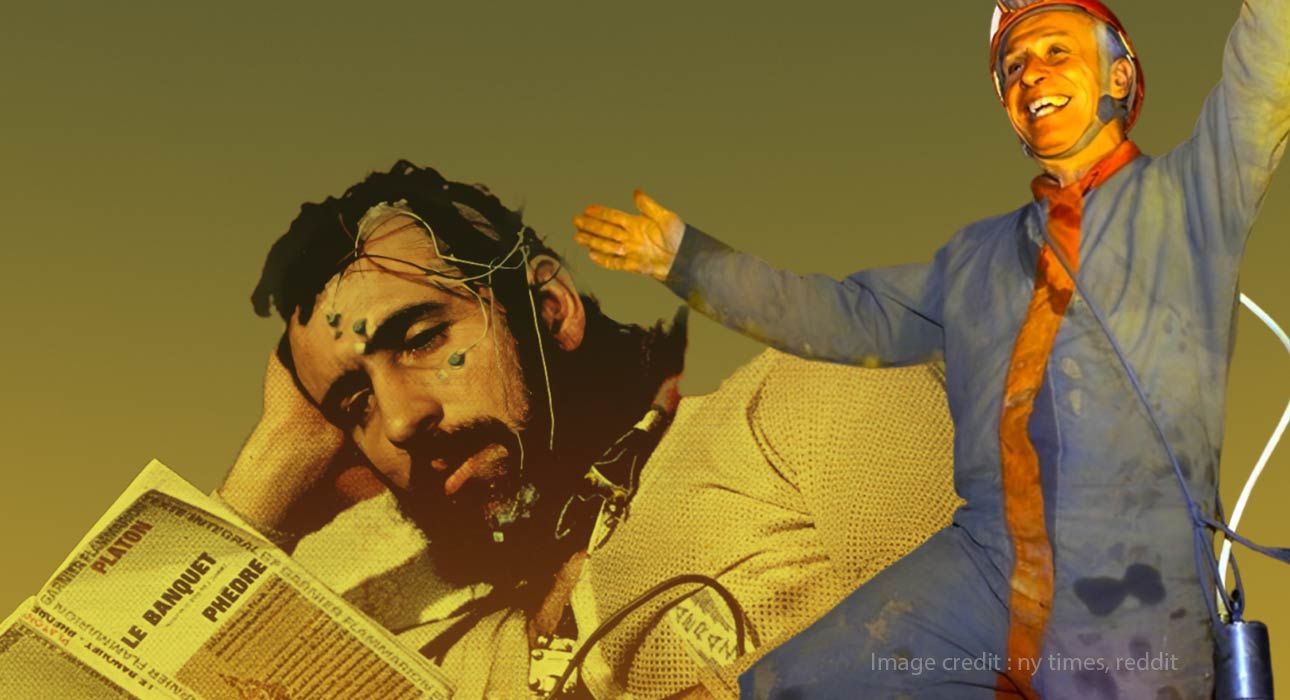
Back in the 1960s, there was a Frenchman who chose this to happen decades before the modern discussion and debate. In 1962, French Geologist Michel Siffre chose to go into a cave beneath the Alps and live there for two months without sunlight, a clock, or any other references to track how much time had passed. He wanted to observe exactly how human minds experience a sense of time in the absence of all the indicators.
His findings from these few months’ experience in an underground cave totally transformed the modern-day understanding of biological rhythm, sleep, cognition, and the huge psychological importance of environmental factors (Siffre, 1964). The cave experiments of Michel Siffre have to be considered one of the most influential naturalistic studies on the human mind that has been recorded to date, as his experience showed that when people remove all cues, they tend to create their own sense of time not as it’s ticking on a watch, but as a biological and environmental rhythmic construct (Aschoff, 1965).
Since this time, his work has continued to shed light on circadian rhythms, sleep disorders, and the importance of sleep for shift workers, and has even been crucial for designing and implementing better support for astronauts on long space missions (Czeisler et al., 1999).
Read More: Circadian Rhythms and the Warm Environment: How the Brain Adapts
The Man Who Chose To Live Outside The Time
In July 1962, Michel Siffre entered an underground cave on a glacier in the French Alps, approximately 130 meters below the earth’s surface. He carried food, scientific equipment, and a telephone that allowed researchers to keep a record of his observations. But crucially, he had no information about the date or time (Siffre, 1964). The underground cave environment was kept at a near-constant temperature (i.e., near 00) and had been entirely isolated from the external day/night cycles for months prior to his arrival. The experiment aimed to test if humans have a biologically generated rhythm independent of any other usual external ‘signs’ which people rely on daily for tracking the day and time (in the same way that animals and plants do). Several extremely peculiar effects started to surface:
- A general underestimation of time passage
- An increased sleep-wake cycle, which is lengthened beyond 24 hours
- Periods of wakefulness and sleep became increasingly irregular.
- He often believed far fewer days had passed than was the actual reality.
The ultimate revelation came on the day when the team informed Michel Siffre that the project was finished, as he had completed sixty-three days. He was astonished because he believed the date was approximately one month earlier (Siffre, 1975). This discrepancy suggested that subjective time is remarkably flexible and strongly dependent on environmental indicators.
Read More: Non-24-Hour Sleep Wake Disorder
Discovering Biological Clocks
An intriguing finding by Michel Siffre was that the body would continue its internal cycle even without the presence of time-keeping devices or even sunlight. Sleep, awakenings, and hormonal fluctuations would continue in some kind of cycle, though it doesn’t match the 24-hour mark any more (Siffre, 1975). It became clear through follow-up lab experiments that humans do have biological clocks. A specific structure in the hypothalamus, the Suprachiasmatic Nucleus (SCN), sets the pace of the circadian rhythm. In standard conditions, this clock is reset by light each day, the internal mechanisms staying in sync with nature. When this reset signal is absent, people fall out of rhythm with the clock:
- The cycles of sleep may drift beyond 24 hours
- Hormonal secretion patterns become desynchronized.
- Body temperature rhythms shift gradually.
- Alertness and cognitive efficiency fluctuate unpredictably.
For the strongest environmental signal or zeitgeber, light helps to regulate the circadian rhythm. Siffre’s cave abolished that synchronisation, which helps researchers to understand the tendencies of the human biological clock (Czeisler et al., 1999).
Why Is This Still Relevant Today?
Many elements of modern life have parallels with the condition Siffre experienced in isolation:
- Increased time spent indoors restricts access to natural light.
- Shift work can disrupt the circadian rhythm.
- Intense use of screen-based devices in the evenings significantly delays the sleep schedule.
- Increased reliance on remote working can remove many daily life cues.
All these effects result in a state of mental, physical, and emotional turmoil, characterised by a lack of energy, low mood, a reduced attention span, and a disturbed sleep cycle (Walker, 2017). Siffre’s research continues to offer valuable insight into the vital role environmental rhythms play in promoting overall mental well-being and health.
Read More: The Psychology of Social Isolation and Its Impact on Mental Health
When Time Slows Down: The Psychology of Temporal Perception
One of Siffre’s most well-known discoveries relates not to sleep, but rather to his experience of time. Throughout the test, time passed in an inflated way for Siffre, with minutes seeming to pass faster than they actually had, days flying by, and months going by quicker than in reality (Siffre, 1975). Psychologists explain this phenomenon of the human mind in terms of ‘temporal cognition,’ which they theorise as occurring based on many temporal cues in the human experience. They often describe some of the following phenomena:
- Sunrise and sunset;
- Daytime and evening work and recreation routines;
- The occurrence of meals;
- Social schedules, such as a working day and interpersonal contacts.
Without these signals, he says, it’s very hard for the mind to keep a proper chronological account of things (Fraisse, 1984). Isolated in a space with minimal to no sensory input, time in an abstract sense simply no longer makes any sense in terms of actual clock time. Over and above this, fewer memories were made, and there is evidence to show that memory plays an extremely important role in measuring elapsed time. Where numerous different events occurred over a period of time, the recollection is usually longer than for those events that consisted of monotonous experiences (Block & Zakay, 1997).
People who have experienced recent periods of social isolation are likely to be reminded by this article of their own experience when, during those periods, they often complained about no longer being able to differentiate between ‘days of the week’ with the sense that the weeks went by quite rapidly, while the day passed very slowly. Such experiences illustrate how psychological time depends on structure and meaningful activity.
Isolation, Cognition and Emotional Health
Having months underground by himself “was a psychological as well as physical struggle”, and while Michel Siffre never stopped thinking, he also experienced periods of confusion, memory lapses and problems with focusing (Siffre, 1975). Research continues to show that extended and/or severe isolation can detrimentally impact:
- Attention and concentration,
- Memory performance
- Decision-making
- Problem-solving skills.
Cognitive functioning and circadian stability are closely related to each other, and a lack of predictable sleep patterns may directly affect brain processes linked to attention and executive functions (Walker, 2017).
Emotional Consequences of Isolation
Humans are wired to be social, with social interaction acting as a mechanism for regulating emotion and for psychological resilience. Spending time isolated can trigger higher instances of:
- Feeling lonely
- Insecurity and emotional dysregulation
- Increased anxiety and agitation
- Lack of motivation or drive
Studies conducted during phases of quarantine and social distancing have illustrated similar mental effects, showing the social connection as being a necessary factor to overall health and well-being (Brooks et al., 2020). Despite the negative emotional effects, Michel Siffre did report periods where his introspection ran incredibly deep. Unrelieved by social or environmental input, he gained increased access to his own inner experiences and the workings of his mind, showing a reflection of the limitations of the mind and its capabilities.
Read More: Surrounded by Millions, Still Lonely: The Hidden Psychology of Loneliness and Digital Isolation
Conclusion
Michel Siffre descended into a cave for scientific purposes. He didn’t expect to be on the verge of an existential breakthrough: ‘Time is not something we get from our clocks or calendars. It’s something that is cobbled together by the interplay of natural cycles, external cues, human interaction and awareness.’ When those reference points vanish, our brains begin to fill the gap imperfectly.
His research provided evidence for an internal clock, but also that its connection to reality requires external cues, sunlight, predictable schedules, and human interaction for keeping itself in sync. Siffre’s isolated expedition into the silence has an important and potentially unsettling message for everyone: more attention-deficit workdays and disrupted sleep schedules blur people’s connection to the natural rhythms of time and human life.
This is not just a story about a man isolated for months underground. It’s a story about all the things we need to stay connected to time, to each other, to ourselves. The silence we hear beneath us shows that we don’t just live by the time we measure; we actually live as time.
References +
- Siffre, M. (1964). Hors du Temps (Beyond Time). Paris: Juilliard.
- Aschoff, J. (1965). Circadian rhythms in man. Science, 148(3676), 1427–1432. ∙ Moore, R. Y., & Eichler, V. B. (1972). Loss of circadian adrenal corticosterone rhythm following suprachiasmatic lesions in the rat. Brain Research, 42(1), 201–206. ∙ Siffre, M. (1975). Beyond Time. London: Thames and Hudson.
- Fraisse, P. (1984). Perception and estimation of time. Annual Review of Psychology, 35, 1–36.
- Wehr, T. A. (1991). The durations of human melatonin secretion and sleep respond to changes in day length. The Journal of Clinical Endocrinology & Metabolism, 73(6), 1276–1280.
- Block, R. A., & Zakay, D. (1997). Prospective and retrospective duration judgments: A meta-analytic review. Psychonomic Bulletin & Review, 4(2), 184–197.
- Czeisler, C. A., Duffy, J. F., Shanahan, T. L., et al. (1999). Stability, precision, and near 24-hour period of the human circadian pacemaker. Science, 284(5423), 2177–2181. ∙ Walker, M. (2017). Why We Sleep: Unlocking the Power of Sleep and Dreams. New York: Scribner.
- Brooks, S. K., Webster, R. K., Smith, L. E., et al. (2020). The psychological impact of quarantine and how to reduce it: Rapid review of the evidence. The Lancet, 395(10227), 912–920.