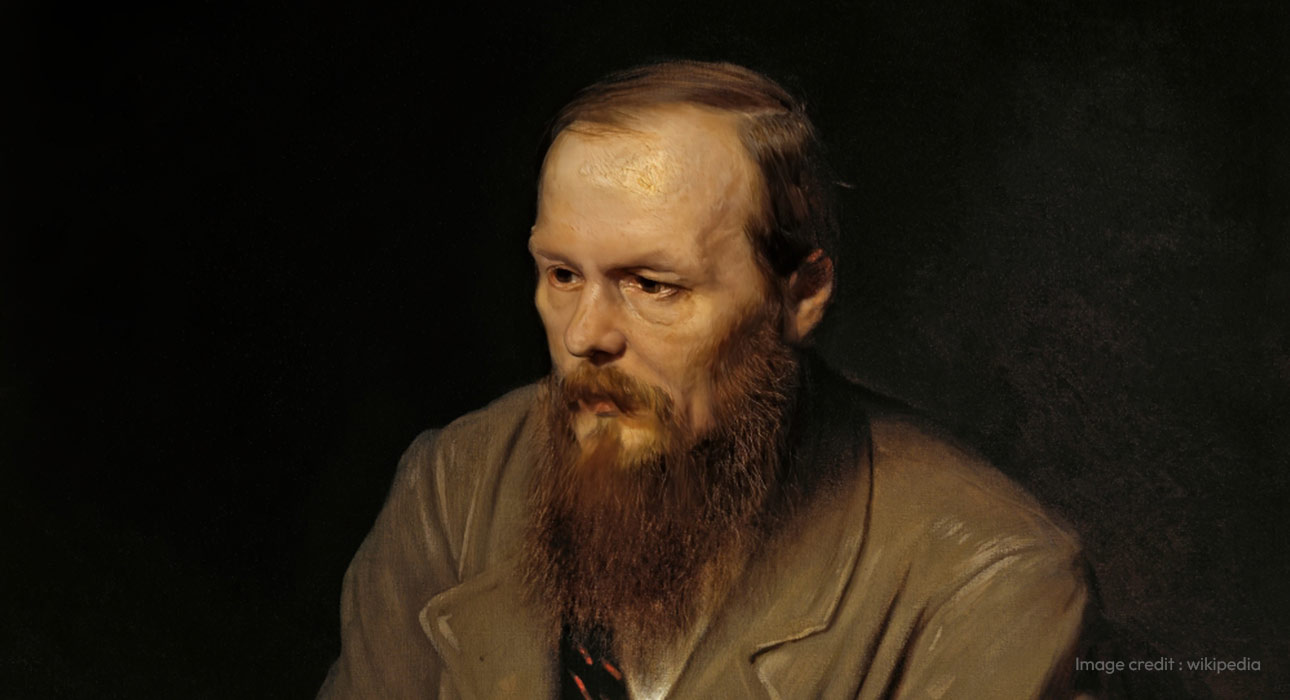
Suffering is one of the most powerful psychological and existential themes in Fyodor Dostoevsky’s writings, where pain becomes a window into guilt, morality, identity, and the struggle to find meaning in human existence. The nineteenth-century Russian novelist Fyodor Dostoevsky is widely known for the intense exploration of human consciousness, morality, faith, and inner conflict in his writings.
His own experiences of prison and exile in Siberia were a deep influence on his understanding of human nature and suffering (The Midnight Chronicles, 2026). In books such as Notes from Underground, Crime and Punishment and The Brothers Karamazov, Dostoevsky described suffering as something more than physical hardship. It manifested itself as guilt, moral conflict, isolation, fear, struggles over identity and questions about the meaning of existence. His characters are often caught in a deep psychological conflict where their beliefs, actions, and moral values conflict.
However, at the same time, suffering can also lead to self-awareness, redemption, resilience, and transformation. Dostoevsky’s work is especially relevant to contemporary psychology, which understands suffering in terms of concepts such as cognitive conflict, trauma, moral emotions, identity development, and psychological growth.
Suffering and the Divided Mind, Raskolnikov and Guilt
Raskolnikov in Crime and Punishment represents one of Dostoevsky’s clearest portrayals of suffering as an internal psychological conflict. He also developed a theory that extraordinary individuals may cross ordinary moral boundaries if their actions serve a greater purpose, and he murders the pawnbroker to test whether he belongs to this category.
However, after the crime, his rational justification starts to weaken under the pressure of overwhelming guilt, anxiety, fear, physical illness, and isolation. His suffering is, therefore, not only a matter of the possibility of punishment, but of the contradiction between his intellectual beliefs and his conscience. This can be cast in terms of the contemporary concept of cognitive dissonance in which conflicting beliefs and actions create psychological tension (Festinger, 1957). His experience can also be seen as a form of moral conflict, as the reality of his actions subverts the identity he has created for himself.
His growing detachment from others also shows how guilt can cause alienation and emotional turmoil. But Dostoevsky does not present suffering as wholly destructive. Sonia’s compassion, his confession, and his eventual acceptance of responsibility, Raskolnikov begins a gradual movement toward moral awareness and redemption. His journey suggests that confronting guilt, rather than escaping from it, can become the beginning of psychological transformation.
Trauma, Loss, and the Psychological Burden of Suffering
The suffering Dostoevsky depicts is deeply psychological. Guilt, isolation, moral conflict, and an inability to reconcile one’s beliefs and actions can all cause suffering. After the murder, Raskolnikov’s suffering in Crime and Punishment is increased by his fear, physical illness, disturbed thoughts and social withdrawal, which indicate the psychological consequences of his actions. His suffering is not only fear of legal sanctions; it is also related to his wounded sense of identity and failure to become the “extraordinary” person he dreamed he would be. His dreams and delirium are another illustration of his inner turmoil. And how it continues to trouble him even as he attempts to rationalise his crime.
Morality and the Psychological Burden of Choice
According to Dostoevsky, morality is closely related to a person’s psychological well-being. In Crime and Punishment, Raskolnikov develops his own defence of murder because he thinks that “extraordinary” people are capable of transgressing common moral laws. But his suffering demonstrates that conscience cannot be totally silenced by reason. He struggles morally and emotionally with what he has done, despite his attempts to rationalise his actions. This illustrates the psychological tension that can develop when a person’s actions and beliefs diverge from their underlying moral principles.
In The Brothers Karamazov, Dostoevsky depicts a similar struggle through Ivan Karamazov, in which intense internal conflict is created by issues of evil, suffering, responsibility, and human freedom. Dostoevsky implies through these characters that moral decisions affect a person’s emotions, identity, and psychological health in addition to being matters of logic. This is related to contemporary concepts of moral emotions, moral reasoning, conscience, and cognitive conflict.
Redemption, Resilience, and Psychological Transformation
According to Dostoevsky, suffering can lead to self-awareness and transformation rather than ending in hopelessness. His characters frequently start to change when they face their mistakes head-on and stop running from their pain and guilt. Raskolnikov’s journey in Crime and Punishment illustrates this shift from pride and denial to accountability and the potential for rejuvenation. According to Dostoevsky, suffering takes on significance when an individual takes accountability, considers their decisions, and looks for a greater meaning in life.
In this way, resilience is more than just the capacity to bear suffering. It’s also the capacity to find purpose and reconstruct oneself following it. This perspective can be linked to contemporary psychological concepts of meaning-making, acceptance, resilience, and post-traumatic growth, where challenging circumstances can occasionally result in increased self-awareness and personal growth. Dostoevsky thus depicts suffering as potentially transformative as well as destructive, depending on how a person handles it.
Dostoevsky’s Insights into Modern Psychological Theories
Many concepts in contemporary psychology are closely related to Dostoevsky’s examination of human suffering, guilt, moral conflict, identity, and inner struggle. His characters frequently encounter tensions between moral or emotional reactions and logical reasoning, which may be connected to cognitive dissonance and contemporary theories of decision-making. Raskolnikov’s attempt to rationally defend murder, which was followed by severe guilt and psychological suffering, serves as an example of how contradictory attitudes and behaviours can lead to internal conflict.
Freud acknowledged Dostoevsky’s psychological depth in part because his works foreshadowed psychoanalytic concepts about unconscious motives, repression, guilt, and internal conflict (Schmidl, 1965). In a similar vein, Notes from Underground connects to contemporary conversations about identity and existential psychology by examining self-awareness, loneliness, and challenges in developing a solid sense of self. In particular, when characters face their suffering instead of avoiding it, Dostoevsky’s depiction of suffering and recovery can be connected to modern concepts of resilience, meaning-making, and post-traumatic growth (Ewald, 2011). Therefore, despite the fact that Dostoevsky was not a psychologist, his literary investigation of the human mind offers important insights into psychological theories pertaining to identity, morality, emotion, conscience, cognition, and psychological transformation.
Conclusion
Dostoevsky’s writings show that suffering is deeply connected to the way people understand themselves, their choices, and the meaning of their lives. Through guilt, moral conflict, isolation, and inner struggle, his characters experience suffering not only as pain but as a challenge to their identity and beliefs. At the same time, Dostoevsky suggests that confronting suffering can lead to greater self-awareness, responsibility, resilience, and the possibility of change. His portrayal of suffering therefore remains psychologically relevant, as it reflects ideas that modern psychology continues to explore, including cognitive conflict, moral emotions, meaning-making, and psychological growth.
References +
- Chapple, R. L. (1983). A catalogue of suffering in the works of Dostoevsky: His Christian foundation. The South Central Bulletin, 43(4), 94–96.
- Davis, M. H. (1983). Measuring individual differences in empathy: Evidence for a multidimensional approach. Journal of Personality and Social Psychology, 44(1), 113–126. https://doi.org/10.1037/0022-3514.44.1.113
- Dostoevsky, F. (2002). Notes from underground (M. R. Katz, Trans.). W. W. Norton & Company. (Original work published 1864)
- Dostoevsky, F. (2003). Crime and punishment (R. Pevear & L. Volokhonsky, Trans.). Vintage Classics. (Original work published 1866)
- Dostoevsky, F. (2004). The brothers Karamazov (R. Pevear & L. Volokhonsky, Trans.). Farrar, Straus and Giroux. (Original work published 1880)
- Festinger, L. (1957). A theory of cognitive dissonance. Stanford University Press.
- Janoff-Bulman, R. (1992). Shattered assumptions: Towards a new psychology of trauma. Free Press.
- Jordan, J. V. (2000). The role of mutual empathy in relational/cultural therapy. Journal of Clinical Psychology, 56(8), 1005–1016. https://doi.org/10.1002/1097-4679(200008)56:8<1005::AID-JCLP2>3.0.CO;2-L
- Masten, A. S. (2001). Ordinary magic: Resilience processes in development. American Psychologist, 56(3), 227–238. https://doi.org/10.1037/0003-066X.56.3.227
- Park, C. L. (2010). Making sense of the meaning literature: An integrative review of meaning-making and its effects on adjustment to stressful life events. Psychological Bulletin, 136(2), 257–301. https://doi.org/10.1037/a0018301
- Rogers, C. R. (1957). The necessary and sufficient conditions of therapeutic personality change. Journal of Consulting Psychology, 21(2), 95–103. https://doi.org/10.1037/h0045357
- Tedeschi, R. G., & Calhoun, L. G. (2004). Posttraumatic growth: Conceptual foundations and empirical evidence. Psychological Inquiry, 15(1), 1–18. https://doi.org/10.1207/S15327965PLI1501_01