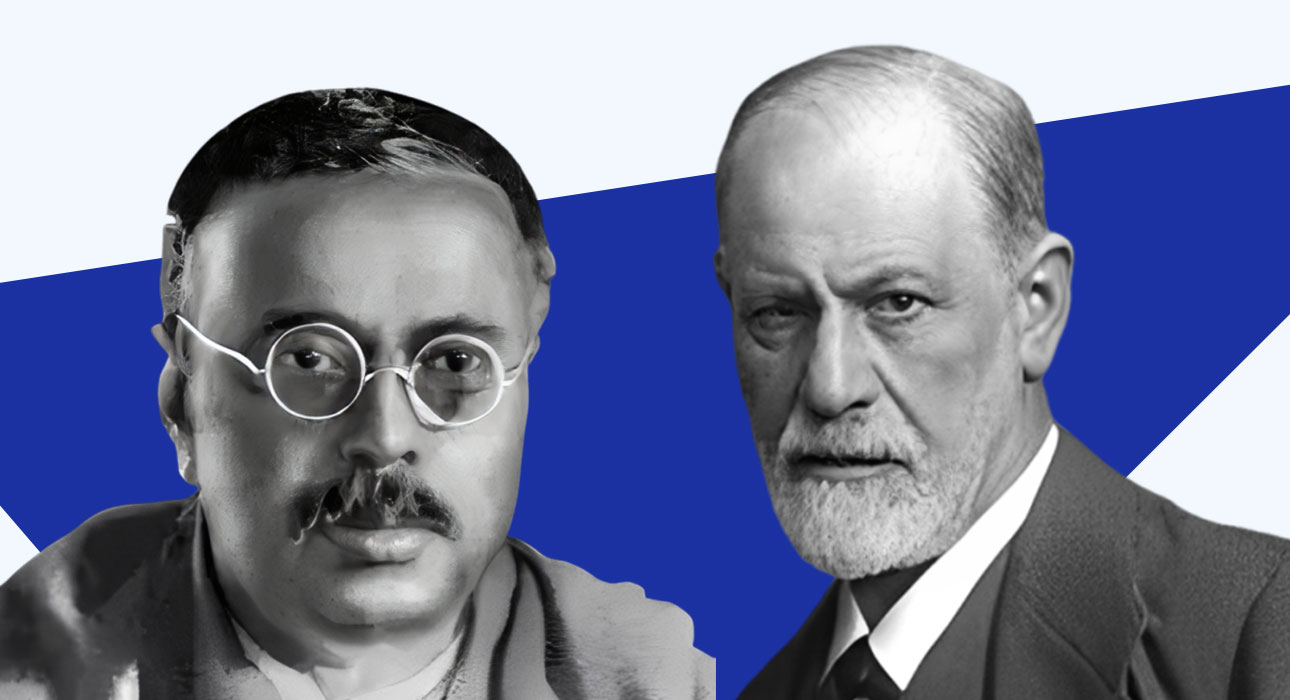
The credit for establishing psychoanalysis is often given to Sigmund Freud. It was his remarkable works that sowed the seed of this specialised subfield of psychology. Yet, thousands of miles away, in India, an Indianized psychoanalytic study was gradually taking shape. One that was not a copy of Western ideas. One that was influenced by Indian philosophy. In 1922, the Indian Psychoanalytic Society (IPS) officially came to light. India became one of the earliest countries outside of Europe to establish its own psychoanalytic society.
Dr Girindrasekhar Bose: The Visionary Behind Indian Psychoanalysis
Dr Girindrasekhar Bose (1887-1953) was a psychiatrist from Kolkata. He is known as the Father of Psychoanalysis in India. He was an admirer of the works of Freud. However, he soon realised a shortcoming in Freud’s works. Many of them did not sit well with the Indian patients. With further investigation, he realised the reason was the difference between Indian societies and European societies. While in Europe, personal ambitions are prioritised; India values social well-being more.
Keeping in mind this difference, in 1922, Bose established the Indian Psychoanalytic Society (IPS) in Kolkata. The society was highly recognised by Sigmund Freud himself. For many years, both Freud and Bose would exchange their ideas through letters (Freud & Bose, 1964; Hartnack, 1990).
Bose was not merely introducing Freud’s ideas to India. He was also examining whether those ideas could adequately explain the experiences of Indian patients. His engagement with Freud therefore became an intellectual exchange rather than a simple transfer of Western psychological knowledge. Through his correspondence with Freud, Bose discussed his own observations and theoretical ideas, while Freud himself took an interest in Bose’s work (Freud & Bose, 1964).
Freud’s Ideas Reached India
Freud’s works suggested that human behaviour is shaped by childhood experiences and personal drive and that unconscious psychological processes can influence human behaviour (Freud, 1953). These ideas reached India through the growing engagement of Indian psychiatrists and scholars with European psychoanalysis. Bose became one of the most important figures in this process. However, his response was not simply to accept Freud’s theories as universal explanations of human behaviour. He examined them in relation to Indian patients and Indian social life.
One of the important areas where Bose differed from Freud was his understanding of opposing psychological tendencies. In his Theory of Opposite Wishes, Bose proposed that individuals could simultaneously experience opposing wishes, and that behaviour could emerge from the tension between them (Bose, 1929). This allowed him to move beyond a straightforward application of Freudian concepts and develop an interpretation based on his own clinical and cultural observations.
Bose’s work therefore represents an important moment in the history of Indian psychoanalysis. Freud’s theories provided the starting point, but Bose believed that psychoanalytic concepts needed to be examined against the experiences of the people to whom they were being applied. His approach helped establish the idea that psychoanalysis could develop through dialogue between global theories and local psychological realities.
Read More: What are the Techniques of Psychoanalysis?
Indianizing Psychoanalysis Meant Understanding the Roots
European society prioritises individual development. However, the culture of India places a greater importance on social obligations and collective identity. This distinction can also be understood through the broader cultural psychology literature on cand collectivism, which highlights how cultures can differ in the importance they place on individual goals and collective relationships (Triandis, 1995). Thus, while the Western psychoanalytic theories were not false, they could not be applied in Indian society. A psychological theory developed in one cultural environment may therefore interpret certain behaviours differently when applied in another. This led to the need for adaptation of the psychological ideas in an Indianized standard.
Taking note of this scenario, the works of psychiatrist Sudhir Kakar focused on how, in India, religion, social norms and sexuality influence personality development. His works argued that it is possible for psychoanalysis to be scientifically significant while taking culture into consideration (Kakar, 1978).
Indian psychoanalysis also developed in the context of social and religious norms. Davar (1999) explores the theme of Indian psychoanalysis in the context of patriarchy and Hinduism, showing that psychoanalytic thought is strongly linked to a particular social and cultural context.
Further research in cultural psychology showed that the idea of prioritising oneself varied across regions and cultures. In many Asian countries, family is given more importance than one’s independent existence (Markus & Kitayama, 1991). Much before these findings were globally accepted, Indian psychoanalysts had understood the variation.
Read More: Collectivism vs. Individualism: What Psychology Reveals
Building a Home for Psychoanalytic Research
The Indian Psychoanalytic Society was not just a professional organisation. It was a hub for people to learn more about this domain. It would organise training programs and scientific discussions and encourage scholars interested in the human mind to collaborate. The society had further launched its own journal, called the Indian Psychoanalytic Journal. This was one of the earliest platforms across Asia for researchers to publish their work in psychoanalysis. Indian researchers would study dreams, childhood development, and personality while taking into account the cultural context (Hartnack, 1990).
Bose’s contribution was therefore not limited to establishing the IPS. His theoretical work, correspondence with Freud, and efforts to develop psychoanalysis within the Indian context helped create an intellectual foundation for Indian psychoanalytic thought. Later, scholars such as Sudhir Kakar continued this effort by examining psychological development through specifically Indian experiences of family, religion, society, and sexuality (Kakar, 1978). Although later many more branches of psychology emerged, IPS continues to be an important landmark.
A Legacy That Still Shapes Psychology
Today, culture is seen as an important aspect for understanding human behaviour. Yet, decades before, Bose and the Indian Psychoanalytic Society had understood this linkage. They had anticipated this modern perspective long before it became an unavoidable priority. Their contribution was not simply that they emphasised culture. It was that they demonstrated why psychological theories need to be examined within the social world in which people actually live.
Freud’s ideas provided a foundation for understanding unconscious motivations and psychological conflict, but Bose did not treat those ideas as absolute. He questioned and developed them through his own observations, particularly through his Theory of Opposite Wishes (Bose, 1929). Similarly, Kakar later examined personality development through Indian experiences of family, religion, social norms, and sexuality (Kakar, 1978).
This history therefore shows how Indian psychoanalysis developed through adaptation rather than simple imitation. The important contribution of the IPS was not rejecting Western psychology, but creating space for Indian experiences to participate in the development of psychological theory.
Read More: Most Controversial Debates in Modern Psychology
Conclusion
More than a century after the Indian Psychoanalytic Society (IPS) was established, it continues to be a reminder for every psychology student. It reminds us that human behaviour cannot be understood only by scientific evaluation; it is important to take into account one’s culture, beliefs, and lived experiences. G. Bose promoted the engagement of Indian scholars with global theories while taking into account their own society. This led to originality of theories and development of psychology at an international level. The history of IPS reminds us that psychology becomes richer when more voices are heard. And sometimes, new ideas emerge when global theories meet the regional realities.
Reference +
- Freud, S. (1953). Three essays on the theory of sexuality. In J. Strachey (Ed. & Trans.), The standard edition of the complete psychological works of Sigmund Freud (Vol. 7, pp. 123– 245). Hogarth Press. (Original work published 1905).
- Bose, G. S. (1929). The genesis and adjustment of opposite wishes. University of Calcutta Press.
- Freud, S., & Bose, G. S. (1964). The beginnings of psychoanalysis in India: Bose–Freud correspondence. Indian Psychoanalytic Society.
- Kakar, S. (1978). The inner world: A psycho-analytical study of childhood and society in India. Oxford University Press.
- Hartnack, C. (1990). Vishnu on Freud’s desk: Psychoanalysis in colonial India. Social Research, 57(4), 921–949.
- Markus, H. R., & Kitayama, S. (1991). Culture and the self: Implications for cognition, emotion, and motivation. Psychological Review, 98(2), 224–253.
- Triandis, H. C. (1995). Individualism and collectivism. Westview Press.
- Davar, B. V. (1999). Indian psychoanalysis, patriarchy and Hinduism. Anthropology & Medicine, 6(2), 173–193.