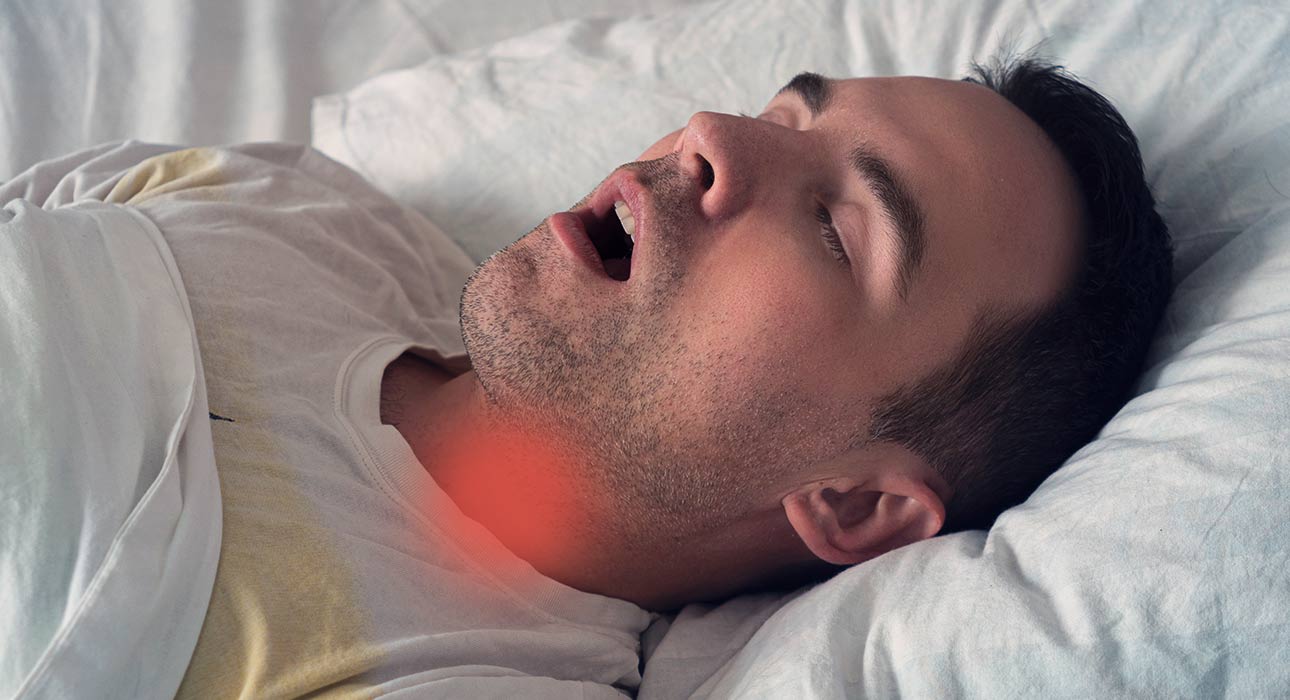
Most people consider snoring something insignificant and not worth worrying about. However, scientists from Ume University in Sweden have discovered that snoring can actually harm the throat muscles and be one of the causes of obstructive sleep apnea, a condition that impairs the breathing system while sleeping.
The focus of the research is on the effects of powerful and rhythmic muscle activity that is present in snoring and what it has on the power-generating ability of the muscle cells of the upper airway. The research team analysed the impact of the vibrations in question on samples of muscles extracted from real snoring patients by utilising a lab environment designed to replicate snoring. The researchers used this model to identify how vibrations may lead to a weakening of muscles that function to prevent airway collapse.
Snoring as a deficit of vibration
But at the heart of the study is the notion that mechanical shaking- what happens when you sleep with someone who snores often and loudly- can damage the cell membranes of your muscle cells and compromise the function of your muscle cell power generators (called mitochondria), which provide energy. So essentially, the muscles in your throat get vibrated so much every night that their ability to deliver energy begins to falter, and they can essentially lose tone during the night.
Obstructive sleep apnea occurs when airway muscles loosen and collapse while sleeping, disrupting airflow, creating breathing stoppages, oxygen dips, and resulting in repeated awakenings. While causes like anatomy, muscle tone, and body weight are classic risk factors, this research adds a novel concept: the physical process of snoring is in itself a stressor that harms the airway muscles. The researchers also connect this to other vibration injuries, like Hand-Arm Vibration Syndrome in workers using heavy tools, suggesting that the same basic biology of vibration-induced damage may apply across very different situations.
Read More: Is Snoring Harmless?
Research background
The research team at Umeå University’s Laboratory for Vibration Biology designed their work in two main parts: a laboratory model using muscle cells and an analysis of muscle samples from real snorers and OSA patients. In the lab, researchers treated L6 muscle cells (an established line of muscle cells) with prescribed vibrational frequencies associated with snoring at different intervals, at 8, 12, 24, and 48 hours. To carry out this work, postdoc fellow Yu-Cheng (Yucheng) Qian and the tech staff developed and verified a specialised vibrating simulator to precisely stimulate living cells with high-frequency mechanical vibration.
This overall project was guided by the work of Andr Mateus. Chloe Williams, Farhan Shah, and their colleagues worked in a multi-faceted lab environment that integrates specialities across muscle cell biology, mechanobiology, mitochondrial function, and vibration. The second half of the paper looked at biopsies taken from upper airway muscles from people who snore, as well as from OSA patients, in an attempt to confirm that what they saw at the cellular level reflected what was happening at the tissue level.
Read More: Sleep Apnea: Definition, Symptoms and Treatment
Biology of the snoring process
At the cellular level, the researchers found that snoring-like vibrations caused extensive remodelling of the mitochondrial proteome, especially as early as 8 hours of exposure. Key pathways such as oxidative phosphorylation, protein import into mitochondria, ribosome biogenesis, and RNA processing were all disturbed, showing that the cells’ energy and protein production machinery was under stress. They found changes in the subunits of components of the electron-transferring chain; for example, expression was upregulated for some elements of Complex I, IV, and V (e.g., NDUFS4, COX5A, and ATP5PD), while levels of proteins related to the spliceosome and mitochondrial ribosome decreased, indicating impairment in protein production and RNA metabolism.
In practice, by carrying out in vivo real-time metabolic assessments, they determined there was a total breakdown in both aerobic respiration and glycolytic capacity of cells by the 8th hour, so they temporarily couldn’t produce enough energy either via the primary energy production process or the secondary glycolytic pathway. Although there was evidence of improvement in oxygen usage by the 48th hour, they were unable to adapt and use their secondary energy source, glycolysis, in times of increased need.
Their work revealed less capillarization, low COX activity, and disorganised mitochondria in the upper airway muscles of snorers and OSA patients. And as in the lab cells, gene transcription of the two complexes IV genes that they checked, COX5A and COX6A2, was high, though protein was not. Their interpretation is that snoring vibrations are another hitherto unappreciated cause of stress on mitochondria in upper airway muscle, ultimately causing it to become weak and fatiguing.
Read More: Is Sleep Apnea Stealing Your Brain’s Power?
Author’s viewpoint on the findings
They view their research results as evidence suggesting snoring is a cause, not merely a warning sign, of obstruction of the upper airway musculature. “We believe those mechanical vibrations should be looked at as repeated physical insult,” Farhan Shah told Science Daily, “that is destabilising perfectly healthy tissue even in the absence of usual predictors like anatomy or weight.”
They also highlight the importance of the mechanosensing–mechanotransduction axis that was activated in the cells, involving integrin subunits, mechanosensitive ion channels, and focal adhesion signalling. This, the researchers write, “suggests that muscle cells sense the applied mechanical stress and attempt to adapt, although maladaptation causes altered RNA processing and protein synthesis, thus failing to maintain an adequate coupling between transcripts and proteins.”
On a clinical level, “prevention or reduction of vibration can preserve muscle energy and may mitigate or prevent the transition to full OSA,” the researchers report. But beyond sleep apnea, they said, the broader relevance includes a wide variety of exposures that affect muscle, such as “occupational vibration, ageing, immobility, cachexia in cancer, and space flight muscle atrophy.”
Read More: Unlocking Better Sleep: Understanding and Addressing Sleep Disorders
Conclusion
In summary, this work demonstrates that snoring vibrations cause direct injury to muscle cells, impair energy production and cell division in these muscles, and impair the machinery that translates the cell’s blueprint to build and regulate cells that keep the upper airway from collapsing during sleep, which not only signals the potential development of obstructive sleep apnea but causes it as well.
Snoring is no longer just an irritating condition but one that may be directly threatening the health of muscles, as well as sleep breathing, if identified as an active disease process. If snoring is to be identified as an active disease process, physicians’ screening practices, counselling, and treatment of the disease would need to shift to incorporate an effort to minimise muscle vibratory exposure so that muscles do not expend energy in vibration to the detriment of their structural and function-preserving roles.
References +
- Neuroscience News. (2026, July 3). Sleep Apnea’s Main Symptom Is Also Its Cause. Neuroscience News. https://neurosciencenews.com/snoring-vibrations-sleep-apnea-30991/
- C. W., Farhan Shah, et al. (2026). Multi-faceted lab environment that integrates specialities across muscle cell biology, mechanobiology, mitochondrial function, and vibration. [Review of a multi-faceted lab environment that integrates specialities across muscle cell biology, mechanobiology, mitochondrial function, and vibration.] Nih.Gov. https://pubmed.ncbi.nlm.nih.gov/42235782