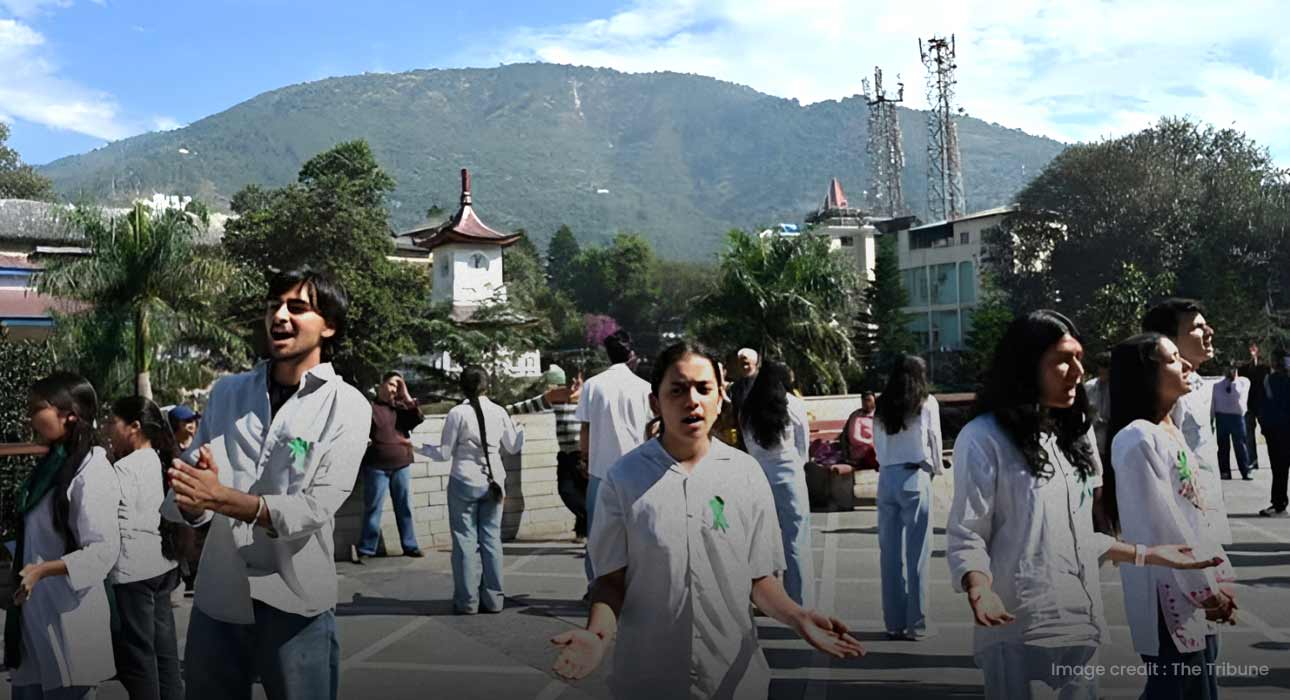
A college in Himachal Pradesh has taken its mental health awareness campaign(Street Play) to the streets in an attempt to promote seeking help without apology or shame. The Department of Psychology at Vallabh College in Mandi titled their play Mental Health for the Common Man. It was based on Experiences Heard: Real Voices, Real Change, which was the theme for World Mental Health Day by the World Health Organisation.
The play was directed by Vipasha Kashyap, who is an assistant professor of Psychology with a focus on open conversations, timely support and collective responsibility towards a healthy society. It made use of real experiences and stories that showed how stress, anxiety and depression affect everyone, regardless of their background.
Core Focus Of The Play
The message behind the play was to encourage people to seek help and support without feeling embarrassed or guilty about it. It also created awareness of the importance of emotional support, with special emphasis on listening, understanding and empathising with somebody’s emotional struggles. This will in turn contribute to a more supportive and educated society.
Highlighting The Importance of Tele-MANAS
One of the main focal points of the play was to highlight the Indian Government’s national mental health helpline. The students highlighted its many features that are confidential, 24×7 and free of cost. The audience was encouraged to make use of these services and seek expert guidance without second thoughts. Former Health Secretary Rajesh Bhushan had recently stated in a separate program that community participation was key in improving mental healthcare. He had also highlighted the vital role that ASHA workers and ANMs play in identification and referral of people in need of help, according to The Tribune India.
Tele-MANAS
The national helpline and service for mental health, under the Ministry of Health and Family Welfare, provides support, expert guidance and consultation. It is a two-tier system which is made up of the state Tele-MANAS cells, including trained counsellors and mental health specialists at tier 1. Tier 2 includes specialists at the district mental health program and resources from the district medical college for physical consultation. The e-Sanjeevani app is available for audio or visual consultation. The services are available to every citizen of India.
- Tele-MANAS can be accessed by dialling 14416
- Connects to an IVRS-based system with a timely auto call-back feature
- The automated call-back service will connect the user to a trained counsellor
- Depending on the level of care required, the counsellor will take the call or pass it on
- The call will be passed on to a psychologist, psychiatrist, psychiatric social worker or psychiatric nurse
- The call has both audio and visual (video) options
- In case of urgent in-person intervention and management, the caller will be directed to the nearest in-person facility
- A video consultation may also be arranged through the e-Sanjeevani app
Theatre As A Form Of Outreach
Theatre plays an underrated but transformative role in creating awareness, especially on topics like mental health that need to be sensed and felt. In this case, a street play becomes a powerful tool for its ability to awaken the senses and trigger emotions on the spot. Witnessing something relatable live and connecting to it with many others makes room for different perceptions. It also creates a sense of discussion and empathy unlike any other.
Street plays or Nukkad Nataks in India are often used to awaken collective empathy, literacy and thought on particular topics. A live performance also allows people room to digest things in the present that they may otherwise choose to ignore. This is especially effective in rural areas where literacy and knowledge on issues such as mental health remain lacking despite repeated efforts to highlight them. In such spaces, a live performance could have greater impact on people who cannot read or write but use their emotions and senses to connect and understand.
Conclusion
Initiatives like street plays and other forms of art become important mediums of wisdom on topics like mental health, which are still considered taboo in many rural areas. The initiative by Vallabh College reveals a larger attempt by educational institutions and students themselves to inspire people towards seeking expert help. It highlights a move towards effective prevention before it reaches a point to be cured. It especially prioritises the need for communities to listen, understand and support those who need help but are too afraid or ashamed to ask. Such initiatives also act as an important link where people are encouraged to use existing resources and enable the government to expand mental healthcare to every corner of India.
Reference +
- Tele Manas https://telemanas.mohfw.gov.in/about
- Tribune India https://www.tribuneindia.com/news/delhi/experts-call-for-open-mental-health-talk/
- Tribune India https://www.tribuneindia.com/news/himachal/mandi-college-students-raise-mental-health-awareness-through-street-play/
- WCP https://www.worldculturalpsychiatry.org/wp-content/uploads/2019/08/8-Play-V10N3-4.pdf